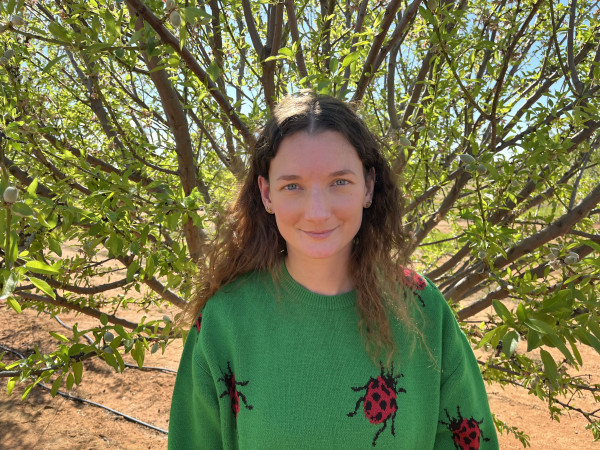
CARPOPHILUS truncatus might not realise it just yet, but the destructive insect is in the sights of Mildura-based entomologist Dr Samantha Edley.
Who has taken a wandering path between university in Wales and Agriculture Victoria’s SmartFarm here.
Which has included several years at the Natural History Museum in London working on parasitoid wasp taxonomy before arriving in Australia to complete her PhD in agricultural entomology at the University of Melbourne.
Having an American husband (and ecologist) already in Mildura has made the transition from the UK seamless for Dr Edley but not such good news for almond industry pests.
She said having joined Ag Victoria as a senior research scientist, she is working primarily in integrated pest management alongside senior research scientist (insect ecology and management of orchard pests) David Madge.
With their work focused on field trials, lab testing, insect identifications and extension, and especially on the almond carpophilus beetle – and carob moth.
“After finishing my PhD I joined Cesar Australia working on pests in grains,” Dr Edley said.
“With a focus on canola, our research there mostly involved aphids, their associated natural enemies, and their ability to transmit viruses.
“But I have always had a fascination with bugs and pests and trying to help the horticultural industry get on top of the carpophilus beetle is an important challenge and exciting opportunity.”
Dr Edley’s wealth of enthusiasm and new expertise in applied entomology and taxonomy will add valuable depth to the small but dedicated team at the Mildura SmartFarm (soon to be expanded with a PhD student) and its work to protect the region’s most valuable horticultural crop.
Carpophilus truncatus is at its most dangerous after wet weather and when fruit is ripening, and even though it is just 2-3mm in size, this beetle is a big problem for almond growers but also attacks stone fruit, persimmons, fallen citrus, apples, and figs.
The adults lay eggs in rotting or damaged fruit on the orchard floor and mature larvae emerge from the fruit and pupate in the ground.
Carpophilus beetles are also a vector of brown rot, a fungal infection which results in rapid fruit rot both on the tree and also during the post-harvest storage period.
It tends to become a pest when there is a run of days above 20C degrees and early in the season because beetle flight activity is high but food supplies are low. Flight does not occur at temperatures below 18C, and they can travel several kilometres, so area-wide cooperation is needed for most effective control. meaning it will require a multi-tiered industry approach to combat the growing problem.
“It’s interesting how my career has turned out, to bring me here to Mildura, on the back of all my work with parasitoids, especially wasps,” Dr Edley said.
“While I have done work in broadacre, horticulture really appeals to me because it is such a different bag of pests and there is so much research to be done.
“Carpophilus has recently been detected in the US (home to more than 80 per cent of world almond production) and it is now seen as a global challenge and the team here in Mildura has already made some significant steps pioneering an effective trapping strategy.
“We have proved the trap works and we have trials being rolled out with growers and now we have to find ways to make it commercially viable.”
Dr Edley said carpophilus has been in Australia for some time but there is a lot to still be discovered about where it came from, as well as how and why it odes the damage it does.
She said it is also in the European Union and South America but in a world “as connected as we are today, with so many people and products going in every direction” biosecurity has to become with watchword of all agricultural industries.
“The best thing about working in horticulture in general, and with almond growers in particular, is it is an industry so engaged, so happy to share and so happy to be involved with research and anything else that will help them produce a better product,” Dr Edley said.
“We have a meeting planned next week with growers who have been working closely with us trialling the traps to get their take on progress.
“They are the ones in the orchards and see day after day what is happening – their feedback is essential for us researchers about what they think is, and isn’t, working.
“Now we just have to work out where carpophilus is going, and how many are involved.”