Tune into a recent recording of a ParaBoss webinar about dung beetles and discover how these fascinating creatures can help you in the war against parasites on your property.
You can learn top management tips to increase dung beetle stocking rates, which are especially important right now given recent flooding has reduced their population.
Dung beetles play a valuable role in Australia’s grazing ecosystems, benefiting farmers’ production systems leading to greater profit.
For example, the beetles have a positive impact on nutrient recycling by taking dung and its nutrients down into the soil for pasture to access; they aerate the soil which increases water infiltration; and they reduce the runoff of dung into waterways.
In addition, Dr Russ Barrow and Paul Meibusch of EcoInsects, detailed in the webinar how dung beetles can help suppress pest and parasite populations by interrupting the life cycles of flies and nematodes.
“The Australian sheep flock produces about 50 million tonnes of dung each year, in addition to the 237 million tonnes produced by beef cattle,” he said. “That is a lot of dung and without dung beetles to help clear it from pastures, it is a breeding ground for flies and other pest species such as nematodes.
“If there are dung beetles on hand to interrupt the dung mass – where the eggs, the juvenile stages or the larvae of the flies and nematodes are present – then there is the capacity for the dung beetles to stop them developing further, thereby suppressing the levels of parasites or pests re-infecting and continuing their life cycle.”
Dung beetles and their larvae don’t do any damage to pasture or other foliage, they just eat dung.
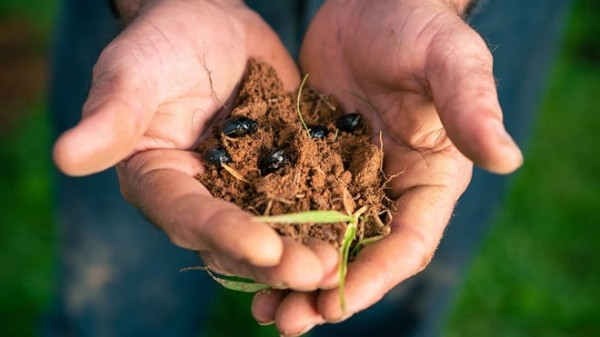
Dr Barrow says the easiest way for a farmer to determine if and how many dung beetles they have in a paddock is to scoop up the sheep’s pellets or dung with a little bit of the soil from underneath and drop it into a bucket, then fill it with water.
“This is called a flotation method, and about 95 per cent of the beetles will come to the surface within a couple of minutes,” he said. “Throw the beetles into some clean water to clean them so you can identify them properly; dungbeetles.com.au has a lot of high-resolution photos to help you.
“It’s useful to keep a record of which type of beetles you are finding in which month.
“There can be large differences in dung beetle abundance and diversity of species even across short distances, such as across a single property.”
What can affect dung beetle populations?
Dr Barrow says there are four factors that affect dung beetle population levels. The first factor is flooding, which causes dung beetles to drown.
“Unfortunately, we live in a relatively flat country and vast areas of southern NSW and northwest Victoria and South Australia have recently been inundated across massive areas for an extended period of time,” he said. “This has resulted in a severe depletion in dung beetle numbers, which without assistance will take decades to recover.
“However, topography is the beetles’ friend. Even when there’s flooding, if there are rises on your property then some of those beetles will survive and they can be used to repopulate the pastures.”
The other natural cause of beetle depopulation is drought because this is when livestock producers de-stock, resulting in less or no dung which leads to starvation of the dung beetles.
“There is no solution to this apart from restocking the dung beetles,” Dr Barrow said.
Similarly, the type of land use affects the dung beetle populations.
“If you’re doing broad scale cropping and there are very few sheep or cattle in that system then you’ll have very few dung beetles,” he said. “It’ll need management in order to reintroduce them.”
Dr Barrow says that veterinary chemicals have a major impact on the abundance and diversity of dung beetles existing at an optimal level on your property, with some chemicals being more toxic than others.
Effective use of veterinary chemicals
Dr Barrow encourages producers to do a worm egg count to determine if there is a need to drench their sheep.
“For the small cost of getting a worm egg count done, you might be able to save yourself large amounts of dollars by not needing to buy the veterinary chemicals, and saving even more dollars because you won’t have been impacting the dung beetle population which is providing ecosystem services and benefiting your production systems,” he said.
“We’re not saying you don’t need to drench; sometimes you will have to drench. We’re just trying to encourage you to ask the question ‘Do I need to drench?’ and you can that find out by doing worm egg counts.”
Dr Barrow said that, if you do need to drench, then drench, but the question you must ask becomes ‘What drench should I use?’
“Some chemicals are more toxic than others,” he said. “If there are very few beetles around then use a drench which is perhaps more toxic because few beetles are going to be impacted. Conversely, if there are a lot of beetles around, be wary about treating them with a toxic drench because you’re going to kill many beetles in your paddock.
“Also keep in mind that dung beetles aren’t uniformly abundant across seasons in Australia. In general beetles aren’t as present in high numbers in spring as they are in autumn. But this changes for different locations, so you really need to consult with an expert to get the right information.
“Likewise, it is advisable to consult with an expert about stocking or restocking your farm with dung beetles, so that that you get the right information about what beetles are suitable for your production system.
“You can contact us at EcoInsects if you want to know more about dung beetles, whether that be identification, or information as to where to get them from, and what’s going to work best on your property.”
The webinar presentation, titled ‘Dung beetles – are you managing your smallest livestock?’ lasts for 30 minutes followed by a useful 40 minute Question & Answer session.
More information:
· View a recording of the webinar on the ParaBoss YouTube channel at youtube.com/@paraboss3901
· dungbeetles.com.au