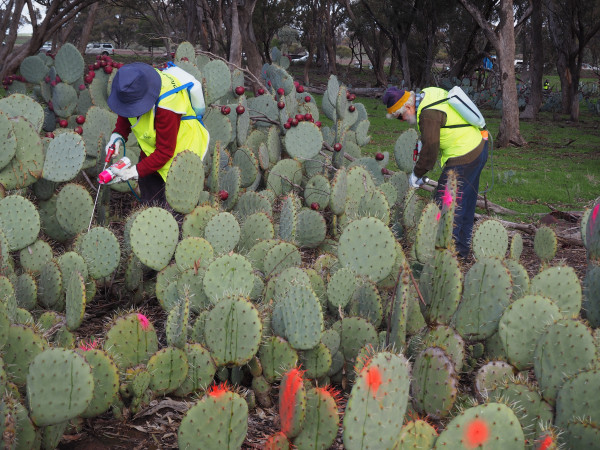
Fight on against cactus invader

Daniel Forwood

WHEEL cactus has infested several areas of Sunraysia as its continues its march across northern Victoria.

The latest Landcare maps show an alarming solid red patch starting near Kerang and spreading north-west along the Murray River.

Given weeds such as serrated tussock and blackberry already cost the Victorian economy $900 million a year, significant investment is required to stop the spread of wheel cactus.

Recognising the magnitude of this cactus-borne catastrophe, a team of dedicated local volunteers from surrounding Landcare groups and landholders formed the Tarrangower Cactus Control Group in 2005 with one primary target – wheel cactus.

Group president Lee Mead leads the charge of the Froggatt Award-winning organisation, protecting Australian native plants, animals and the natural environment from the incursion of dangerous new invasive species.

Wheel cactus, which is plaguing the northern and central Victorian landscape, is a rapidly spreading, wheel-shaped reminder of Australia’s prickly past.

“There’s just as much wheel cactus as there is when we started. It grows just as fast as it’s killed,” Lee Mead says.

Ms Mead and the Cactus Warriors work passionately to raise the profile of wheel cactus, increase awareness and educate farmers.

Many property owners are actively controlling wheel cactus, but their hands are tied when it comes to the apathetic or absentee property owners and securing Victorian Government resources as wheel cactus is not considered a priority weed.

“People don’t think cacti are a problem,” Ms Mead says. “Wheel cactus won’t stop spreading.”

An ornamental, drought-resistant shrub turned escapee garden plant; wheel cactus (Opuntia robusta) is named after its peculiar spherical shape.

Once an oddly placed fixture in the Victorian landscape, wheel cactus has undergone plague-like spread in northern and central Victoria, akin to the other 27 opuntia species across Australia.

It is native and endemic to central and northern Mexico.

Each species has its own unique biological features, growth patterns and response to chemical treatments.

This has firmly etched their place as weeds of national significance, an infamous accolade awarded to 32 weeds based on their invasiveness, potential for spread and environmental, social, and economic impacts.

In Victoria, several catchment management authority boundaries aim to prevent further spread of wheel cactus.

The Australian climate presents ideal conditions for wheel cactus to naturalise and spread into Victoria, South Australia, NSW and Queensland.

With no natural predators, no competing cactus species native to Australia and a tendency to grow on top of inaccessible rocky granite hills, the weed has established itself in regions of Victoria during the past 50 years.

With the continued threat of infestations at some sites merging, now is the time to act to mitigate the development of a core wheel cactus seedbank.

Courtesy of the Victorian Farmers Federation

Digital Editions


  • Almond boss resigns

    Almond boss resigns

    ALMOND giant Select Harvests is on the hunt for a new boss after shock news its chief executive is stepping down. Chief executive and managing…

More News

  • Dog’s Day Out arrives in the Mallee

    Dog’s Day Out arrives in the Mallee

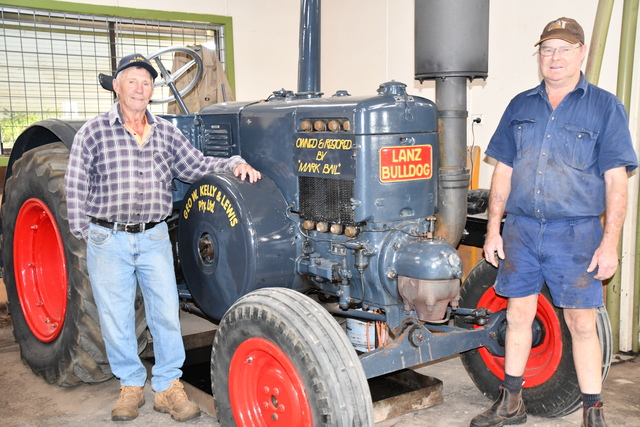
    THE iconic spluttering rumble of Lanz Bulldog Tractors is set to roar across Swan Hill and Woorinen next month, when the Mallee Steam, Oil and Machinery Club hosts Dog’s Day…

  • Perfect storm for grape industry

    Perfect storm for grape industry

    This year is certainly testing ones resolve, excessive heat, high water costs, record low grape prices, 170mm of rain at the wrong time and now the fuel issue. After eventually…

  • Holding on to their heritage

    Holding on to their heritage

    Purchase this photo from Pic Store: 531373 TRADITIONAL family farms, passed down from generation to generation, are becoming rarer and rarer these days. With the growth in corporate farming, greater…

  • Wet weather halts harvest

    Wet weather halts harvest

    It’s been an eventful start to harvest for the almond industry. Like all of agriculture in the region, Mother Nature and geo-political tensions have played a hand in providing extra…

  • Royal Commission push back

    Royal Commission push back

    A FIERY clash in Federal Parliament has reignited the bitter fight over the future of the Murray-Darling Basin, with the federal environment minister rejecting claims the government is “destroying family…

  • Call for royal commission into water welcomed by irrigators

    Call for royal commission into water welcomed by irrigators

    FARMING communities have backed a call for a federal Royal Commission into water, saying it is time to expose the “treachery, lies and shonky deals” behind the Murray-Darling Basin Plan.…

  • Nationals push to protect prime farmland with new federal Bill

    Nationals push to protect prime farmland with new federal Bill

    THE Nationals have moved to block taxpayer funding for energy and mining projects on Australia’s best farming land, unveiling a new Bill they say is vital to protect the nation’s…

  • Sally returns from Japanese adventure

    Sally returns from Japanese adventure

    I am pretty excited for this week , actually just tomorrow evening specifically when Sally returns from her first globe trotting adventure. Flying in from Osaka Japan, she’s been on…

  • CWA brings life skills program to the Mallee

    CWA brings life skills program to the Mallee

    Purchase this photo from Pic Store: 539453 A SURGE of community spirit swept through the Mallee when Country Women’s Association of Victoria president Jenny Nola attended the Murray Valley Conference…

  • Basin leaders meet as water plan review looms

    Basin leaders meet as water plan review looms

    NEARLY 200 leaders from across the Murray-Darling Basin gathered in Brisbane last week to debate the future of water management, with northern Victorian councils warning food production and regional communities…