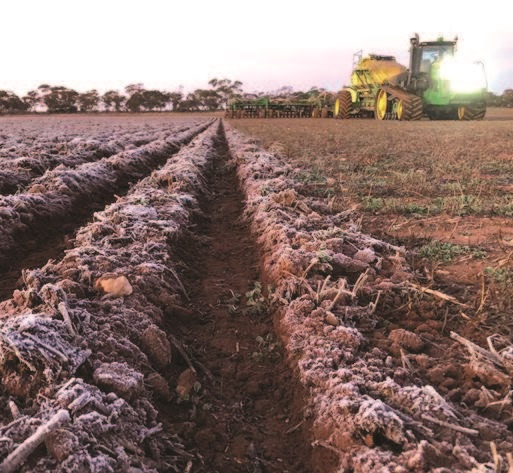
A THREE-year program managed by Mallee Sustainable Farming to help growers offset the impact of frost has provided new tools, strategies and support networks to help minimise risk and lessen damage caused by the unpredictable and sometimes catastrophic natural event.
It is another example of the Mildura-based farmer organisation’s work at the cutting edge of the agriculture industry – of using its extensive member network and established expertise in delivering research projects to growers.
The industry investment to better inform grower decision-making around frost also draws on the skill base of agronomists to help with identification of frost and talk through decisions before and after a frost event occurs.
Starting with frost response workshops, the project evolved to develop a central digital resource and a range of mitigation strategies.This was driven by growers seeking a more hands-on role to help combat frost.
MSF program manager Tanja Morgan, who had oversight of the investment, said even though everyone knew it would never be possible to eradicate frost, this program focused on strategies and agronomic practices to help reduce either its severity or the probability of it occurring primarily at the critical flowering stage.
Digital resource
Morgan said the MSF footprint stretched well beyond Victoria, covering about four million hectares including parts of South Australia and New South Wales.
She said to ensure the investment was relevant to the southern region, MSF partnered with GRDC, Agricultural Innovation & Research Eyre Peninsula (AIR EP), Upper North Farming Systems, Birchip Cropping Group and Southern Farming Systems Group, with each one tailoring projects specific to its members’ needs.
Meanwhile, to counter the tyranny of distance, MSF itself turned digital, creating the Better Frost Decisions Facebook group which provides growers with resources to identify frost damage, assess options for frosted crops and plan for seasons ahead.
“Updated regularly once frost events are looming, the page hosts live reports from agronomists in real time in the wake of frost events and features useful videos and information on how to best mitigate against frost and what to do should a frost occur,” Morgan said.
Major frost response
“Frost response materials have also been prepared and are ready to be deployed in the event of a major frost.
“This digital suite of ‘micro-learning’ materials will be available in real time and includes fact sheets and training on what to look for and do in the days after a frost.
“It will also feature live broadcasts from agronomists, and growers will be invited to share photographs and their experiences while being provided with both professional and emotional support.
“A frost event can be emotional – it can be very traumatic to lose all your income in one cold night.
“So rather than just holding a workshop and walking away, we’re providing bite-size pieces of frost response information, walking people through the process of what they can do while also providing them with some mental health support in that space.”
More than just conveying information, the Facebook page and resource package will help maintain community and support networks as people face the complex decisions that need to be made around frost mitigation and management.
“We’re trying to come up with innovative ways of making growers feel connected and part of the community,” Morgan said.
The Facebook page is about sharing the latest research findings and also people’s experiences while providing an avenue for people to reach out for support.
Identifying frost
Fortunately, she said, 2023 did not produce a widespread significant frost so the resource package stayed on the shelf.
“It was great it didn’t have to be rolled out to its full capacity but we did use bits and pieces and we’re ready to go in the event that we get another big state- or region-wide frost event,” Morgan said.
In place of a major frost in 2023, growers across the Mallee endured several smaller events which had varying impact on grain quality and yield.
This highlighted the need for information around frost identification.
“Frost identification is still really hard, especially when it’s not widespread, because you need to know where to look,” she said.
One of those looking was Lower Eyre Peninsula agronomist George Pedler.
Appreciating the challenges around identifying frost damage, he uploaded a video to the Better Frost Decisions Facebook page soon after a localised frost event, showing growers the tell-tale signs.
A quick response
Morgan said it was critical to identify frost as quickly as possible.
This would ensure timely decisions could be made bringing growers maximum value.
For example, a frosted crop destined for hay needed to be cut as soon as possible to ensure it maintained its quality, she said.
“The longer you leave it, the more the quality drops, so a fast response is really important if you are cutting for hay,” Morgan said.
“You need to know quickly how bad it is so you can make that decision.”
Similarly, an accurate diagnosis will ensure inputs such as fertilisers and fungicides are not wasted on a frost-damaged crop.
It could also help to gain maximum value from grazing a crop rather than taking it through to grain.
In response to the 2023 frost events, experts conducted live Facebook sessions, inviting questions from, and fostering engagement with, growers.
Agricultural strategist Kate Burke addressed mental health issues while COtL Mesonet co-founder Damon Grace explained how to use his company’s weather stations.
Morgan said these live events and other uploads provided information in accessible “short bursts” and helped to increase awareness of the issues, providing practical as well as emotional support when it was most needed.
A proactive approach
As well as helping growers to best respond to frost, the project also took a proactive approach, looking at mitigation.
This is demonstrated by the work MSF is doing with the four farming systems groups:
* With AIR EP it is looking at how sowing times and variety choice can reduce the impact of frost
* Upper North Farming Systems is using sensors to develop frost maps for paddocks, identifying high-risk areas for targeted frost mitigation management
* Southern Farming Systems has developed a frost economic calculator that enables modelling based on a range of scenarios
* Birchip Cropping Group is looking at manipulating the flowering time of crops with grazing.
Better Frost Decisions newsletters and podcasts featuring agronomists and growers have been created, summarising this work and communicating insights and findings to growers.
And a range of case studies featuring different frost management strategies is also being completed.
The investment concluded in March and the frost response materials are ready to be rolled out when needed.
The Facebook page will continue to be updated, providing an accessible archive of resources over time.