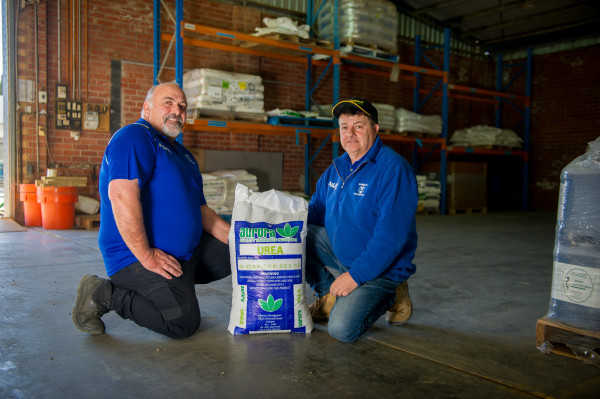
MILDURA Ag Supplies broadacre commercial manager Geoff Morris says global forces have impacted on the supply of urea, leaving local broadacre producers critically short as the Australian industry calls for greater domestic production.
Mr Morris said the shortage, threatening significant yield losses in cereals, has been caused by years of soaring natural gas prices, COVID, the war in Ukraine and tighter controls on Chinese fertiliser exports as that country focuses on internal demand.
He said worthwhile supplies were still weeks away and for many growers it will be too late, with some already predicting crop losses as a result of the delays.
Department of Agriculture figures showed fertiliser import costs skyrocketing in the past 12 months – from $2.5 billion in 2020-21 to $4.9 billion in 2021-22 for the same amount of product.
National Farmers’ Federation president Fiona Simson agreed on-time supplies of fertiliser was critical to agricultural production and, while understanding the challenging economics of domestic manufacturing, “we’d love to see government step in” with local production answers.
“Imports will always be a big share of the market though, and the efficiency of our supply chains for things coming into the country are a factor,” she said.
“In an ideal world we’d have a level of local production, plus better efficiency in getting imported products onto farms.”
Mr Morris said urea had been a balancing act for the past two years, with price fluctuations and in-country availability.
He said that was compounded this year by the late start to the local season, the break not coming until well into May, which meant the urea which was already here in sheds was not moving.
“As a result, the ships which had been booked to arrive in time for August were delayed due to lack of demand and storage facilities at capacity,” Mr Morris explained.
“Then when the break did come, demand jumped through the roof and the stock was quickly cleared out – the next available ships are now not due until September and that’s too late for most.
“For a lot of crops, the window for top dressing has passed, so September won’t help and yields will be impacted.
“The growers who ordered early would have been OK, but after that it has been a bit of a scramble. A good tactic moving forward would be for growers to take forward positions – if you think you might want 500 tonnes, take a position on 250 tonnes for security and average the cost variation.”
The growing concern over reliance on imports took a new twist with the Indonesian bid to take over Incitec Pivot, Australia’s largest fertiliser producer.
GrainGrowers chair Rhys Turton said given the business was expected to bring about $1.5 billion, the deal will be subject to close Foreign Investment Review Board scrutiny and approval.
“Ultimately, however, it will be up to the government to ensure that any sale is in the national interest and to include growers and industry in those discussions,” he said.
“The guarantees we need to see in place cover the ongoing and uninterrupted supply of fertiliser products, no long-term impact on Australian food security and the future development of fertilisers assets such as Phosphate Hill in Queensland.
“Growers are concerned and need answers and more information about a sale that can potentially seriously impact their business operations.”
GrainGrowers was also calling on Canberra to spend part of its $5 billion National Reconstruction Fund to help finance a lower cost and more reliable fertiliser supply chain and a “greener domestic fertiliser manufacturing base”.
It said there was an opportunity for the government to co-fund phosphorus and potassium-based fertiliser production initiatives, “with numerous shovel-ready projects on hand”.
Other benefits included shortening supply lead times, job creation, gross domestic product increases and government gaining greater control over manufacturing standards and emissions.
Of the three most promising domestic projects in the pipeline, the Perdaman plant in north-west Australia would convert natural gas into an estimated 2.3 million tonnes of urea a year.
Fertiliser Australia executive manager Stephen Annells said while “it would be sensational to have more domestic production”, the billion-dollar capital costs, low barriers to entry for imports and Australia’s “tough” environmental and industrial relations all present a significant competitive disadvantage.