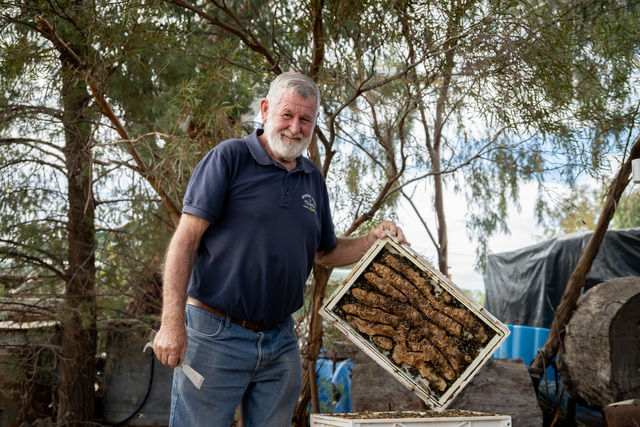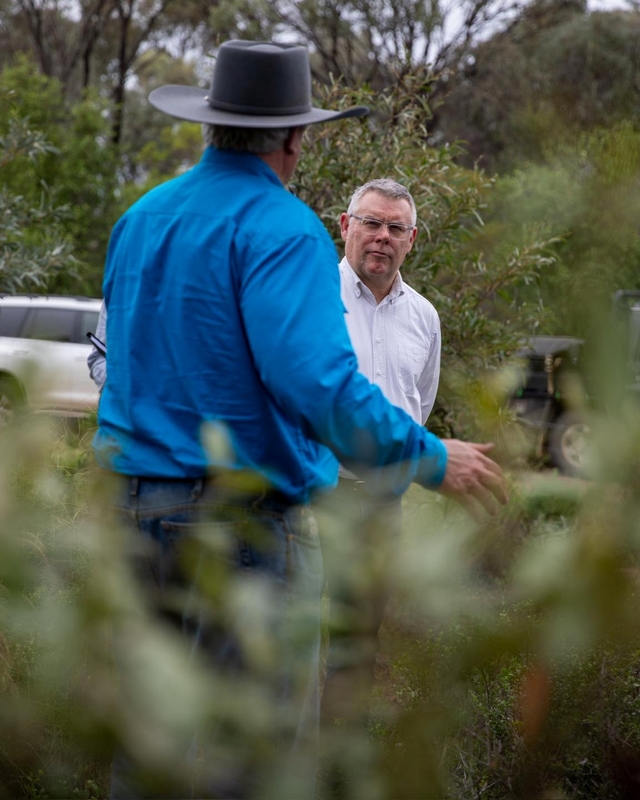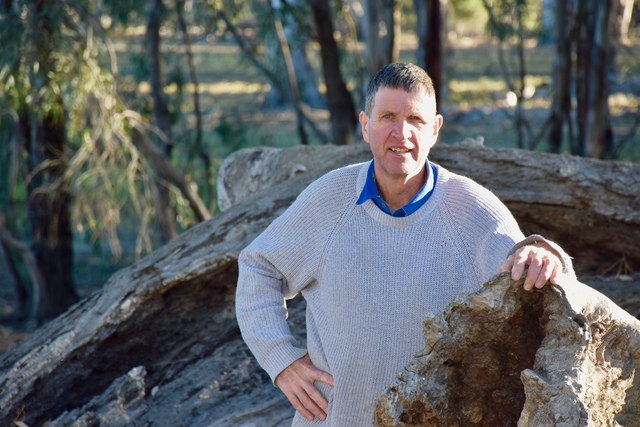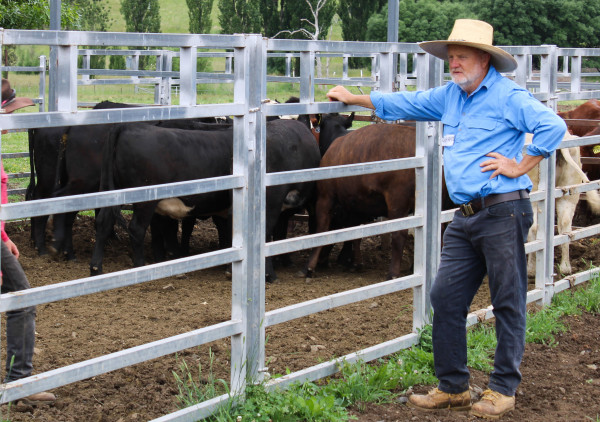
Considering Grahame Rees had spent much of his life in the open, endless spaces of western NSW around Ivanhoe, it’s amazing how much of his more recent life has been spent in the company of small farmers.
Especially newbie farmers, city folk who have had an epiphany about the concrete canyons, desperate to escape the rat race and see a whole new world out there in the sticks.
Until, Grahame confirms, they come up against a full-grown bull (even the 450kg of a mature Dexter can be intimidating to someone whose only brush with the animal world has been their pampered pet Poodle) between them and the gate in a very constricted stockyard. Even an angry ram with headgear can cause a crippling injury during an unexpected collision with your kneecap.
All creating the culture of fear, which Grahame says, not without a little irony, impacts both human and animal – and neither really understands why.
But fortunately, for those smart enough to find Grahame, his own 1999 epiphany at a Bud Williams stock-handling school, where he realised the significant benefits in handling his animals, all animals, differently, there is an answer.
Just three years after that first school, he joined forces with Jim Lindsay who founded Low Stress Stockhandling (LSS) in Australia, to share these advanced animal handling skills – and their alumni can now be counted in the thousands. Grahame’s graduates alone go past 4000.
“I am constantly surprised by the achievements of graduates of LSS as they implement the principles taught on their own properties,” Grahame admits.
“Both sheep and cattle producers are finding increased animal performance and easier handling in all situations, with less effort and labour.
“Whether it is imprinting and weaning calves and lambs, settling bought stock; or handling our livestock in the paddock or the yards, everyone seems to find something to improve their livestock operation.”
Grahame also believes the added benefit of having people work in a low-stress environment leads to a safer workplace and increased staff satisfaction.
Incredibly, after all those years of teaching, one of the first things Grahame tells any participants in training he is about to learn a lot more than they will.
“What I learn is as much about the people I am training, and their individual approaches to low stress principles, and how you see most of them blossom as they begin to grasp how differently they can go about managing their livestock and how much more enjoyable and stress free it can be,” he says.
“And not just for them, but for their stock as well.”
Grahame says for many people, any job would be better than a day in the yards, moving cattle and sheep around and trying to get them to do what they need them to do to get the job done.
He says the moment people realise there is not only a better way, but that they are able to learn it in a short space of time is incredibly rewarding.
“The best thing about this program, this two-day course is you can go home and continue using it from the very next day,” Grahame adds.
“Also, it’s pretty hard to go back once you break the paradigm.
“And that is perhaps one of the biggest thing we have noticed in recent years, where there has been a noticeable shift that sees the whole family, not just the farmer, helping out – especially around the yards, mustering for shearing and in similar activities. Also, it’s not just husband and wife, it is more often than not the kids as well.
“That shift demands a whole new approach to working around livestock – and that’s safety.”
Post Covid, Grahame says he has been surprised by the numbers of city people spreading across regional Australia, many with the idealistic dream of becoming farmers.
A dream that can quickly become a nightmare because of the total lack of farm knowledge – beyond YouTube anyway – and the sudden challenge between the wannabe farmer and the wanna-not-be herded into a yard cattle or sheep.
“The beauty of working with this new wave of small farmers is they come with a clean slate,” Grahame says.
“They are not the product of generations of farming, they are enthusiasts with a clean slate and they embrace everything we try and show them – that’s something different, and gets me just as enthusiastic.
“Yes, we do big stations, intensive livestock enterprises, we even do transport companies – I have one client where I go at least once a year.
“In a nutshell, stockmanship has re-emerged as an important ingredient for successful livestock businesses.
“Human-livestock interaction has been changing and in the past 20-30 years most grazing operations have, to varying degrees, substituted the need for high levels of stockmanship by changing yard design and facilities.
“Unfortunately our human nature has focused more on what we want and less on what animals want.
“That’s how we have been so successful with small/hobby/lifestyle farmers. Very few, often no, preconceptions and they really benefit from the LSS emphasis on mutually beneficial outcomes for stock and handlers regardless of yard design.”
Grahame says the foundation for LSS is the four basic animal instincts, that clearly explain to us “what our animals want, and why they behave the way they do – so long as we are looking for them, and know what we are looking for”.
“In addition there are seven principles guiding how we can interact with the animals to work with those natural instincts and produce low stress outcomes,” he says.
“If the right methods are implemented, livestock will move with less stress through most facilities. Moving stock can be a low stress, painless activity for the livestock and the handlers. With these skills behind you, you can look forward to a day working closely with your livestock as an enjoyable day out.
“Plus, the business benefits of training people in animal handling are enormous as it leads to improved production gains, better meat quality and higher economic return for the livestock industry.”
Research shows one of the major causes for losses in meat quality (bruises, mortality, meat downgrades) is from poor management by the stock handlers. Yet animals can be, and are being, moved through the entire system with minimal force from people or mechanisms.
Meat quality defects can be caused by poor transport and preslaughter handling (more bruising, higher DFD, PSE and carcase downgrades). Dark-cutting meat is a result of the failure of muscle to produce enough lactic acid to reduce its pH after death from about 7.2 to 5.7 or less.
Grahame says the failure is often because of a lack of glycogen in the muscle as a result of either poor nutrition, not allowing for it to build up or stress in handling causing too much to be used up before the animal is slaughtered.
He says the late Bud Williams, the US-based global founder of LSS, believed a person’s attitude is the key to obtaining benefits for both people and livestock.
“The right attitude promotes harmony between man and animal in the work environment. We can put ourselves in a position to be able to consider the situation from an animal’s point of view and therefore have an obligation to do so,” Grahame explains.
“When we have knowledge of how an animal reacts to different situations, we can use that information to effect. Being an effective stock handler is about knowledge, understanding, attitude and patience.”
Grahame cannot overemphasise the value of practical, hands-on training in situations livestock producers will meet on a very regular basis, meaning LSS is relevant to all livestock production industries and the people who work within them.
He says past LSS participants have varied in age from 4 to 73 with skill levels ranging from very experienced and competent stock people through to total beginners. All you need is a willingness to learn.
“The basic animal instincts and principles of LSS are universal,” Grahame says. “They have been observed and put into a framework that makes them easy to learn and they form the basis of the LSS school content.
“Methods relating to the principles are taught through a combination of direct teaching and practical situations, allowing each participant the opportunity to work livestock inside and outside the yard.
“Emphasis is placed on developing a sound understanding of the key information through experience and the majority of the school time is for this.”
Grahame says he lives for participants who question what they are learning.
“Our goal is you leave the school with a broader knowledge and understanding of stock handling, which will help you, the resident, make informed decisions to achieve maximum cost effective production gains with low stress livestock whatever your situation may be,” he says.
“And be safe as you do it, I honestly can’t remember the last time I got caught between two fighting rams or got some horns into my knee – or a less-than-impressed bull who has his own way of doing everything and is now burning up all those gold star credits.”