Harrison Gurnett loves life on the land – and the 11-year-old primary school student isn’t just running a few chooks and the house cow.
Instead he is doing his best to preserve an almost-forgotten slice of farming history while joining dad Darren in the pursuit of a new phase in the Australian beef industry.
And alright, yes, Harrison does have a few chooks as well.
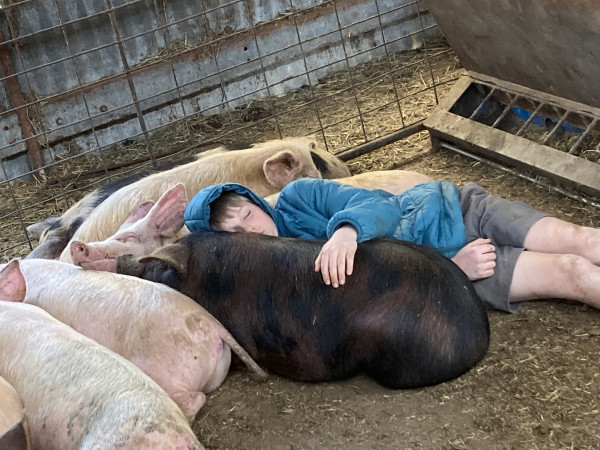
But it’s the pigs where his heart is; they have been part of his life since he started walking and he’s pretty sure he will be a farmer when he grows up – a pig farmer.
“I love my pigs,” Harrison says in the understatement of the day. “They’re not so hard to work with as some of the other animals, they’re a good animal to have and they are also good for profits.”
Harrison is not just talking your run-of-the-mill pigs either, he has become enamoured of the Tamworth, an ancient British breed now registered with the Rare Breeds Trust and classified as critically rare.
The Tamworth has become so endangered in its home country that Australian Tamworths are being exported back to the land from whence they came.
But our boy Harrison is also moving in exalted, even royal circles – a fellow Tamworth enthusiast being no less a personage than King Charles.
Meanwhile, back in the chook yard, Harrison breeds, shows and sells Modern Bantams and the Black Australorp Bantam, putting about 300 eggs a year through his incubator.
The Year 6 student says he has been to a couple of shows already this year – and lots of them in the past few years – and the birds he will have at Wentworth represent the best of his latest genetics.
“Mostly I breed my own roosters – selling birds to breeders and culls also go, some to homes as yard pets and others to breeders as well,” Harrison adds.
“I do most of the genetic selection, which roosters will be used and the best birds to mate them with.
“Dad is also into the chooks, he was a breeder himself originally, so we work on them together and it all goes pretty well.”
And he is right there beside dad in his campaign to make the Bazadais a growing presence in the Australian beef cattle industry.
Plus somewhere in there, Harrison still has to find time for school at Kerang South Primary, and a few other bits and pieces that occupy the time of a go-get-em 11-year-old.
“I’ve been working with my pigs for seven years I reckon, and I like it because they are easy to work with and while some people just see them as smelly and dirty, I find them great to work with,” Harrison says.
“We get around 500 piglets each year and we turn them off for the ham and bacon markets when they are at 90kg.”
Harrison also holds a special place for his sheep – yet another heritage-listed breed originally out of the UK.
The Shropshire arrived in Australia in 1855 after its predecessors were crossed with Leicester and Southdown genes in the early 1800s.
By the time they became a recognised breed, their fleece production had gone from around 1.5kg to more than 3.5kg 2 pounds and the carcase weight had doubled, making it an important sheep to support the growing desire for meat.
By 1920, the production of Shropshires slowed greatly due to the Great Depression and the desire for meat from ‘smaller joints’ in Australian households giving way to Southdowns.
Today in Australia, the Shropshire is a rare breed with eight registered flocks in 2013.
Harrison’s Shropshires are hornless, with dense wool all over, but with little or none on the face, which is a soft black colour with eyes showing, clear of wool and the hindquarters are square, with good full, fleshy leg and broad tail set level with the back. It has short legs which are also a soft, black colour.
“I like shearing the sheep, and working closely with them, they are easy to handle and they have soft wool to work with,” he says.
Shropshire fleece is dense, of medium strength and staple, showing plenty of character and is white, with no black hairs to contaminate dyeing.
Traditionally Shropshire are white and therefore black lambs are culled early, or at least should not be bred to be true to the breed. The staple length is a typical down 5-10cm and the fibre range is generally 25-33 microns.
Darren describes his son as a “real cracker” because the little guy is prepared to have a go at anything on the farm.
Even more importantly, after a bad motorcycle accident left him with a permanently limited use of his right arm, Harrison has become his right-hand man – literally.
And the two have found a real passion to share in the farm’s growing Bazadais beef cattle herd.
Harrison can be seen moving cattle at all hours, day in and day out, as their Gunyado stud continues building its breeding numbers.
“Our farm has been working with Bazadais for about a decade but been serious with the stud during the past four years, and Harrison has helped me enormously with some of the more physical tasks,” Darren says.
“As a breed they’ve got the highest bone to muscle ratio in the industry, and that’s where they run rings around the competition.
“And now Harrison also has his own Bazadais, which he is responsible for – and he has paid for the cow by offsetting it against being in charge of feeding all the cattle.”
Harrison says his female has a heifer calf at foot and he only sells steers, keeping heifers to add to the breeding pool and to boost herd numbers.
“I have been doing a fair bit with the Bazzers, and when I sell my steers, I like to set the price and anyone who wants the animal has to meet my price,” he explains. And with the currently resurgent cattle market the junior breeder is probably looking at a minimum $1000 – very handy pocket money when you’re just 11.
“We almost always sell through the local saleyards as we still only have small numbers in the Bazadais.”
Harrison and his parents are already looking at his future education, with Longerenong Agricultural College, near Horsham, already part of the discussion for the years ahead – where he would have to go as a boarder but would be near enough for weekends at home.
He turns 12 on December 4 and in 2023 will start at Kerang Technical High School and keep working with his on-farm menagerie.
“I’m definitely going to be a farmer, and most probably a pig farmer, but I love working with all the livestock – and I will almost certainly still have the poultry,” he says.
There’s no doubt about it, Harrison Gurnett is in a class of his own.