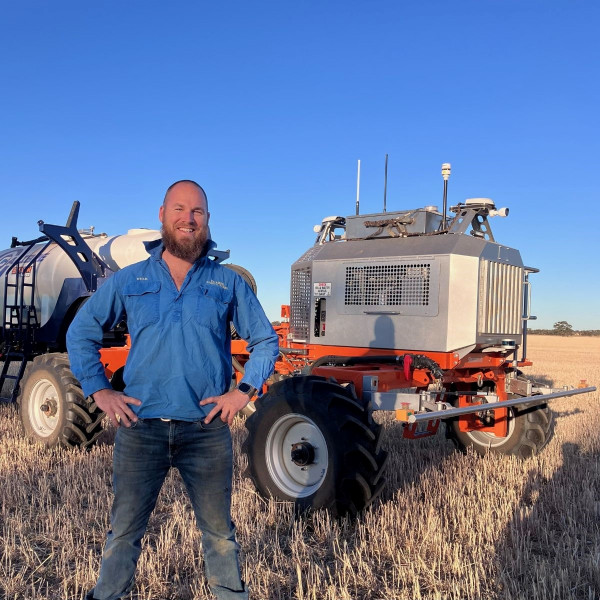
A 2022 study tour to northern NSW and Queensland sparked a revolution in the Victorian Mallee for Kyle Pearse and his family on their mixed cropping and sheep enterprise.
Mr Pearse is a Birchip Cropping Group member and also part of a national grower group, and said the study tour introduced him to several growers in that region using autonomous spray technology.
He said “hearing from their experiences sparked an interest for me”.
“On our farm, we like to be conscious of our herbicide application,” he said.
“We have a bit of a reluctance to use particular herbicides, meaning we can have weeds such as fleabane and marshmallow growing in summer which haven’t been controlled in crop.
“We wanted to concentrate the chemical where it’s needed to get on top of those tough, hard-to-kill weeds, and we began exploring technology we could invest in.
“The cost to purchase a 60-foot (18-metre) autonomous unit was similar to a 120-foot towed unit – but the towed unit would also tie up a tractor which would have another job to do.
“And I also don’t have to drive it. For the same price, I’d rather have something I don’t have to sit on.”
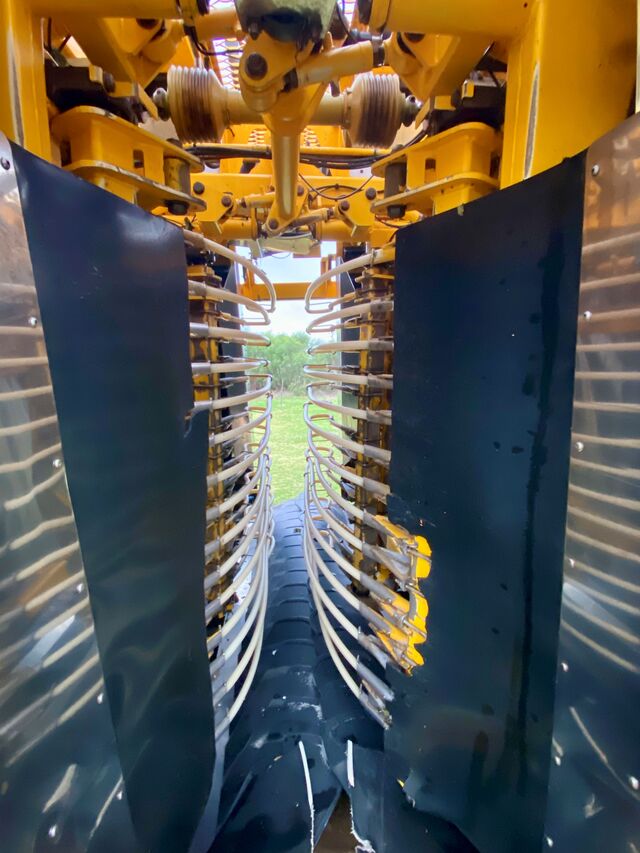
So the family invested in a SwarmBot and Mr Pearse said in the first paddock they sprayed with the new technology they saved $10 per hectare in chemical, compared to the cost of a blanket spray.
He said after the SwarmBot finished one paddock overnight and he checked the tracking on his phone, he saw it had sprayed just 12 per cent of the paddock, leaving 88 per cent untouched by unnecessary chemical application.
“Besides the cost saving, I have concerns about what some of the chemistry we use does to the soil biology, nitrogen use efficiency, our food system, and the resulting resistance issues,” Mr Pearse said.
“I’d rather spray less of the paddock at a higher rate to concentrate the chemical where it needs to be.
“When we put the SwarmBot in a paddock, the paddock must be mapped out, so it knows where the obstacles are.
“I drive around with a RTK GPS receiver on the ute, mapping every power pole, tree, or fence line to ensure its smooth operation.
“In the first paddock I mapped I missed a tree, so instead of spraying around the tree, it detected an obstacle and went to sleep.
“I woke up the next morning and went to check on it to find it sleeping on the job because I hadn’t mapped it properly – but that’s the only real challenge we’ve had with the unit so far.”
Mr Pearse said most of their mapping was done before cropping, in February and March, “when there’s not much else going on”.
He said the idea was that once the headers are out of the paddock, the SwarmBot can go in to get started on the summer weed control and conserve any moisture left in the soil.
While the unit operates at a lower speed than a typical tractor and boom, its 24-hour operation accounts for any lost productivity due to the reduced speed.
It also has an on-board weather system, so if it starts to rain or the delta T is outside optimal parameters, it will stop and wait until the conditions are better.
Mr Pearse said the servicing team at SwarmFarm had been fantastic and “I’ve only had good experiences, they’re always happy to help”.
“We are typically very slow adopters of technology,” he said.
“We’re certainly not the people to jump onto new things early, but this one I saw as a bit of a game changer – and it fits really well with my ethos of good-practice farming.
“I have a gut feeling that in the future our grain will be marketed against our carbon footprint, and anything we can do to lower our CO2 emissions going forward will be beneficial in the long term.
“There’s been such a big push for the world to be cleaner and greener. I think as farmers, if we can show we are being more efficient by only putting chemicals where they’re needed, that’s a step in the right direction.”
Mr Pearse said his best advice before making an investment in technology was to talk to people who are using different solutions to solve the same problem.
He said he spoke to 10 people who were using SwarmBots, and then to people running tractor-drawn Weed-IT sprayers.
“Listen to their experiences and their challenges and apply that information to your own situation to help guide your decision,” he said.
“For us, the technology aligns well with our values, and saves us money, so it’s a win-win.”
The fifth-generation farmer from eastern Donald runs wheat, barley, canola, lentils and a few sheep across 2800ha with his wife Teghan and his parents – plus some casual staff in busy times.
Being in the Mallee also means their business prepares for droughts by conserving the moisture they get in summer periods.
He said last year had been a standout example of how important it is to conserve any moisture received through out-of-season rainfall.
“Our main strategy for this is weed control and our SwarmBot will certainly play a role in that,” Mr Pearse said.
“Everything we do in farming we do with the understanding that we never know when it will rain or when it will frost.
“We place higher value on consistency rather than brilliance, and run a lower-input, lower-risk system.
“We don’t need to achieve a brilliant result in the great years but try to flatten the curve so that in the less favourable years our results are more consistent.”