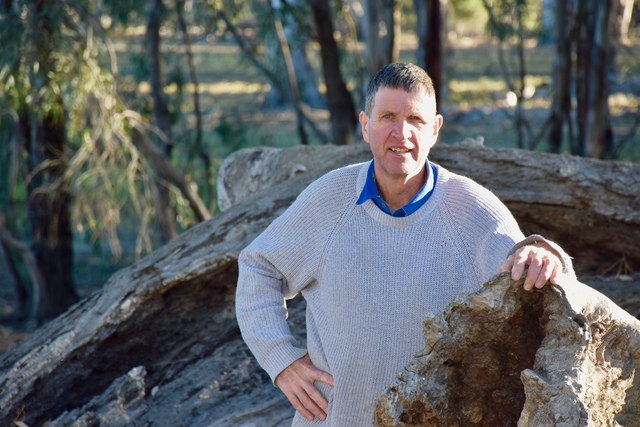
Lake Boga’s Scott Bruton was left with the remains of the Shorthorn gene pool in 2002 when he took over the family’s Roly Park stud.
His uncle and aunt – Ross and Lyn Pfeiffer of Katandra West – had dispersed their stud, and Scott finished up with “the name and a heifer”.
It was a small start for the school boy, soon to be apprentice, and still full-time, electrician.
But it was also pretty inevitable – between his time with the Pfeiffers and his other family stud, Swanlea Beef Shorthorns Shirley and Arthur Swan of Murraydale, – he had been around cattle most of his childhood.
Today he has built Roly Park Shorthorns into 50 breeders (and counting) with an impressive show and sale track record that has his stud punching well above its weight.
The highlights (to date) are a Reserve Junior Interbreed Champion Bull at the Melbourne Royal in 2018 – followed by grand champion broad ribbons at the Royals in Adelaide, Melbourne and Sydney.
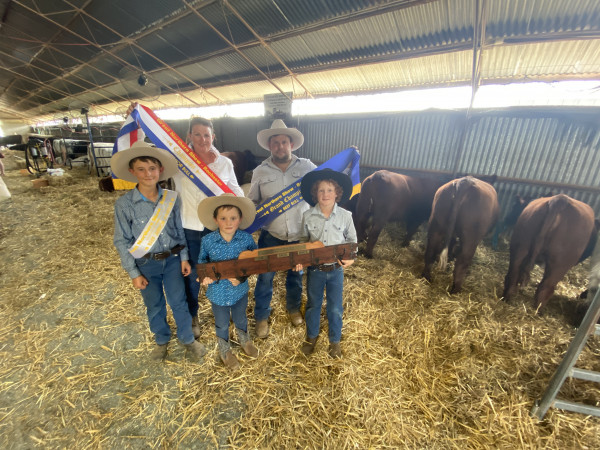
At Rochester’s Great Northern Show at the weekend, Team Roly Park was back doing what it does best, taking home a swag of ribbons across multiple classes, including his standout 18-month-old bull Roly Park Mr Sydney being sashed Grand Champion Bull.
The young sire will now headline Scott’s team at Deniliquin, Euroa, Cohuna and Sydney before being his star lot at the Shorthorn national show and sale at Dubbo on June13-14 (where he set a stud record sale of $16,000 in 2022 for a bull which went to a commercial beef cattle enterprise in NSW).
Roly Park also sells bulls privately from its Lake Boga base.
“He is one of the best we have bred” Scott says.
“Great conformation and muscling and while he’s not the biggest bull for his age, he will grow out nicely.
“He’s a bit over 700kg at the moment after coming out of joining some of our stud heifers, he’s just about the complete package.
“Peter Collins (one of the industry’s premier judges), who awarded him grand champion Shorthorn bull in Melbourne last year, and saw him out here again today, told me the bull is hard to fault.
“The Rochester judge’s comments supported that when he described him a bull with no flaws. We also showed a 12-month-old bull weighing 680kg that won his class today. A lot of people commented on his muscling and weight for age.”
Scott says the stud was originally Roly Park Beef Shorthorn, recognising the days when the breed actually had a short horn.
But he says the increasing interest in dealing with polled animals has changed the breed from Shorthorn to No-horn.
“It supposedly makes them safer and easier to handle, but I don’t recall having any problems with them,” he says.
“The Shorthorn breed has a natural docility, and it has been one of the must-haves in every animal I breed – the slightest sign of any type of aggression and they’re gone. It’s easy to breed in, but takes a lot longer to breed out.
“We also select for marbling and muscling, for me they are some of the great attractions of the breed – along with its tender and tasty meat.
“At the Sydney Royal in 2021 we exhibited a purebred shorthorn steer that won his class on the hoof and took out the virtual taste test award which is based on the MSA eating quality assessment. Also in 2022 we were awarded champion carcase at the Swan Hill carcase competition.
Turning two cows into 50 breeders (and counting) is no mean feat, even when you are working with the breed that built the whole business.
It has required Scott to carefully manage his outcross genetics – he has used a few bulls from Canada and the US but still mainly use Australian genetics including Australian sources such as Spry’s Shorthorns, Bayview Shorthorns, Leeds Shorthorns and many others.
“We AI all our females, which allows us to select sires for individual cows rather than using a bull for the entire herd,” he says.
“We’ve only purchased a few females since taking over the stud and have just got some of our first embryo calves on the ground from a few of our top females.”
According to Shorthorn Beef, the breed has the oldest breed registry in the world, with the first Shorthorn cattle first arrived in Australia in 1825, and barely 65 years later they accounted for 50 per cent of all temperate cattle and 100 per cent of all cattle in the difficult northern climate.
“It literally is,” Scott says, “the animal on which the Australian beef cattle industry was built, and on which Australia was settled.”
The society says Shorthorn cattle are bred to solve problems, not create them.
“Balancing out all the economically important traits for your business, not just a few, means providing you with an easy care, efficient and productive cow base, producing quality steers suited to a wide variety of markets,” it says.
“The Shorthorn breed offers balanced, multi-trait excellence, designed to increase productivity by impacting all areas of economic importance, not just a few.
“Shorthorn females are extremely adaptable, across a wide variety of environments, and maintain production and fertility under seasonal adversity and across the breed, have excellent marbling traits, combined with high yield percentages.
“They are also extremely efficient converters of feed.”
The Shorthorn ranges from white to a deep, reddish brown, with a mix of both in the middle of the breed spectrum and classified as roan.
And as white as Roly Park Mr Sydney is, around his tail there are pigment spots confirming he has the breed’s natural dark tones deep in his hide, ensuring protection from the harsh Australian sun.
But it is also a sun that is shining on this growing stud, and the road to Sydney and Dubbo is already looking very promising.
Further details from Scott Bruton on 0437 852 239 or scott@rolypark.com.auBREAKOUT PANELShorthorns are also one of the most complementary of all cattle types.
Shorthorn Beef says the remarkably diverse Shorthorn has provided one of the cornerstones of more than 40 newer, and now recognised, beef cattle breeds around the globe.
Shorthorns have shown their marbling is equal to any comparative breed, boosted by access to the world’s largest multi-breed genetic evaluation, IGS, providing EPDs on purebred, crossbred and composite cattle.
In 2000, Shorthorn Beef launched a progeny test program, called Durham Research and Development
The first program of its type in the world, Durham Research and Development produced progeny from 2001-2010. Performance records from DRD were used to develop EBV’s for the Shorthorn breed, and others, as well as improve accuracies. This research has carried forward into the Shorthorn Beef IGS analysis.
Whether for purebred or crossbred purposes, utilising Shorthorn genetics allows breeders to differentiate their programs, and increase their overall productivity and profitability.
The Shorthorn breed today is backed by science, and the world first DRD, providing buyers the confidence Shorthorn cattle deliver as described.
Shorthorn cattle also deliver high compliance rates and extremely consistent performance across a variety of market specifications, while requiring less feed to achieve it (net feed intake) – helping explain why Shorthorns are in such high demand today.
This performance level is also why Shorthorns enjoy price parity and access to all mainstream markets in Australia.
Underpinned by science, the Durham Research and Development progeny test program, commercial breeders can access one of Australia’s most innovative solutions to increase productivity and profit.