Behind farming’s frontline – and in the paddocks – is a diverse and dynamic network of researchers working hard with growers and industry to redefine the role of pulses in Australian farming.
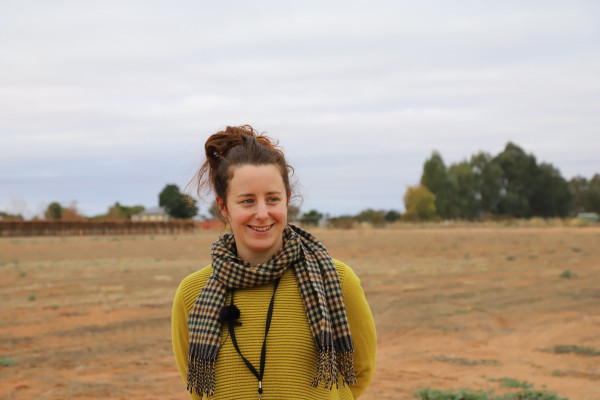
Audrey Delahunty is one of them.
Although working in agricultural research is probably not the first place you might expect to find a Bachelor of Science – with honours in geochemistry – like many other graduates fresh out of academia, Ms Delahunty was intent on finding a job using her degree.
So when she was given an opportunity as a casual technical assistant, supporting researchers at the Horsham SmartFarm, she grabbed it.
“Once I got there, I was captivated by the work and innovation AgVic was doing and how it integrated with the grains industry,” Ms Delahunty explained.
Born and bred in western Victoria, the opportunity to do a PhD with The University of Melbourne but based at the SmartFarm was irresistible for her scientifically-inquiring mind.
She could now add value to research about the wider world of pulses in a region she knew well.
Her thesis on increasing the heat tolerance of lentils and creating a screening methodology was almost tailor-made for a seamless transition into her current slot as a key member of the AgVic crop agronomy team.
“When I first started at the SmartFarm we were looking at the effects of elevated CO2 on cereals and you could literally see the changes happening in front of your eyes, I got into that work so quickly and decided that’s what I wanted to do,” Ms Delahunty said.
“It was one of those ‘oh, my goodness, look at this’ moments and the challenge of being part of that research was just too good to miss.”
“At the same time, we have been looking at applying heat in a field scenario, so we had to create a way of doing that with chambers and that was great as well.”
That work was part of a project to mimic the potential effects of increased CO2 levels and temperatures as part of climate change, but the work is equally applicable with Australian farming’s all-too-regular rotation of drought and heatwaves.
As a researcher, Ms Delahunty is already a familiar face around the state, and the industry, due to her active involvement in field days and industry events as she brings them the latest news from her work in improving pulse production.
Improvements such as developing climate-resilient crops, particularly a heat tolerant lentil, and seeking new farming methods supported by agronomic best practices on-farm as well as to helping diversify and grow the pulse industry.
The bottom line of that research is to benefit the Victorian grains industry – it’s all about helping growers optimise their productivity.
But as Ms Delahunty pointed out, it is also about helping to create growing opportunities, for example to support current and emerging opportunities for pulse in for domestic and international markets.
Which also explains her involvement with the CSIRO-led National Pulse Agronomy Project, which captures all pulse regions in Australia through project partnerships.
The national project focuses on maximum yield formation under different seasonal conditions, working to find which levers to pull to narrow the water-limited yield gap of chickpeas, lentils, faba beans and narrow-leafed lupins by combining experimentation and crop simulation modelling.
The project runs a series of detailed and satellite trials, with commercially available cultivars with an aim to benchmark the water-limited yield potential of pulses across the country under best practice agronomy.
In particular, the project will investigate yield formation in these indeterminate crops and identify how crop timing (sowing date, length of reproductive stage) can be used to manage or avoid yield limiting environmental stress (temperature, water stress).
In addition, the project team will investigate the efficiency of nitrogen fixation in stressed plants and evaluate its role in achieving the crop water-limited yield potential.
Ms Delahunty’s role in research ranges from what is termed ‘upstream’ to applied, which reflects research with outcomes that can be implemented directly on farm.
An example of ‘upstream’ research is the work she and her many colleagues do across the industry to identify material with heat tolerance, including genomic selection, to take pulses to the next level of adaptation.
“When you are trying to look at how each variety interacts with its environment, and then all the other factors which come into play with those varieties in their own breeding, such as for herbicide tolerance, nothing happens overnight,” she said.
“With much of my work being classified as pre-breeding, the changes and progress we are able to regularly report to field days and industry events gives growers the chance to take home key learnings to assess where they go with their own properties.
“Our work here with AgVic, co-funded by the Grains Research and Development Corporation, is also a partnership with the people in the paddocks. We all want the same outcome, a bigger, better and more sustainable crop.”