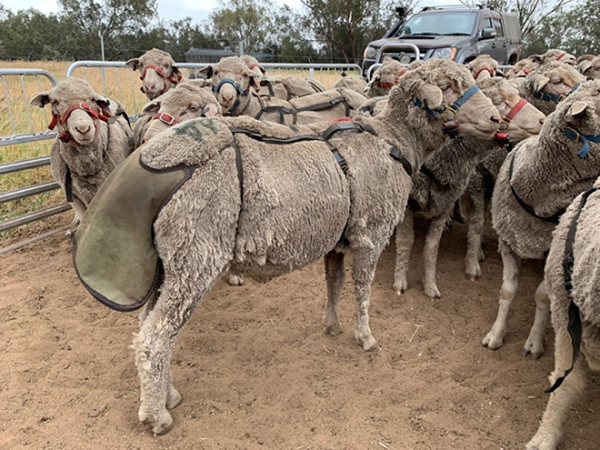
AWI smart tags allow real time monitoring of flock

A three-year project, aptly titled ‘Grazing Bytes’, has demonstrated AWI smart tags can be used to predict feed intake, and especially liveweight change, which could enable woolgrowers to optimise grazing decisions.

This would improve both pasture and animal performance.

AWI’s investment in smart tags aims to enable woolgrowers to track, monitor and assess the status of their flock in real time – and make more informed decisions to increase their enterprise’s profitability.

The recent Grazing Bytes project utilised AWI smart tags to assess grazing behaviour, feed intake and ultimately accurately predict liveweight change.

At the beginning of the project in 2019, farmer workshops were held across a range of Australia’s sheep producing regions (WA, SA, Victoria, NSW) to gain insights from a broad range of producers on the kinds of use cases they would envisage, and the format they would like the information to be in.

However, all research work was undertaken in WA due to COVID restrictions.

The smart tag data generated during the project was matched with known feed intake information and liveweight change information generated in a range of scenarios.

The data sets were then used to train and test machine learning algorithms to predict a range of grazing and liveweight change attributes. The results were very promising.

“The Grazing Bytes project clearly and successfully demonstrated that AWI smart tags could be used to predict both feed intake and especially liveweight change,” AWI Agri-Technology program manager Carolina Diaz says.

The most promising result was the ability to accurately predict liveweight change over seven days from smart tag behaviours (grazing, walking and ruminating) over the same period.

While the datasets were small, almost 70 per cent of the actual changes in liveweight over seven days were explained by the predicted changes in liveweight.

Furthermore, the predictions of liveweight change appeared to be independent of the plot and feed on offer (FOO) and therefore, if validated using larger data sets, the approach may be transferable across different grazing environments and scenarios.

Carolina says the implementation of this technology in due course would likely have a positive impact on labour efficiency, farm productivity and business profitability.

“The prediction of grazing behaviour, feed intake and liveweight change from the AWI smart tags could ultimately be used to develop paddock movements that optimise the utilisation of feed available across the farm at different times of the year,” she says.

“It could also enable more efficient and timely use of supplementary feed.

“The data, even on a weekly basis, would make it much easier to allocate the appropriate amount of feed to priority mobs and increase the accuracy of achieving condition score targets to improve reproduction and lamb marking rates.

“Together with information on location, the data could also provide spatial information on forage productivity that could be used to improve paddock management and design.”

Digital Editions


  • Almond boss resigns

    Almond boss resigns

    ALMOND giant Select Harvests is on the hunt for a new boss after shock news its chief executive is stepping down. Chief executive and managing…

More News

  • Dog’s Day Out arrives in the Mallee

    Dog’s Day Out arrives in the Mallee

    THE iconic spluttering rumble of Lanz Bulldog Tractors is set to roar across Swan Hill and Woorinen next month, when the Mallee Steam, Oil and Machinery Club hosts Dog’s Day…

  • Perfect storm for grape industry

    Perfect storm for grape industry

    This year is certainly testing ones resolve, excessive heat, high water costs, record low grape prices, 170mm of rain at the wrong time and now the fuel issue. After eventually…

  • Holding on to their heritage

    Holding on to their heritage

    Purchase this photo from Pic Store: 531373 TRADITIONAL family farms, passed down from generation to generation, are becoming rarer and rarer these days. With the growth in corporate farming, greater…

  • Wet weather halts harvest

    Wet weather halts harvest

    It’s been an eventful start to harvest for the almond industry. Like all of agriculture in the region, Mother Nature and geo-political tensions have played a hand in providing extra…

  • Royal Commission push back

    Royal Commission push back

    A FIERY clash in Federal Parliament has reignited the bitter fight over the future of the Murray-Darling Basin, with the federal environment minister rejecting claims the government is “destroying family…

  • Call for royal commission into water welcomed by irrigators

    Call for royal commission into water welcomed by irrigators

    FARMING communities have backed a call for a federal Royal Commission into water, saying it is time to expose the “treachery, lies and shonky deals” behind the Murray-Darling Basin Plan.…

  • Nationals push to protect prime farmland with new federal Bill

    Nationals push to protect prime farmland with new federal Bill

    THE Nationals have moved to block taxpayer funding for energy and mining projects on Australia’s best farming land, unveiling a new Bill they say is vital to protect the nation’s…

  • Sally returns from Japanese adventure

    Sally returns from Japanese adventure

    I am pretty excited for this week , actually just tomorrow evening specifically when Sally returns from her first globe trotting adventure. Flying in from Osaka Japan, she’s been on…

  • CWA brings life skills program to the Mallee

    CWA brings life skills program to the Mallee

    Purchase this photo from Pic Store: 539453 A SURGE of community spirit swept through the Mallee when Country Women’s Association of Victoria president Jenny Nola attended the Murray Valley Conference…

  • Basin leaders meet as water plan review looms

    Basin leaders meet as water plan review looms

    NEARLY 200 leaders from across the Murray-Darling Basin gathered in Brisbane last week to debate the future of water management, with northern Victorian councils warning food production and regional communities…