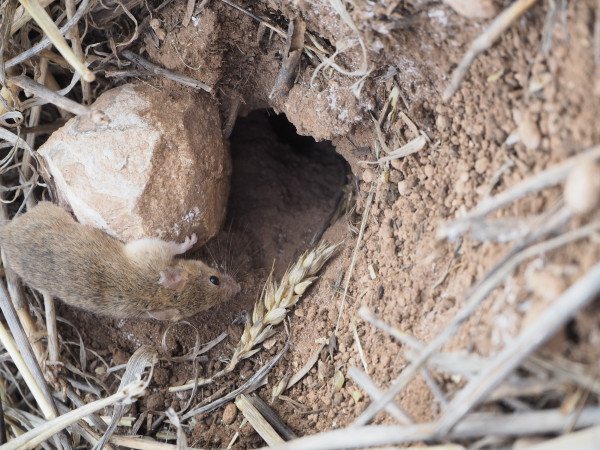
WALPEUP in the heart Mallee has become the frontline in the rodent wars, and Victoria’s only benchmark and rapid assessment site, making it part of a national network tackling the ongoing – often crippling – threat of mouse activity to graingrowers.
Now the Grains Research and Development Corporation (GRDC) and partners is sinking a further $11 million into projects to enable continued cutting-edge research led by CSIRO.
Mallee farmers know elevated mouse populations in key graingrowing regions have led to substantial economic losses for years.
While advances in farming systems have resulted in tremendous benefits, they have also inadvertently contributed to making the pest problem even worse.
GRDC pest manager Leigh Nelson told North West Farmer our modern strategies are providing more cover (from retention of crop residues), more food (from increased cropping intensity), and less disturbance (from reduced tillage).
“This has fundamentally changed the face of mouse management on grain farms,” Dr Nelson said.
“However, there are a range of management practices which can be used to reduce the impact.
“Over the years, GRDC initiatives have improved mouse surveillance techniques, refined predictive models, and promoted the widespread adoption of effective management practices through robust communication and extension activities.”
Senior research scientist Wendy Ruscoe is leading the research on mouse ecology to increase understanding of house mice in zero and no-till cropping systems.
In the next five years, she said CSIRO research will develop a range of impact mitigation strategies by investigating:
*How different farming practices (e.g. stubble management, strategic cultivation, grazing) can reduce food availability and habitat quality for mice, thereby lowering breeding success and survival.
*The effectiveness of baiting strategies, including how to increase toxic bait encounter rates and reduce background food competition to improve kill rates.
*Novel bait formulations (e.g. coloured or pelletised bait) and how bait appearance or substrate might influence detectability and uptake by mice.
*The use of non-lethal deterrents, such as seed coatings or “chemical camouflage,” to protect freshly sown seed from mouse predation at crop establishment.
*The role of invertebrates and other high-protein food sources in supporting rapid mouse population growth, with a view to informing broader pest management strategies.
*The impact of non-crop habitats (e.g. field margins and pasture paddocks) as refuges or breeding grounds during low-resource periods, and their contribution to crop reinfestation.
*Some of this research will be conducted in partnership with the University of Sydney, including collaborative work on novel deterrents and bait visibility based on mouse visual perception.
“The more we know about mouse behaviour in these systems, the more we can help grain growers reduce their economic impact through leading crop protection practice and mouse management techniques,” Dr Ruscoe said.
Investment from GRDC will also support ongoing monitoring and surveillance of mice throughout cropping zones to predict seasonal mouse population outbreaks.
This work is being led by CSIRO research scientist Dr Peter Brown and will include:
*Monitoring mouse activity at over 200 sites in key grain-producing areas, three times per year, to provide consistent, region-specific data.
*Enhancing spatial forecast models and developing interactive mapping tools to help growers assess mouse risk and make timely, informed management decisions.
*Field-testing and optimising remote monitoring devices that automatically detect and record mouse activity in real-time.
*Ongoing facilitation of the grower-led National Mouse Group, an information-sharing forum bringing together growers, industry and researchers.
*Producing and distributing seasonal ‘mouse updates’ with management recommendations agreed by the National Mouse Group.
“This comprehensive portfolio of research will deliver grain growers the latest evidence-backed information on how to reduce the impact of mice in crops,” Dr Brown said.
The research programs will also have access to CSIRO’s recently redeveloped rodent research facility in Canberra, which houses wild pest rodent species, enabling groundbreaking research into rodent management.
For more information, go to grdc.com.au/resources-and-publications/resources/mouse-management.