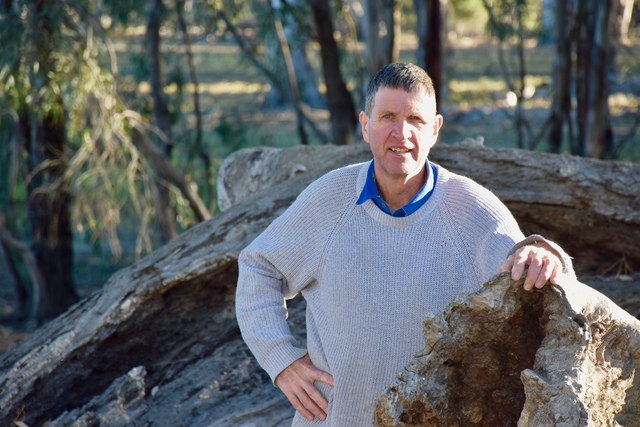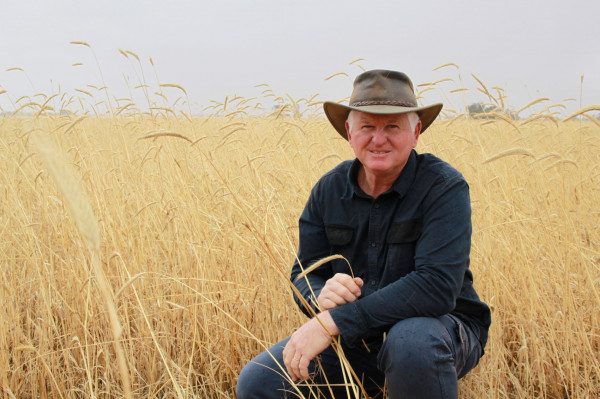
In north-west Victoria on the border of the Big Desert, fourth-generation farmer Steven Hobbs stands as a testament to the power of data-driven decision-making for overcoming the scourge of drought.
During the past 33 years, the frequency of drought on his property increased from one year in 10 to one in three, until it brought both him and his business to a crossroad.
“I reached a point where the harder I tried, the less successful I seemed to be,” he says. “The way I was doing things just wasn’t paying the bills.”
With mounting financial pressure and growing frustration, Mr Hobbs was forced to change his approach to farming to ensure the sustainability and continuity of his farm.
By harnessing technology and data to drive profitability on his dual-purpose Merino farm, Mr Hobbs is now successfully navigating an increasingly challenging agricultural landscape.
“I don’t bother using gut (instinct), I just use data,” he says. “If I can’t prove it with data, it goes.”
Mr Hobbs says his logical approach has seen profits rise while reducing his herd size and subsequently maintaining more cover feed to use during periods of drought.
“A lot of people have gone to scale to get efficiencies that way, but with land prices having tripled or quadrupled over the past couple of years, I don’t know how people make it work,” he says.
On top of the already devastating impacts of drought, farmers in Mr Hobbs’ region also have to contend with an increasing frost season that now runs from May to November.
“We’ve also had minus four-degree frosts in November which wiped out millions of dollars’ worth of legumes in the area,” he says.
In 2016, Mr Hobbs enlisted an adviser to assist with a detailed examination of his business. He removed all of the emotion from the decisions he made about his future farming operations.
“We found that livestock were the ones that were making the farm profitable and the cropping was very, very erratic,” he says.
“The biggest problem that I faced was I don’t like sheep. But if I’ve got to run animals, I’d rather run profitable animals.”
Mr Hobbs embarked on a mission to collect as much data from his sheep as possible, starting with weights.
His meticulous collection and analysis of data since then has enabled him to make informed decisions.
He maintains a master spreadsheet that tracks the lifetime data of each animal, covering aspects like growth rates, fertility, fecundity and income generation.
By using this data, he identifies the most profitable animals and systematically culls the least productive ones.
“When I first had a complete data set, I was able to identify that the top-earning sheep was generating $280 in revenue, then the bottom sheep was generating $40,” he says.
“When I went through my books, I could see it was costing me at that time $15 a head to look after that animal and if I was spending $15 on a sheep that’s only making me $40, she’s the first one to go.”
This data-driven approach has led to increased profitability and sustainability on his farm, allowing him to weather the challenges posed by droughts and frost.
Adapting to a changing climate
Mr Hobbs has not only focused on profitability but has also taken steps to mitigate the environmental impact of his grazing operations.
He emphasises the importance of maintaining ground cover and minimising soil erosion, highlighting the role of livestock management in achieving these goals.
Moreover, he’s proactively engaged in regenerative agricultural practices, acknowledging that climate change is a reality.
He has registered an ERF (Emission Reduction Fund) project using the soil carbon methodology to improve soil health and increase carbon sequestration on his farm.A word of advice
His advice to fellow farmers contemplating change is rooted in the pragmatism that defines his approach.
“It really comes down to, as my dad used to say, necessity is the mother of invention … the pain of making the change has to be less than the pain of not making it.”
He encourages farmers to embrace change when necessary, even if it means questioning traditional methods, and emphasises that technology doesn’t always require expensive solutions.
“We need a cultural shift, and the data will help us make that shift,” he says.
Mr Hobbs is participating in a new research project called Decide and Thrive, which aims to assist producers to make informed decisions about selection and culling during drought.
The project, being delivered by the University of New England, CQUniversity and CSIRO through funding from the Australian Government’s Future Drought Fund, began by gaining an understanding of producers’ current decision-making and management strategies.
More than 30 in-depth interviews were carried out with producers and advisers to assist technology developers and farm consultants in how best to offer support to industry to improve drought management strategies.
The project is working with agtech developers to keep stock selection tools simple to assist with deciding exactly which breeders to keep or cull when entering or exiting a drought.
The Decide and Thrive team has also developed communications and training tools for extension providers, farm consultants and the Commonwealth-funded Drought Resilience, Adoption and Innovation Hubs to assist in driving adoption by producers of objective stock selection tools and early decision making.