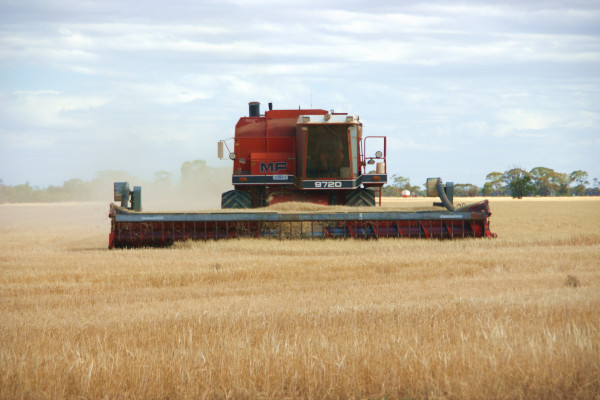
JUST a few millimetres of rain were enough to cost grain grower Brett Hosking a day of his canola harvest – in the first paddock.
He has the lentils done and dusted but, after the canola, the Quambatook farmer still has the barley and wheat to go.
With a perfect run from here on, he figures he could give the bulk of it “a good shove” in the next four weeks.
But there is rain forecast later this month and that’s the last thing he, and every other Mallee farmer, wants to see.
“The lentils were finished Monday and then we had literally just got into the first paddock of canola when the rain came down,” Mr Hosking said.
“That was one day we won’t get back and while we went hard all day Wednesday we had to stop as the sun went down and the moisture started making an appearance.
“We were very happy to get about 50mm four weeks ago, it gave us and a lot of others a near perfect finish.”
Mr Hosking said that while the region wouldn’t match the record hauls of the past two seasons, it would still be a strong year and with prices above average there wouldn’t be too many unhappy with their position.
Provided that rain held off.
He said that with the NSW harvest getting to the tail end, there was only Victoria to go.
“You have to feel for those in northern NSW, it was pretty tough right through there,” Mr Hosking said.
“It is also creating challenges for feed, a lot of people are now looking for it and it is having to come from further away.
“But it is nice that we are friends again with China, especially for the barley, and a few vessels have already headed that way from this harvest.”
Birchip Cropping Group chair John Ferrier, who farms about 25km north of Birchip, agreed and with his barley harvest still ahead of him he had been encouraged by the market moves.
Mr Ferrier said there had been plenty of talk about good yields and results for barley and he hoped for the same.
Like the Hosking farm, he got 30 to 40mm of that October rain which he described as “fantastic, and it was great finishing rain for all of the crops in this area”.
Grain Producers Australia southern region director Andrew Weidemann reflected the buoyant attitude around the Mallee, confirming the Australian wheat price was sitting as much as $90 a tonne above world parity.
But he warned everyone not to be too excited as the weather must still hold off and he still expects prices to soften slightly in the coming weeks.
“All the signs say we are looking at a reasonable harvest; it is just a matter of how it plays in Victoria,” Mr Weidemann said.
He anticipated the Victorian wheat harvest to come in about 6 million tonnes this year.
However, ABARES wasn’t aiming quite as high, forecasting total Victorian winter crop production, including barley and canola, to decline to 8.6 million tonnes – still an upward revision and 14 per cent above the 10-year average.
It said the revision was driven by above-average yields, reflecting favourable growing conditions to date across most cropping regions. Well-above average rainfall during June benefitted soil moisture levels, and supported crop emergence and development.
In its forecast, ABARES said “a positive start to the season enabled timely planting for winter crops”.
“Total winter crop area is forecast to remain similar to 2022-23 at 3.6 million hectares, 6 per cent above the 10-year average,” it said.
“Winter crop yields are forecast to fall 22 per cent from the record highs of 2022-23. However, yields should still be 9 per cent above the 10-year average.
“Yield potential is being supported by average levels of soil moisture for this time of year across key cropping regions in Victoria. Heavy rainfall at the start of the growing season allowed residual lower layer soil moisture from the previous season to be connected to this season’s moisture profile providing positive crop development and a buffer for a potentially dry spring.”
The Australia Fodder Industry Association said dry conditions in the north of the country continued to keep demand fairly steady, stabilising prices at a higher point.
AFIA chief executive Paula Fitzgerald said feedlots are seeing an increase in need as producers destock to manage their on-farm usage, driving demand from that sector.
She said transport costs continued to be a factor in the overall cost of fodder.
“Exporters continue to source cereal hay throughout the country and are looking for good parcels at premium prices,” Ms Fitzgerald said.
“This is providing a base line for cereal hay which will need to be met by local buyers who are looking to buy new season hay.
“At the same time, local pasture availability, especially in the south of the country, is keeping demand reduced.
“The continuing reduction in the size of the beef herd and sheep flocks is applying downward pressure on prices as demand wanes in local areas.”
She said the amount of agricultural land affected by fires in NSW and Queensland was still being assessed.
“The Bureau of Meteorology has still confirmed an El Nino and positive (Indian Ocean Dipole) are under way and likely to persist until at least the end of February,” she said.