Ian Goodwin and Alessio Scalisi, Agriculture Victoria
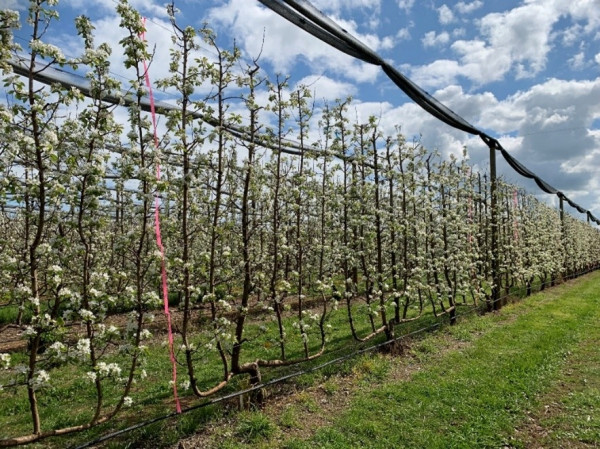
ORCHARDISTS across northern Victoria are being updated on the potential of initial tree training from as soon as the tree is planted, and how it is critical in narrow orchard systems (NOS).
Shoot removal in late spring and laying down cordons in autumn will minimise tasks and set the orchard up for establishing vertical leaders in the following season.
The Narrow Orchard Systems for Future Climates project is a partnership between state agriculture agencies in Victoria, South Australia, Western Australia and New South Wales, as well as the University of Queensland, and Plant and Food Research NZ, funded through Hort Innovation.
Agriculture Victoria leads the project with experimental and demonstration sites at SmartFarms across three states and in one commercial cherry orchard.
One of the components of the project is to set up cherry, nectarine, plum, apple and pear field experiments to compare rootstock performance and canopy height in rows spaced at 2 metres with trees at 2m spacing down each row.
Critical will be a narrow porous canopy so that the light environment within the tree is adequate.
To achieve good light penetration through the canopy, the trees will be trained as a narrow multileader cordon system.
Two permanent horizontal branches known as cordons form the foundation of this training system.
Shoots arising from the horizontal cordon (known as vertical leaders or uprights) are spaced out so fruiting spurs and laterals can adequately develop flowers and support good quality fruit.
In the NOS experiment at the Tatura SmartFarm, we set the cordon wire at approximately 0.45m above ground level.
This wire was tensioned so cordons could be laid close to horizontal without the wire lifting.
Grafted tree ‘rods’ were purchased from commercial nurseries and planted in September 2024.
At planting, the tree rods were cut back to approximately 5cm above the cordon wire and clipped to the wire to stabilise the tree.
In late spring or early summer, shoots arising from above and just below the cordon wire were removed.
These shoots arising from the top buds would end up being very strong with a steep angle, making it difficult to lay down as cordons later in the season.
Remaining shoots were weaker with a preferred wider angle.
Throughout the season, trees were managed to avoid pests, diseases and weed competition, and auto irrigated and fertigated (total seasonal N application = 20kg N/ha) to avoid stress.
No further tree training was undertaken until early autumn when shoots were pulled down to form the horizontal cordons.
Two shoots of adequate length were targeted.
In our case, the shoots were a minimum of 1m in length.
At this time of the year, the shoots tend to be more supple and less susceptible to snapping off – if the shoots are very thick, they can be twisted slightly whilst pulling down.
Special care must be given to plum shoots, which are brittle and easy to snap when laid down as cordons.
The laid shoots were clipped in two to three positions.
For apple, pear and cherry we recommend leaving the growing tip on the cordon shoot.
This tends to prevent sylleptic shoots arising from the cordon.
Once laid down, any remaining ‘spare’ shoots arising from the trunk were cut off. Any sylleptic shoots (very common in nectarine and plum) were cut back to 25-50 millimetre stubs.
Next spring we will do some bud rubbing to space out where vertical leaders will be positioned.
When the buds have swollen, and even when they have just burst, it is very easy to knock them off.
The aim will be to rub off buds on the underside of the cordon and space them according to the crop type (vertical leaders in cherry, plum and apple will be spaced at 25cm whereas vertical leaders in pear and nectarine will be spaced at 33cm and 50cm, respectively).
Upward facing buds closest to the trunk will also be removed to create vertical leaders of consistent vigour and size – vertical leaders arising from upward facing buds closest to the trunk tend to result in leaders with too much vigour.
In addition, plant growth regulators will be tested next season for their ability to improve leader growth uniformity.
More information on the NOS project and videos of tree training can be found at: www.hin.com.au/current-initiatives/narrow-orchard-systems-for-future-climates#development