THE chief executive of the Australian almond industry returned from a major industry conference in London with a few problems and a lot of potential on his hands.
Almond Board of Australia’s Tim Jackson is overseeing an astonishing industry growth phase in which plantings – spread from SA’s Riverland through Victoria’s Sunraysia and into the southern Riverina – soared by a factor of 20 in barely 20 years, up from a meagre 3500ha to 62,500ha, and counting.
But by the time Mr Jackson was back from the UK he already knew this was not going to be a boom season for the business.
“The annual industry conference (which is for tree nuts and dried fruits) is a bit of a round table for all the players, looking at global conditions, prices, crop yields and anything else happening and provides our growers with a market update,” Mr Jackson says.
“It is also a touch point for the whole industry as a major networking event.”
While Australia is now the world’s second-largest producer, when it comes to almonds grown and harvested it is very much a one-horse race.
With California responsible for 80 per cent of global production, compared with Australia’s 10 per cent (and climbing). Spain is No.3, and in a good year can match Australia, but a bad season there with drought can more than halve its production. Portugal and Italy are also recognised as small producers.
These countries happily compare notes on the production chain and industry activity, from production to marketing.
Mr Jackson describes his industry as “demand creative” as it has to compete with the massive marketing budget of US almonds and a market awareness of the quality Australian product.
“One of the biggest drivers here has been a growing awareness for many producers that almonds are a better, more reliable crop – across the southern Murray-Darling Basin almonds are seen as a crop which will consistently deliver stronger results through more efficient use of water, and as a result a lot of people started to make the switch from less-profitable crops.
“We have seen everyone from dryland farmers to cotton and rice growers or mixed farmers, either make a complete swap or add almonds into their mix.”
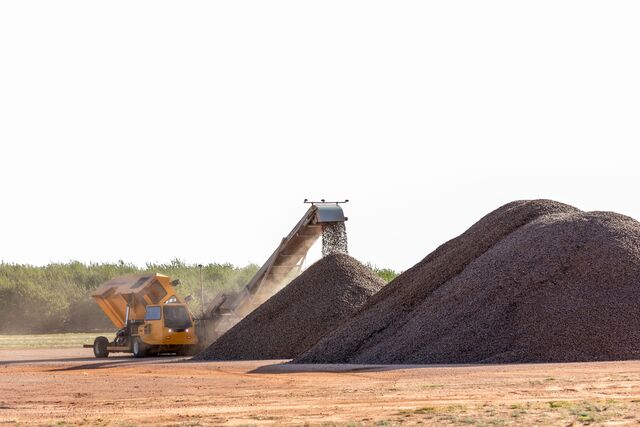
The not-so-good news for almonds is the falling yield for the 2023 crop. In December the ABA forecast 156,200 tonnes but a poor season has cut that by 30 per cent to 108,000 tonnes.
Mr Jackson says adverse weather conditions through pollination, which extended right through the growing season, conspired to cut the yield.
But he remains confident the industry will bounce back and is still on target for its 200,000-tonne forecast in five years.
Such an increase will need at least another 50,000 tonnes in total but as more and more of the new plantings reach peak production, this is a realistic ambition.
“There are huge opportunities waiting our industry and that was part of the good news when we got home from London,” Mr Jackson says.
“We are joining forces with Hort Innovation to ramp up the Australian almond sector for growth on the back of an encouraging 118 per cent rise in overseas demand during the past decade.
“In real numbers that means we have gone from exporting 52,795 tonnes in 2013 to 115,049 tonnes in 2022.”
Mr Jackson says the Almond Board will implement a Hort Innovation supported $7 million program over the next three years to increase almond exports in existing, emerging and new markets to cater for that increase.
“The Australian origin has a great name around the world so we know from current sales data that there are opportunities for expand in a number of markets,” he says.
The program will support the almond industry through a range of market access and development activities such as participation in trade shows and missions, educational messaging about health benefits and engagement with key trade stakeholders.
Mr Jackson says the ABA has led the industry’s market access and trade development activities for more than two decades and is “ready for the challenge of expanding our export growth”.
“Five years of increased plantings has laid a strong foundation for the next era of our industry.
“There are 800 million people on our doorstep in South-East Asia who are not huge consumers of almonds.
“This money will help us kick-start a campaign to find new customers in South-East Asia and meet the increasing global trend for plant based food ingredients and more healthy eating.
“We have recognised that there are untapped opportunities in countries such as Indonesia, Malaysia, Singapore, Vietnam and Thailand.
“Our key objective is education and highlighting the benefits of almonds as a source of nutrition and protein.”
Right now, global almond returns for growers are at the lowest levels for more than a decade. It is hoped that a predicted short crop in California will improving pricing in the not-too-distant future.
Mr Jackson says California has been integral in the opening of many almond markets, but those closest to Australia represent an opportunity that is relatively untouched.
He says the Almond Board of Australia’s collaborative “all of industry supported” approach marketing program has been a pioneer in developing markets in more than 50 countries, including key targets of India and China.
“It is interesting to see the new focus on exporting Australian products to India,” he says. “We have been in that market for more than 20 years. It is a country that is modernising very quickly but establishing trusting relationships on the ground is the key to ongoing success.
“We have devoted a lot of time as an industry to cultivating those B2B relationships and building the Australian origin awareness. We have plans to take that to another level on the back on the recent trade agreement that reduced tariff charges into India by 50 per cent.
“As a direct result of that agreement our sales for the first three months of the season into India are up 63 per cent on last year.”
Mr Jackson says a strength of almonds is their shelf life. This is a product that is good for two years or more – not an option for more perishable products – so the value against water used is much higher given that crop waste is almost non-existent.
The Australian almond industry delivers a regional economic impact of more than $1.6 billion and employs more than 10,000 people across the various growing regions.