If we have sold the farm, who in hell bought it?


ALL those newspaper headlines and interviews on the wireless have really been getting to me.

If I only believed half of what I had read or heard, I would be expecting the hosts of Midian to be setting up camp on the farms next door.

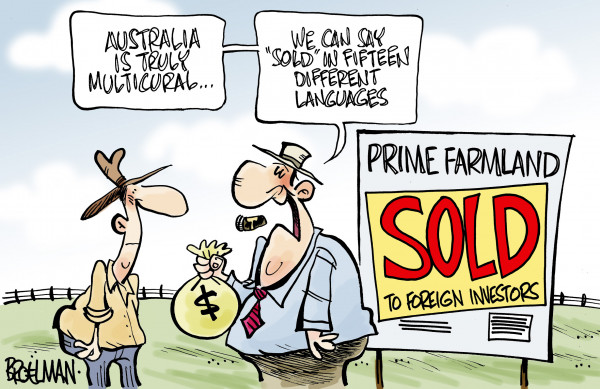
Because, it seems, we have gone ahead and sold the farm to these rapacious overseas interests.

It had reached the stage where I was beginning to think I might have to revive the Australian Natives Association (if that’s too far back for you, thank heavens for Google) to put some spine back in our governmental system.

Just like the good old days.

Until the latest figures came out from the good old Australian Bureau of Statistics.

It seems there is 400 million hectares of farmland in Australia. I doubt that includes the Northern Territory and northern Queensland, because that’s not farming, that’s just turn ’em loose and see what you can round up a year later.

Of that 400 million, less than 14 per cent has some degree of foreign ownership.

Just some degree – not outright ownership.

And 90-plus per cent of that not-quite-14 per cent is in the hands of just a handful (on this scale, that’s about 50) companies that have invested here.

In fact, most of that land owned by pesky foreigners is in the NT (so really, who cares?) and the least is in Victoria. Anyone who lives here wouldn’t want to sell, would they?

However, the numbers that still give the old Whacker the heebie-jeebies are the world population figures.

Already we’ve hit eight billion and actually speeding up, not slowing down, it is tipped to hit 10 billion by the end of the century.

That might seem a long way away (too far for the Whacker, thank God) but crikey Christmas, at this rate I’ll soon be carving up the high country for condominiums and ghettos.

Anyhow, once the ABS released its figures, of course everyone had their take – and of course everyone was hollering at the top of their lungs that it was actually worse.

Not helped by the ABS admission its figures were sort of a guesstimate.

Because there is no super-accurate register of foreign ownership of land in this country, and even allowing for halfwits sinking their cash into the NT, it might just turn out we own less than we actually think we do.

Sort of like our farm.

We own about 12 per cent, just like the foreigners, and the bank has a tight grip on the other 88 per cent.

And for those of you who have been following the family adventures, junior has taken on finance from a foreign bank.

Which means – when push comes to shove – we are in the same boat as the rest of that land snapped up by foreigners.

We own a bit and they own a lot. Of course, as the old man always said to me, “sell ’em as much as they want, they soon learn they don’t really know how to farm here, and they can’t take the land anywhere”.

And, I can assure you, that’s got me thinking again.

First, about ever trusting junior with the farm and, second, about how to get them bloody foreigners off our farming land.

Hang on, isn’t that where we started?

Digital Editions


  • Almond boss resigns

    Almond boss resigns

    ALMOND giant Select Harvests is on the hunt for a new boss after shock news its chief executive is stepping down. Chief executive and managing…

More News

  • Dog’s Day Out arrives in the Mallee

    Dog’s Day Out arrives in the Mallee

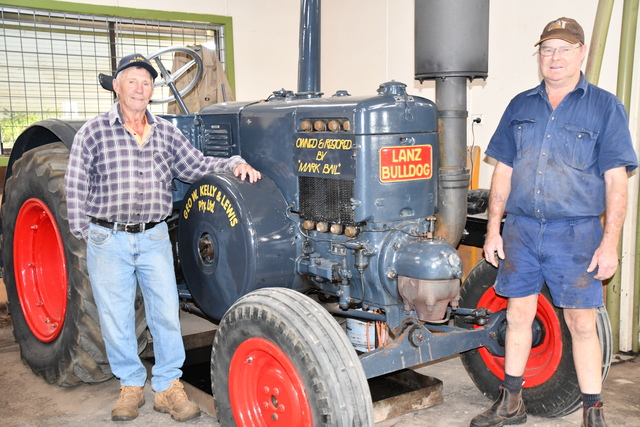
    THE iconic spluttering rumble of Lanz Bulldog Tractors is set to roar across Swan Hill and Woorinen next month, when the Mallee Steam, Oil and Machinery Club hosts Dog’s Day…

  • Perfect storm for grape industry

    Perfect storm for grape industry

    This year is certainly testing ones resolve, excessive heat, high water costs, record low grape prices, 170mm of rain at the wrong time and now the fuel issue. After eventually…

  • Holding on to their heritage

    Holding on to their heritage

    Purchase this photo from Pic Store: 531373 TRADITIONAL family farms, passed down from generation to generation, are becoming rarer and rarer these days. With the growth in corporate farming, greater…

  • Wet weather halts harvest

    Wet weather halts harvest

    It’s been an eventful start to harvest for the almond industry. Like all of agriculture in the region, Mother Nature and geo-political tensions have played a hand in providing extra…

  • Royal Commission push back

    Royal Commission push back

    A FIERY clash in Federal Parliament has reignited the bitter fight over the future of the Murray-Darling Basin, with the federal environment minister rejecting claims the government is “destroying family…

  • Call for royal commission into water welcomed by irrigators

    Call for royal commission into water welcomed by irrigators

    FARMING communities have backed a call for a federal Royal Commission into water, saying it is time to expose the “treachery, lies and shonky deals” behind the Murray-Darling Basin Plan.…

  • Nationals push to protect prime farmland with new federal Bill

    Nationals push to protect prime farmland with new federal Bill

    THE Nationals have moved to block taxpayer funding for energy and mining projects on Australia’s best farming land, unveiling a new Bill they say is vital to protect the nation’s…

  • Sally returns from Japanese adventure

    Sally returns from Japanese adventure

    I am pretty excited for this week , actually just tomorrow evening specifically when Sally returns from her first globe trotting adventure. Flying in from Osaka Japan, she’s been on…

  • CWA brings life skills program to the Mallee

    CWA brings life skills program to the Mallee

    Purchase this photo from Pic Store: 539453 A SURGE of community spirit swept through the Mallee when Country Women’s Association of Victoria president Jenny Nola attended the Murray Valley Conference…

  • Basin leaders meet as water plan review looms

    Basin leaders meet as water plan review looms

    NEARLY 200 leaders from across the Murray-Darling Basin gathered in Brisbane last week to debate the future of water management, with northern Victorian councils warning food production and regional communities…