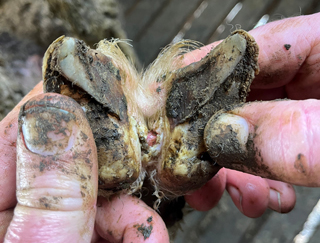
ACCORDING to one of the latest reports on endemic diseases, footrot costs Australian sheep producers $83.4 million per year – and foot abscess add another $10.4 million per year.
Ovine interdigital dermatitis (OID), over-grown hooves and poor pastern angle also cause lameness in sheep.
And sheep with foot disease tend to have poorer condition scores, slower growth rates, lower reproductive performance and lower general productivity.
There is therefore great potential to improve the productivity and welfare outcomes of Merino sheep, particularly those farmed in the medium- to high-rainfall zones where the incidence of foot disease is higher.
You can play a pivotal role in work to overcome this major problem by involving your flock in upcoming research to deliver an Australian solution.
A 10-year research program in New Zealand has determined susceptibility to footrot is heritable and the industry there has successfully developed a breeding value for footrot that can be used to reliably reduce the susceptibility of sheep to the disease.
AWI, Animal Health Australia and Murdoch University together with key partner neXtgen Agri International are now due to start a three-year project to investigate the genetic variation in susceptibility to footrot, OID and foot abscess among Australian Merinos and the correlations with other feet traits and determine if the footrot resistance data in Australia and New Zealand can be combined.
There are already a number of Australian sires tested in New Zealand and the Merino Lifetime Productivity (MLP) Pingelly WA wethers were also exposed to footrot at a Victorian trial site in recent years, but more data is needed.
If Australian Merinos can also be bred to be resistant to footrot and other foot diseases and be profitable, the lifetime welfare of sheep will be improved, the chance of reinfection will be reduced, the economic impact will be reduced and the existing control procedures will be more effective.
The project has three activities where woolgrowers can nominate to be involved:
· Activity 1 – enter a semen sire into the central progeny test where progeny will be evaluated for foot traits including their susceptibility to OID and footrot (30 AI sires per year are being sought for 2024 and 2025)
· Activity 2 – contribute eight cull rams per sire that will be challenged to OID and footrot at a research site in Victoria (the project is aiming for 100 sires across three years from 2023 to 2025)
· Activity 3 – 30 diverse ram breeders are being sought to take part in on-farm assessments of their 2023-, 2024- and 2025-drop progeny, including foot structure and shape, interdigital dermatitis and foot abscess.
Analysis of the data will follow to determine the heritability of a range of feet scores and the correlations with core production traits.
Given the New Zealand experience, it is likely the feet traits will be low to moderately heritable, with few adverse correlations with the production traits.
In MLP analysis to date, good feet structure is favourably correlated with higher production.
The project aims to release a research breeding value and eventually an Australian ASBV for resistance to footrot and inform the Australian Merino industry on appropriate selection strategies for each of the foot conditions examined.
Feet scores will be added to the Visual Sheep Scores guide so selection for footrot resistance is available to all interested ram breeders.
For further information and expressions of interest, contact Dr Amy Lockwood of neXtgen Agri International at amy@nextgenagri.com or Jarryd Krog, Murdoch University at jarryd.krog@murdoch.edu.au.