MOULAMEIN’S Shippen family, one of Australia’s largest woolgrowers, is culling as much as $25 million worth of blue-ribbon Western District land from its portfolio.
The move comes two years after the family combined with Victorian woolgrower Clinton Ross in a $70 million deal to carve up the 3353ha US-owned Woorndoo aggregation.
Ian and Camilla Shippen finished up with the southern end of the aggregation, made up of 10 titles totalling 1400ha.
Offers for the property are expected to reach between $17,296 and $18,532 per hectare ($7000 to $7500 an acre), or more than $24.5 million in total.
It had been the Shippens’ second significant foray into the Victorian market – in 2018 they paid more than $35 million for the 59,000ha Mt Fyans property, bought from Western Australian-based, Chinese-backed company Harmony Agriculture and Food Company. It was previously the seat of Keith and Rosie Rous, the Earl and Countess of Stradbroke.
Last year the family further expanded their landholdings when they paid $16 million at auction for the 9900ha Rhyola and Inverness pastoral aggregation near Deniliquin.
As well as their wool enterprise at Moulamein, the Shippens have a crossbred program at Wagga Wagga.
The Woorndoo sale marked another step in Laguna Bay’s selldown of Australian agricultural assets. Last year the investor offloaded the historic Banongill Station near Skipton in the Western District to a local consortium of farming families for about $80 million.
In 2019 it sold 12,000ha of almond plantations near Robinvale, and almost 90,000ML of high-security water for $860 million in one of the biggest agricultural transactions in Australia’s history.
The water component of the deal alone was worth $490 million.
The land and water were bought by Canada’s PSP Investments.
Elders Real Estate Mortlake and Camperdown’s Rob Rickard is handling the sale of the Woorndoo East farms and he describes it as an incredibly versatile property.
“Since they took possession, the current owners have continued maximising the property’s intensive development as high yielding cropping country which also lends itself to sheep, cattle and fodder conservation.
“The Woorndoo property comprises basalt clay loam soils with gently undulating topography, and land sloping and drained towards the seasonal creek and catchment dams,” Mr Rickard said.
“Raised beds (three metres wide) have also been established to improve overall drainage and maximise the winter cropping program.
“Improvements include a four-bedroom brick-veneer home, hay and machinery shedding, three-stand shearing shed and yards as well as excellent fencing, dam and bore water and 5.5km of bitumen road frontage are also part of the property.”
The Shippens primarily produce between 3500 and 3800 bales of wool a year from about 75,000 merino ewes, up to 15,000 merino wethers and 10,000 crossbred ewes.
They said they were listing the Woorndoo property as part of their ongoing portfolio restructure.
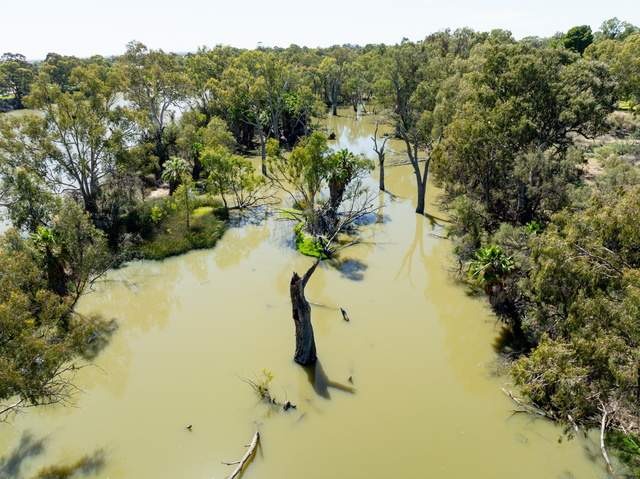
The Shippens and their children Will, Emma and James, made the headlines for another reason at the height of the 2022 floods when they turned to a trial use of seven AWI modular sheep delivery units after thousands of their sheep were stranded by rising water.
The family’s Banyandah Pastoral Company’s huge self-replacing merino operation across 105,000ha – most of it at Moulamein, where the average annual rainfall is 330mm – had more than half its usual shearing sheds out of action.
It was terrible timing, with the gigantic annual task of shearing 55,000 grown sheep and 40,000 lambs having recently begun.
Mr Shippen said his dire situation was helped enormously when AWI organised five modular sheep delivery units it owned, and two more owned by Haynes Engineering, to be made available.
“AWI got some modular shearing units delivered to us at one of our places that wasn’t too badly affected by floodwater. We turned an existing hay shed, sized about 30 metres by 18 metres, into a shearing shed with a set of yards in about three weeks. We cemented the floor and put in seven modular shearing units, which worked really well.”
The size of the existing hay shed meant that the seven modular units were configured into an L-shape, with a fabricator creating a corner to allow the sheep to flow.
The Shippens put 15,000 to 20,000 sheep through the system and have confirmed their intention to purchase the modular units as they had a fully operational shed at a fraction of the cost of other designs.