By Dr Gio Braidotti
With no chemical methods available to control crown rot disease in barley, a project that has identified novel sources of genetic resistance stands to deliver yield and income gains
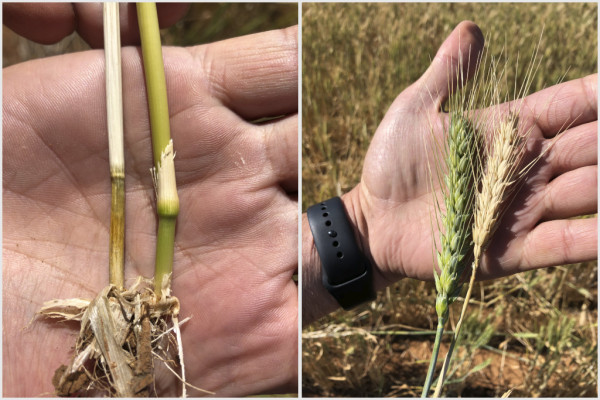
The water stress associated with a hot, dry finish can produce a double whammy by allowing crown rot disease on barley to flourish.
The Fusarium fungus then restricts the flow of water and nutrients to the developing heads of stressed barley crops.
This can result in both yield losses (heads without grain) and grain quality downgrades without yield reductions (pinched grain).
Even the most tolerant of barley varieties can experience some yield losses under high disease pressure, with disease incident increasing under no-till and tight cereal rotations.
Additionally, crown rot can reside in soil and stubble at infectious levels for several years. This creates opportunities for disease carry-over into subsequent crops in a rotation, with durum wheat being particularly susceptible.
These factors interact to make crown rot difficult to manage, especially as there are no chemical methods of control.
That adds up to a situation where it is imperative to prevent build-up of inoculum in the first place. In turn, that raises the importance of management strategies that are based on rotations and genetic resistance.
The GRDC identified that innovation to crown rot control requires improved genetic understanding and breeding for resistance.
To promote these advances, GRDC invested in research led by pre-breeders, Dr Zhi Zheng and Dr Chunji Liu, at CSIRO Agriculture and Food.
In a previous GRDC project, the CSIRO team identified good levels of seedling resistance among 1000 highly diverse barley lines.
That material has now undergone high resolution genetic mapping using near-isogenic lines (NILs). This sophisticated analysis allowed the team to develop diagnostic-grade DNA markers that are tightly linked to sources of crown rot resistance.
The strategy reduces the likelihood of undesirable genes located near the resistance genes being dragged along into breeding programs.
It also allowed for a more detailed characterisation of the resistance traits. This is especially important for crown rot given strong interactions between the genetics associated with disease severity/resistance and important agronomic traits, such as heading date and plant height.
Overall, diagnostic markers for three sources of resistance were developed.
Lines carrying these resistance traits show significantly less yield losses than commercial cultivars under infected conditions.
Kernel yield loss was reduced by an average of 56.9 per cent at Tosari, 66.1 per cent in Gatton and 58.1 in Narrabri in 2020. Under non-infected conditions, the lines produced similar yields, indicating that there is no obvious yield penalty associated with the novel resistance genetics.
Diagnostics markers and breeding lines have been provided to Australian barley breeders.
Additionally, the team showed, for the first time, that a reduction in fertile tiller number is mainly responsible for kernel yield loss, a finding that creates opportunities for future genetic research and new disease management practices.
This project shows beyond any doubt that breeding cultivars with high levels of crown rot resistance in barley is possible.
Importantly, the resistance does not necessarily come with a yield cost, and future crown rot-resistant cultivars may even have a yield advantage over current cultivars in both infected and non-infected conditions.
Benefits from this increase in genetic know-how and resistance primarily affects cereal growers through:
· Reduced crop loss.
· Improved yield and income stability.
· Greater flexibility in choice of crop rotation.
The percentage increase in yield available to growers has been calculated at 1.02 per cent nationally. Estimated yield benefits at a regional level are 2.04 per cent, 0.52 per cent and 0.67 per cent for the northern, southern and western regions respectively.
These gains have the potential to increase gross margins by $5.26 per hectare.
A cost benefit analysis found that the project generated a net present value of $50.6 million with a cost benefit ratio of 12.18 to 1 invested and an internal rate of return of 14 per cent from an investment of $4.5 million (in 2023 dollars).
Costs and benefits expected after 2023 were discounted at a rate of 5 per cent. The benefits are expected to start in 2030 – as barley varieties will require around ten years for testing and approval – and were assumed to accrue for another 25 years in the analysis.