High hopes for narrow orchards

A TEAM of scientists, engineers and economists have been assembled to reimagine what orchards in the future could look like through a $13.6 million program aimed at improving efficiency in resources and labour.

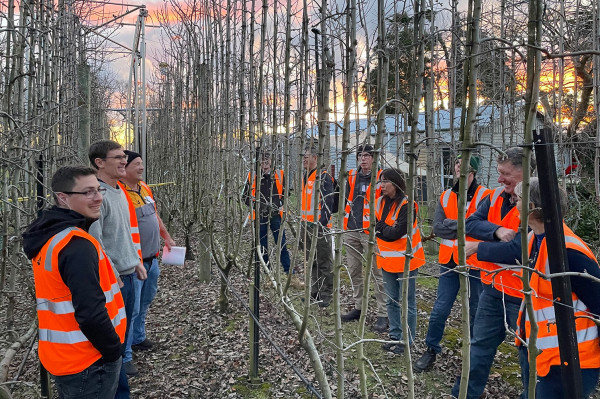
The five-year program, delivered through Hort Innovation, will establish research sites across the country to find out whether transitioning to narrower orchard systems could bring benefits for pome and stone fruits.

Apple and pear grower Jason Shields said the industry was eagerly awaiting the results of this research so it could plan for the future.

“Maximising yield, fruit quality and climate resilience while efficiently using our labour and resources is a key challenge for our industry,” Mr Shields said.

“This research will identify what our options are for our orchards going forward.”

Narrow orchard systems feature two-metre spaces between rows of trees and keeping the canopy narrow to expose fruit and leaves to enough sunlight to maximise yield and fruit quality.

This approach is attractive to field workers and amenable to robotics, automation and sensing technologies, and has the potential to use less labour, energy and increase the efficiency of inputs.

Hort Innovation chief executive Brett Fifield says the transformative research has boosting grower profitability at top of mind.

“This future-focused investment has the potential to transform the way the horticulture sector designs their orchards,” Mr Fifield said.

“It was recently estimated workers could climb around 10,500m per hectare in a season to complete tasks such as harvest, pruning and thinning. Mount Everest is 8848m.

“With growers at the forefront of the program’s aims, this research presents an opportunity to find more efficient to manage orchards that are more profitable, more consistent, more resilient and safer.”

Agriculture Victoria crop physiology research leader Ian Goodwin said the research team would estimate the benefits of narrow- orchard systems.

“Through establishing experimental sites across the country, our research team is anticipating gains in marketable yield as well as the accuracy and efficiency of sensing and robot orchard operations (such as crop load estimation, pruning, thinning, pest and disease monitoring, and fruit picking) in the narrow row orchards compared to existing tree training systems,” Dr Goodwin said.

“In addition to field experiments, we will also undertake an economic study to determine the profitability of transitioning to narrow- orchard systems and will compare the benefits and costs to current standard practices within the industry.”

Digital Editions


  • Ricegrowers backs review

    Ricegrowers backs review

    The Ricegrowers’ Association has welcomed the start of a 12‑week consultation on the Murray–Darling Basin Plan Review. RGA president Peter Herrmann said industry would take…

More News

  • Big crop predicted for almonds

    Big crop predicted for almonds

    The almond harvest is underway and 2026 could produce Australia’s largest almond crop. Nationally it’s estimated that almost 167 thousand tonnes will be harvested this year. That’s a seven per…

  • The calm before the storm

    The calm before the storm

    We appear to be bogged down in a rut, with the commissioning of our new plant. I was super frustrated a couple of months ago – at the spanner throwing,…

  • Backpacking paves the way to leadership

    Backpacking paves the way to leadership

    Purchase this photo from Pic Store: 531373 SUNRAYSIA’s summer harvest attracts travellers on working holidays from all over the world, particularly Europe. These workers perform a vital service for regional…

  • Warm weather set to continue

    Warm weather set to continue

    BARLEY prices are supported as drought speculation builds, with growers holding onto grain for livestock feed. The Bureau of Meteorology January drought statement showed below-average rainfall for much of Victoria…

  • Growers warn of fallout from visa cuts

    Growers warn of fallout from visa cuts

    UNPICKED crops, decimated rural communities and higher supermarket prices are among the consequences that could unfold if One Nation’s anti-immigration policy were to be implemented, farmers and experts have warned.…

  • Grape harvest underway

    Grape harvest underway

    Harvest has begun with our first loads of Chardonnay and Pinot Grigio. Reports of lower yields following the ongoing heat are common, although with the worldwide oversupply of wine, this…

  • Grant strengthens cattle and red meat industry

    Grant strengthens cattle and red meat industry

    Purchase this photo from Pic Store: 528596 Meat and Livestock Australia (MLA) in partnership with industry peak bodies, has secured a grant from the National Foundation for Australia-China Relations to…

  • Safety a priority

    Safety a priority

    EVERY farmer deserves to come home safely at the end of the day. That is the message at the heart of a new statewide campaign urging Victorian farmers to see…

  • Golden opportunity for future

    Golden opportunity for future

    THE Victorian Farmers Federation has called on the State Government to make strategic investments in agriculture, saying smarter policy and targeted funding in seven priority areas could supercharge the industry…

  • New initiative for soil diseases

    New initiative for soil diseases

    THE Grains Research and Development Corporation has recently launched a new initiative aimed at addressing economic strain from soilborne crop diseases. The Soil-Borne Disease Initiative is a five-year program that…