Fight on against cactus invader

Daniel Forwood

WHEEL cactus has infested several areas of Sunraysia as its continues its march across northern Victoria.

The latest Landcare maps show an alarming solid red patch starting near Kerang and spreading north-west along the Murray River.

Given weeds such as serrated tussock and blackberry already cost the Victorian economy $900 million a year, significant investment is required to stop the spread of wheel cactus.

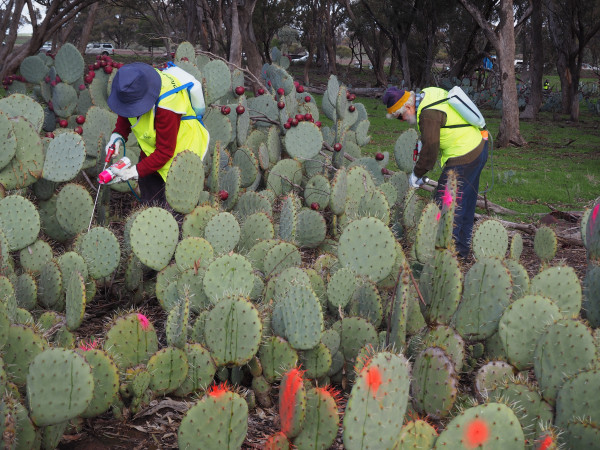
Recognising the magnitude of this cactus-borne catastrophe, a team of dedicated local volunteers from surrounding Landcare groups and landholders formed the Tarrangower Cactus Control Group in 2005 with one primary target – wheel cactus.

Group president Lee Mead leads the charge of the Froggatt Award-winning organisation, protecting Australian native plants, animals and the natural environment from the incursion of dangerous new invasive species.

Wheel cactus, which is plaguing the northern and central Victorian landscape, is a rapidly spreading, wheel-shaped reminder of Australia’s prickly past.

“There’s just as much wheel cactus as there is when we started. It grows just as fast as it’s killed,” Lee Mead says.

Ms Mead and the Cactus Warriors work passionately to raise the profile of wheel cactus, increase awareness and educate farmers.

Many property owners are actively controlling wheel cactus, but their hands are tied when it comes to the apathetic or absentee property owners and securing Victorian Government resources as wheel cactus is not considered a priority weed.

“People don’t think cacti are a problem,” Ms Mead says. “Wheel cactus won’t stop spreading.”

An ornamental, drought-resistant shrub turned escapee garden plant; wheel cactus (Opuntia robusta) is named after its peculiar spherical shape.

Once an oddly placed fixture in the Victorian landscape, wheel cactus has undergone plague-like spread in northern and central Victoria, akin to the other 27 opuntia species across Australia.

It is native and endemic to central and northern Mexico.

Each species has its own unique biological features, growth patterns and response to chemical treatments.

This has firmly etched their place as weeds of national significance, an infamous accolade awarded to 32 weeds based on their invasiveness, potential for spread and environmental, social, and economic impacts.

In Victoria, several catchment management authority boundaries aim to prevent further spread of wheel cactus.

The Australian climate presents ideal conditions for wheel cactus to naturalise and spread into Victoria, South Australia, NSW and Queensland.

With no natural predators, no competing cactus species native to Australia and a tendency to grow on top of inaccessible rocky granite hills, the weed has established itself in regions of Victoria during the past 50 years.

With the continued threat of infestations at some sites merging, now is the time to act to mitigate the development of a core wheel cactus seedbank.

Courtesy of the Victorian Farmers Federation

Digital Editions


  • Collection under the hammer

    Collection under the hammer

    AN eclectic curation of vintage and antique Australian pastoral machinery and memorabilia will go to auction on 1 February. Yvon Smythe and her late partner,…

More News

  • Calls flow for royal commission

    Calls flow for royal commission

    Purchase this photo from Pic Store: 524159 AUSTRALIA needs a royal commission into water management in 2026, according to Murray MP Helen Dalton, who says politicians are “destroying” the nation’s…

  • Big skies and farmscapes

    Big skies and farmscapes

    Purchase this photo from Pic Store: 524028 THE Gallery Balranald is currently showcasing the work of professional artist Graham Hearn. His latest exhibition, Big Skies and Farmscapes, reflects the vast scale and…

  • Difficult outlook for grape growers

    Difficult outlook for grape growers

    Murray Valley Winegrowers has acknowledged the findings of Wine Australia’s Australian Wine Production, Sales and Inventory Report 2025, which confirms the challenging market conditions facing growers. The newly released report…

  • Benham appointed to new ag role

    Benham appointed to new ag role

    The Nationals member for Mildura, Jade Benham, has been appointed Shadow Assistant Minister for Agriculture and Regional Development, as part of Jess Wilson’s new Shadow Cabinet announcement. Ms Benham said…

  • Connecting urban and rural Australia

    Connecting urban and rural Australia

    HAMISH McIntyre grew up on the land in Queensland, learning the rhythms of farming from his family. Today, he runs a sprawling family business across the St George, Dirranbandi, Quilpie,…

  • Farmers warned to stay alert

    Farmers warned to stay alert

    A RUN of booming haystack and shed fires across regional Victoria has sparked fresh warnings for farmers as hay season rolls into full swing. Fire crews in the west and…

  • Bumper harvest fuels Cobram Estate’s growth

    Bumper harvest fuels Cobram Estate’s growth

    COBRAM Estate Olives has reported one of its strongest years on record, with an exceptional “on-year’’ harvest in Australia driving improved earnings, higher production volumes and a confident outlook from…

  • Select Harvests’ cracking pace

    Select Harvests’ cracking pace

    SELECT Harvests Limited has released its 2025 business update, reporting a final almond crop estimate of 24,700 tonnes, slightly below the midpoint of its earlier forecast. The company says the…

  • Further water buybacks anger farming industry

    Further water buybacks anger farming industry

    FARMERS, politicians and advocacy bodies are warning further water buybacks announced last week will gut regional towns, drive up food prices and cripple Australia’s dairy heartland. Federal Water Minister Murray…

  • Farmer takes action in feral pig fight

    Farmer takes action in feral pig fight

    IN THE heart of south-western New South Wales, sheep and cattle farmer Colin McCrabb is waging a quiet war against a destructive and elusive enemy -feral pigs. Operating a 6800-hectare…