A NEW airborne insect pest monitoring system has recently completed a field trial at the SuniTAFE SMART Farm in Mildura.
The trial, focusing on the system’s ability to detect exotic pests of citrus fruit, was conducted as part of the iMapPESTS project by Agriculture Victoria in conjunction with Citrus Australia.
The iMapPESTS project combines the newest developments in pest and disease surveillance technology with the most up-to-date diagnostic techniques and procedures to create quick and effective monitoring systems for industry.
Despite Australia’s rigorous biosecurity system, the citrus industry remains under threat from exotic pests and diseases.
Diseases such as huanglongbìng (HLB) and citrus canker remain high-risk biosecurity threats that could have devastating effects on Australia’s citrus production.
An example of impacts on an overseas industry is the detection of HLB in Florida in 2005, which has caused a statewide 74 per cent reduction in citrus production.
Huanglongbing is a bacterial disease transmitted by two sap-sucking insect species, the Asian citrus psyllid (Diaphorina citri) and the African citrus psyllid (Trioza erytreae), both considered high-priority plant pests.
More than 400 psyllid species have been identified in Australia with a high number remaining undescribed.
The ability of front-line staff to accurately identify both exotic and endemic psyllids is important for effective national surveillance.
A national citrus biosecurity program, CitrusWatch, was launched last year to increase biosecurity awareness and surveillance, with the aim of improving the chance of early exotic pest and disease detections.
Current surveillance and identification of high-priority citrus pests include sticky traps and morphological examinations by expert taxonomists.
This approach can be challenging and time consuming, therefore CitrusWatch is investigating novel surveillance and diagnostic techniques to improve its exotic pest monitoring power.
An emerging technology is the iMapPESTS sentinel surveillance units, which use automated air samplers and novel diagnostic techniques to reduce the dependence on limited taxonomic experts and individual trappers.
The practicality and effectiveness of the iMapPESTS sentinel units as a complementary addition to current exotic pest surveillance methods remains to be explored and it is imperative that this novel technique be trialled against other traditional techniques to gain a better picture of its benefits to the citrus industry.
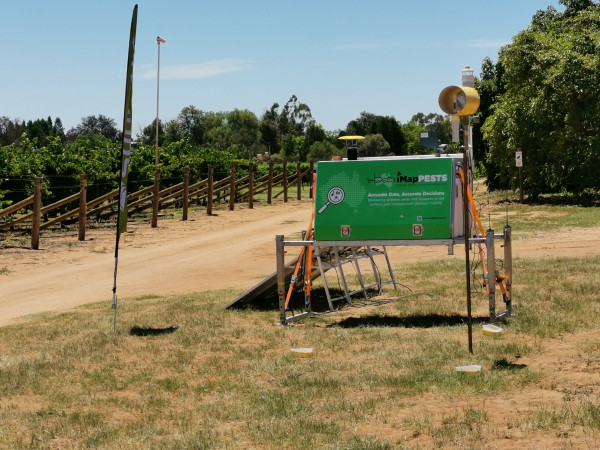
The iMapPESTS sentinels are mobile, easily deployed, automated systems that incorporate a weather monitoring station, onboard telemetry, and suction traps targeting both airborne pests and fungal diseases.
What makes the sentinels different from existing suction traps is an automated carousel, which can change the sample collection pot daily.
The sentinels can be monitored remotely and need fewer man hours to operate than many monitoring systems, only requiring an operator to be present once a week to collect the samples and program a new sampling regime.
The insect samples are sent to a laboratory where they are analysed by an entomologist using traditional, yet labour-intensive, morphological techniques (assessing body parts and patterning under a microscope and comparing them to insect identification keys).
However, in an effort to also streamline the diagnostics step, in addition to traditional morphological analyses Agriculture Victoria is using a DNA metabarcoding process to look for target pests across all plant industries, including citrus.
Once refined, this metabarcoding process is likely to significantly improve the ability of Australian biosecurity monitoring programs to detect exotic pests and diseases.
The trial at SuniTAFE had two main purposes.
First, to test the sampling ability of the sentinels against more traditional monitoring methods (pan traps and passive wind traps).
Second, to survey the local psyllid population and test the ability of the sentinel and Agriculture Victoria’s new high throughput metabarcoding process to detect exotic psyllids.
This element of the trial is of particular interest to the citrus industry as it will assist in monitoring for African and Asian citrus psyllid.
Four locations around the SuniTAFE SMART Farm were selected for the deployment of insect traps.
At each site, a passive wind trap and four ground traps were installed and samples were collected weekly.
At one of these sites, an iMapPESTS sentinel, with a two-metre insect suction trap, was also deployed.
This collected samples six days per week and these samples were sent to Agriculture Victoria for analysis.