Boosting lamb survival

Victorian prime lamb producer Andrew Edgar’s quest to boost lamb survival led him to participate in the MLA-funded Fit to Join project, which mapped out ways to improve reproductive performance.

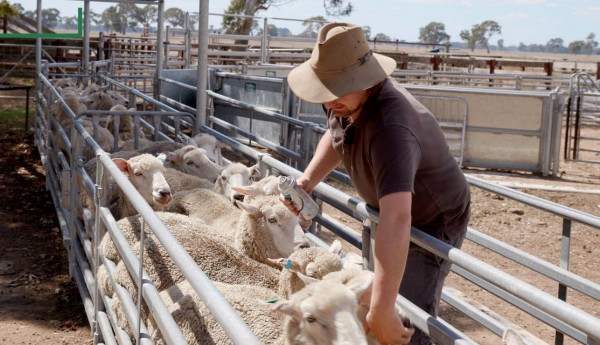
Andrew runs 10,000 composite ewes, with lambing in late June for four weeks. He uses pasture supplemented with straw, silage and grain, and confinement feeding during autumn.

“I start weaning all lambs at 10 weeks of age, regardless of the season, to give the ewes plenty of time to put on condition for next joining,” Andrew says.

“If ewes are not in good condition by joining (excluding ewe lambs, that lamb later) I know there’s something wrong with them and they get culled on body condition.

“Our lamb and ewe survival rates were already pretty good, but we can always do better which is why I was keen to be involved in the ‘Fit to Join’ project.”

Poor udders showed poor results

“What really stood out for me were ewes with poor udders or lumps that were lambed in one mob,” Andrew says. “It was amazing to see the difference in lamb survival rates as a result.

“We marked between 20–30 per cent less lambs out of those ewes with poor udders. These ewes otherwise visually had nothing wrong with them.

“Getting those bad udders out of your flock is important. If they’re just mixed through everything else, you don’t really see the impact, but because they were all in one mob, it was very evident.”

Before this project, Andrew culled based on ‘wet or dry’ at lamb marking and scanning, focusing on retaining a younger flock.

Now, his culling decisions are more strategic after participating in the ‘Fit to Join’ project, and he’s open to retaining older ewes if their condition, teeth, feet and udders are sound.

“In the past I’d wet and dry at marking time,” he says.

“I was taking out the ewes that lambed and lost, but ewes losing one lamb (out of twins) or udder issues developing after marking weren’t being identified.

“But now assessing udders one month post-weaning is my number one culling tool.”

Timing is key

Andrew says it was important to get the timing right when assessing the udders, and wait about four weeks after weaning so the ewe’s udder has time to retract back down.

“When the udder retracts back down you can feel those little lumps and any abnormalities,” he says.

“I think that’s how a lot of them get missed because producers do the assessment at weaning.

“From a producer perspective it’s quite an easy process so just get in there and do it – as the project highlighted, it’s a profitable process to do.

*To learn more go to: mla.com.au/fittojoin 

Digital Editions


  • Ricegrowers backs review

    Ricegrowers backs review

    The Ricegrowers’ Association has welcomed the start of a 12‑week consultation on the Murray–Darling Basin Plan Review. RGA president Peter Herrmann said industry would take…

More News

  • Big crop predicted for almonds

    Big crop predicted for almonds

    The almond harvest is underway and 2026 could produce Australia’s largest almond crop. Nationally it’s estimated that almost 167 thousand tonnes will be harvested this year. That’s a seven per…

  • The calm before the storm

    The calm before the storm

    We appear to be bogged down in a rut, with the commissioning of our new plant. I was super frustrated a couple of months ago – at the spanner throwing,…

  • Backpacking paves the way to leadership

    Backpacking paves the way to leadership

    Purchase this photo from Pic Store: 531373 SUNRAYSIA’s summer harvest attracts travellers on working holidays from all over the world, particularly Europe. These workers perform a vital service for regional…

  • Warm weather set to continue

    Warm weather set to continue

    BARLEY prices are supported as drought speculation builds, with growers holding onto grain for livestock feed. The Bureau of Meteorology January drought statement showed below-average rainfall for much of Victoria…

  • Growers warn of fallout from visa cuts

    Growers warn of fallout from visa cuts

    UNPICKED crops, decimated rural communities and higher supermarket prices are among the consequences that could unfold if One Nation’s anti-immigration policy were to be implemented, farmers and experts have warned.…

  • Grape harvest underway

    Grape harvest underway

    Harvest has begun with our first loads of Chardonnay and Pinot Grigio. Reports of lower yields following the ongoing heat are common, although with the worldwide oversupply of wine, this…

  • Grant strengthens cattle and red meat industry

    Grant strengthens cattle and red meat industry

    Purchase this photo from Pic Store: 528596 Meat and Livestock Australia (MLA) in partnership with industry peak bodies, has secured a grant from the National Foundation for Australia-China Relations to…

  • Safety a priority

    Safety a priority

    EVERY farmer deserves to come home safely at the end of the day. That is the message at the heart of a new statewide campaign urging Victorian farmers to see…

  • Golden opportunity for future

    Golden opportunity for future

    THE Victorian Farmers Federation has called on the State Government to make strategic investments in agriculture, saying smarter policy and targeted funding in seven priority areas could supercharge the industry…

  • New initiative for soil diseases

    New initiative for soil diseases

    THE Grains Research and Development Corporation has recently launched a new initiative aimed at addressing economic strain from soilborne crop diseases. The Soil-Borne Disease Initiative is a five-year program that…