Getting the most out of nitrogen fertiliser

THE burden of choice can rest heavily when making nitrogen fertiliser decisions. How much to apply and when, will it rain, what if it doesn’t and – most importantly – what is the optimal economic rate?

Nitrogen is the single-biggest variable cost and is often the biggest driver of the water-limited yield gap in cereals, especially in favourable seasons. Increasingly, the environmental impact of nitrogen losses is under scrutiny around the world.

In recent decades, many intensive grain production systems have mined soil organic matter, reducing the soil’s ability to supply nitrogen and compromising soil fertility.

Increasing importance

OVER the past 30 years, demand for nitrogen fertiliser has increased four-fold.

Fertiliser purchases are typically about 20 to 25 per cent of the variable costs for Australian grain growers. Even before the recent price spikes, grain growers spent about $1.1 billion on nitrogen fertiliser each year.

Yet the yield potential of many cereal and canola crops remains limited by nitrogen. It is estimated that alleviating this deficiency could increase national wheat yields by 40 per cent and substantially improve farm profit.

Nitrogen deficiency also results in low grain protein content, reducing the value and marketability of grain.

Nitrogen losses – through denitrification, volatilisation and leaching – are more than just a direct cost to growers. Losses can damage waterways and their contribution to greenhouse gas production is a significant cost to the grains industry and the wider community.

The need to include emissions generated during the manufacture and distribution of fertiliser in the farm’s footprint makes it even more important to limit these losses.

Priorities

GRAINS Research and Development Corporation is committed to improving nitrogen use efficiency to help growers increase production and profitability, and reduce greenhouse emission intensity.

One of the biggest challenges faced by the industry is that much of the understanding of soil nitrogen dynamics was developed prior to the shift to continuous cropping and reduced tillage.

In the past, many growers relied on an extended legume pasture phase to restore soil nitrogen supplies and organic carbon. Today, legume crops play a role in boosting nitrogen supplies, but they are by no means ubiquitous in cropping systems around the country and the amounts of nitrogen they add to the system can be variable.

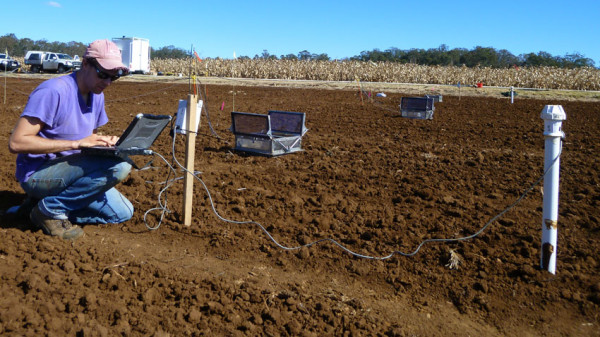
Several GRDC investments aim to update our knowledge of the factors that influence the cycling and availability of both soil and fertiliser nitrogen.

Last year, GRDC made a substantial investment in nationally co-ordinated research to better understand nitrogen losses as a crucial first step to reducing these losses and limiting their impact on the environment.

The knowledge gained through GRDC research is used to update the modelling that underpins nitrogen decision support tools and to better inform efficient use of nitrogen fertilisers.

Crop simulation models and their nitrogen cycling routines are also used to estimate greenhouse gas emissions for the grains industry. These are critical in demonstrating the grains industry’s sustainability credentials to the Australian and international communities.

Evolving grain production systems mean that ongoing research is vital to secure the future of our industry.

More details from Dr Cristina Martinez, 0482 952 781, cristina.martinez@grdc.com.au, and Dr Stephen Loss, 0408 412 453, stephen.loss@grdc.com.au.

Digital Editions


  • Collection under the hammer

    Collection under the hammer

    AN eclectic curation of vintage and antique Australian pastoral machinery and memorabilia will go to auction on 1 February. Yvon Smythe and her late partner,…

More News

  • Calls flow for royal commission

    Calls flow for royal commission

    Purchase this photo from Pic Store: 524159 AUSTRALIA needs a royal commission into water management in 2026, according to Murray MP Helen Dalton, who says politicians are “destroying” the nation’s…

  • Big skies and farmscapes

    Big skies and farmscapes

    Purchase this photo from Pic Store: 524028 THE Gallery Balranald is currently showcasing the work of professional artist Graham Hearn. His latest exhibition, Big Skies and Farmscapes, reflects the vast scale and…

  • Difficult outlook for grape growers

    Difficult outlook for grape growers

    Murray Valley Winegrowers has acknowledged the findings of Wine Australia’s Australian Wine Production, Sales and Inventory Report 2025, which confirms the challenging market conditions facing growers. The newly released report…

  • Benham appointed to new ag role

    Benham appointed to new ag role

    The Nationals member for Mildura, Jade Benham, has been appointed Shadow Assistant Minister for Agriculture and Regional Development, as part of Jess Wilson’s new Shadow Cabinet announcement. Ms Benham said…

  • Connecting urban and rural Australia

    Connecting urban and rural Australia

    HAMISH McIntyre grew up on the land in Queensland, learning the rhythms of farming from his family. Today, he runs a sprawling family business across the St George, Dirranbandi, Quilpie,…

  • Farmers warned to stay alert

    Farmers warned to stay alert

    A RUN of booming haystack and shed fires across regional Victoria has sparked fresh warnings for farmers as hay season rolls into full swing. Fire crews in the west and…

  • Bumper harvest fuels Cobram Estate’s growth

    Bumper harvest fuels Cobram Estate’s growth

    COBRAM Estate Olives has reported one of its strongest years on record, with an exceptional “on-year’’ harvest in Australia driving improved earnings, higher production volumes and a confident outlook from…

  • Select Harvests’ cracking pace

    Select Harvests’ cracking pace

    SELECT Harvests Limited has released its 2025 business update, reporting a final almond crop estimate of 24,700 tonnes, slightly below the midpoint of its earlier forecast. The company says the…

  • Further water buybacks anger farming industry

    Further water buybacks anger farming industry

    FARMERS, politicians and advocacy bodies are warning further water buybacks announced last week will gut regional towns, drive up food prices and cripple Australia’s dairy heartland. Federal Water Minister Murray…

  • Farmer takes action in feral pig fight

    Farmer takes action in feral pig fight

    IN THE heart of south-western New South Wales, sheep and cattle farmer Colin McCrabb is waging a quiet war against a destructive and elusive enemy -feral pigs. Operating a 6800-hectare…