Terryn Milner
PROTECTED cropping – or protected cultivation – is on the rise for table grapes the length and breadth of Sunraysia.
While growing grapes under covers is nothing new for table-grape producers around the world, protected cropping in Australia has evolved significantly since table-grape covers were first used in the early 1990s.
As innovative protected cropping materials and structures are appearing all over the country, the Mildura-based Australian Table Grape Association has been looking at how and why growing grapes with protective methods has changed.
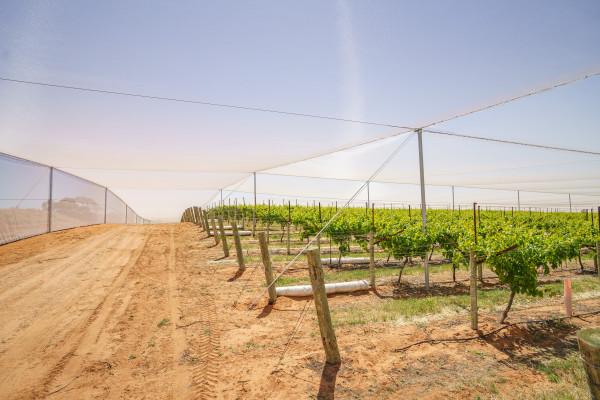
While permanent netting structures require a significant upfront investment in terms of materials and labour, the ongoing savings in labour, reduction of damage and viable undamaged fruit later in the season could be greatly beneficial to producers. Using a combination of netting and covers would also give dual protection.
“The netting provides protection from hail, wind and dust, while the plastic provides cover from rains during flowering and later in the season from sun and late-season rains,” ATGA industry development officer Karen Connolly says.
Under wraps
Over the years, agronomic and production practices and knowledge have evolved in parallel with technologies available for trellising, and agricultural plastic and netting composition.
Now combination covers, permanent covers, temporary covers and netting are all used in a variety of combinations and designs to help producers manage the effects of variable climate conditions and varietal vulnerability, and increase water use efficiency.
They’re also used to advance harvest and perhaps enter the market earlier than competitors, or to extend harvest by keeping viable fruit on the vine longer.
Originally, covers were placed directly on top of vines, which could create a unique microclimate, providing a suitable environment for pest and disease development – something Karen says has changed with knowledge and adoption of new practices, particularly during the past 10 years.
“The industry has seen covers evolve from being placed directly on top of individual rows, to covers spanning multiple rows, such as greenhouse style setups which have openings at either end to allow air flow,” Karen says.
“More recently, we’re seeing a large variety of designs and adaptations of trellising systems which help elevate the covers off the vine’s foliage and allow for greater air flow.
“Elevated covers, while they provided greater air flow, also require stronger, more durable structures to be able to withstand wind, something producers Australia-wide are investing in.
“Lately we’ve seen a boom in experimentation as new materials become available and technology advances, including using high masts that extend further from the trellis in varying sizes and designs, or inverted V-trellis formations, for example.”
Combining strengths, horticultural producers Australia-wide have used netting to protect fruit from hail, wind and predator damage for decades now, a practice which table grape producers are adopting in increasing fashion all over the country. Producers are increasingly using permanent netting structures to help provide extra assurance during the season.
Until recently, the Federal Government provided co-contribution funds for horticultural producers to install netting over established productions, with state governments delivering the programs across the country. The netting program built on the success of a similar program for apple and pear producers and was extended to support all horticultural producers (excluding wine grapes) to develop resilience and respond to Australia’s ever-changing climate.
On or off
Temporary covers and netting are commonly used, with application styles and timing varying, however these remain labour intensive.
Plastic cover designs have evolved in terms of composition and flexibility, which means they can be rolled up tighter and fixed to higher masts, rather than completely removed – potentially saving on labour time and costs.
In Queensland and Western Australia, temporary netting has been a game-changer for managing pests, such as Queensland fruit fly, and birds. In Western Australia, growers like Graeme Roscic are managing their bird concerns by fixing bird netting year-round underneath the vines from post to post which is raised on either side of the vine, when needed, to cover the fruiting zone, and secured to the third foliage wire above the fruit.
“We have so many birds, lorikeets in particular, and five years ago I purchased rolls of bird netting for $500-600 a roll,” he says. “Based on the amount of damage the birds do, it’s well worth investing in bird netting – the return on investment is significant and these rolls will last probably another five years.”
Through the years
While table-grape producers in Europe had been growing grapes under covers since the 1950s, the foundations of protective cropping didn’t really take off in Australia until the early 1990s, when producers in Sunraysia began to install covers.
Overnight, it seems, producers saw the benefit of applying woven or plastic covers over grapevine rows to protect against a range of environmental concerns.
Growers reported the introduction of covers as “revolutionising industry”. Alongside the adoption of using sulphur pads to increase shelf-life, the covers were instrumental in allowing producers to control environmental factors with greater capacity – rather than being controlled by them.
In the past 30 years, as Australian table-grape exports have increased – particularly since 2015-16 during the production boom – producers have had to adapt to changing market requirements and competitive market conditions.
Knowledge, technology and innovation has played a large role in assisting producers to adopt new practices and help build their business’s resilience. While some of the emerging protected cropping systems are complex and elaborate, others are simple, yet innovative solutions adapted from existing systems.
“One thing that’s obvious, we know table-grape producers are inventive, and resourceful,” Karen said. “They’re doing all they can to protect their assets – quite literally!”
First published in the Vine magazine, a joint publication of the Australian Table Grape Association and Dried Fruits Australia.