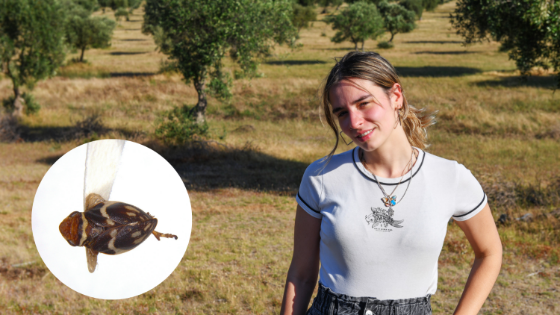
SPANISH scientist Clara Lago, whose fascination with spittlebugs has led her from Madrid to Victoria, has been collaborating with Agriculture Victoria to research how bugs might transmit xylella fastidiosa, an exotic plant bacterium, to our crops.
Xylella is ranked the No.1 biosecurity threat to plants in Australia.
The endemic Australian spittlebug genus anyllis leiala kirkaldy is spread throughout eastern Australia, from north Queensland to Tasmania, while anyllis tiegsi is found only in Victoria and the higher parts of south-east NSW.
“Witnessing the impact of xylella when it crossed Spanish borders, I understand first hand how insidious and devastating the disease can be to agriculture,” Dr Lago said.
“It infects more than 600 different plant species and thrives in climates such as the Mediterranean, hence it’s high-risk for Australia,” she said.
Xylella commonly shows up as leaf scorch similar to drought-affected plants, but many plants carry the disease with no visible signs.
Bacteria grows inside the plant, so finding and controlling it is extremely challenging.
It is rated a high-priority pest of viticulture, almonds, berries, blueberries, cherries, citrus, coffee, macadamias, nursery and garden, olives, pecans, summer fruit and canned fruit.
Xylella is a bacterium that lives in the water-conducting system of plants and grapevines show symptoms of water stress, such as leaf scorch, and the plant progressively weakens and dies.
It can be transmitted in infected propagation material and by leaf hoppers such as grasshoppers.
Xylella is also present in North America, Central America and some regions of South America as well as being found in a restricted range in Italy, Iran and Taiwan, and is under eradication in some other countries in Europe.
The diseases caused by xylella fastidiosa go by a range of names depending on the host species, including: Pierce’s disease, almond leaf scorch, bacterial leaf scorch, citrus variegated chlorosis, olive quick decline and olive leaf scorch.
To learn more about xylella and other exotic pests and diseases, visit agriculture.vic.gov.au/biosecurity