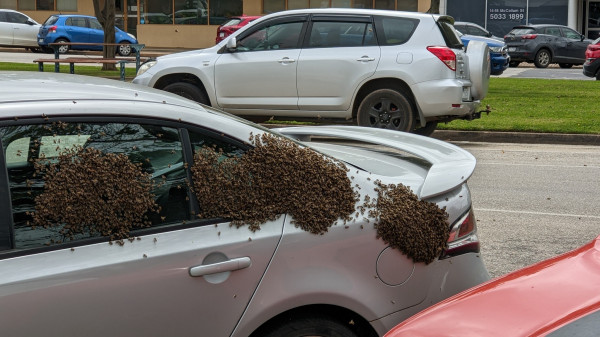
THE closer Alison Bradley walked to her car, the sooner she realised it wasn’t mud on the side of the door – rather, it was a swarm of bees.
The Swan Hill resident had parked her Ford Falcon on McCallum Street to join a friend for lunch at a nearby eatery.
When she returned an hour later, she was shocked to find the swarm on the passenger door before they quickly spread.
“I wasn’t sure for a start if it was mud, but then I realised it was bees, it was just crazy,” she said.
“Someone I knew drove past after I had parked and saw the swarm of bees. Obviously the queen landed on my car and all the bees followed.
“I’ve seen swarms of bees flying around previously and on trees, but not like the quantity on my car.”
Desperate to see the bees relocated, Ms Bradley put an urgent call out on a Swan Hill Buy, Swap, Sell Facebook page for anyone to come and collect them.
“I didn’t want to go near the car and I didn’t know what would happen,” she said.
“I don’t know if it was exciting, but it was an experience.”
A local beekeeper was found online and removed the bees after finding the queen.
“They just all followed the queen into a box,” Ms Bradley said.
“It’s lucky we still have all these bees around … it’s a good sign.”
Beekeeper Jackson Joyce, from Nuplas Apiarist Supplies, had no explanation as to why the queen chose to land on the car.
“It’s starting to get warm so the bees are getting out,” he said.
“They are odd creatures.
“What I believe is they were near a tree and then the car parked there, so they looked at that and decided that’s where they wanted to go.”
Mr Joyce had been called out to collect six swarms in the past week.
“It’s not necessarily that they have moved away from water, it’s just this time of the year when the queen is looking for a new place to go, swarms are growing and looking for a new home.”
Jackson said farmers were in the process of moving hives off floodplains on Pental Island.
“They are clearing all their bees out before the site gets flooded and the hives are lost,” he said.
“The hives don’t enjoy water, especially the timber hives because they rot.
“When the bees are surrounded by water, they can’t get to plants and flowers even if the hives get flooded.”