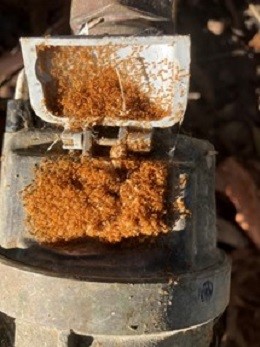
EXOTIC-looking tiny red ants found living inside a northern Victorian man’s water meter could’ve been big trouble for Agriculture Victoria’s biosecurity officers.
Luckily, the man’s quick-thinking to contact Agriculture Victoria enabled them to rule out a potential incursion of electric ants (Wasmannia auropunctata).
When the Echuca resident found the unusual ants, he contacted Agriculture Victoria straight away to make a report, which included providing a series of close-up photos.
Agriculture Victoria leading biosecurity officer Emily Hill said the photos were a great help.
“However, our entomologists weren’t able to categorically determine whether they were a highly invasive exotic species or not,” she said.
As a result, biosecurity officers were soon on the scene and the ants were sampled for further formal identification at the Centre for AgriBioscience Bundoora.
“Thankfully, in this instance, the ants sampled were found to be a native species that were morphologically similar to electric ants,” she said.
“Electric ants are highly aggressive and can rapidly spread through a variety of landscapes, displacing native species and causing injury to livestock, wildlife, pets and people with painful bites.”
Ms Hill said the exotic ant species — which are present in Queensland and under an eradication program there — could come into Victoria in a variety of ways and quickly spread through human activity with the movement of plants, plant products, garden waste or machinery.
Once established, they are known to spread up to 170 metres per year, with a more typical rate range of zero to 25 metres per year, depending on the environment.
There are multiple exotic ant species of concern that are not known to occur in Victoria.
Agriculture Victoria is working to ensure that Victoria remains free of the highly invasive pest species, to protect the environment, agricultural production and social amenity.
More information about Priority Pest Insects and Mites in Victoria can be found online via the Agriculture Victoria website, or the Plant Health Australia website.
Reports of exotic species can be made plant.protection@agriculture.vic.gov.au or by calling 136 186.