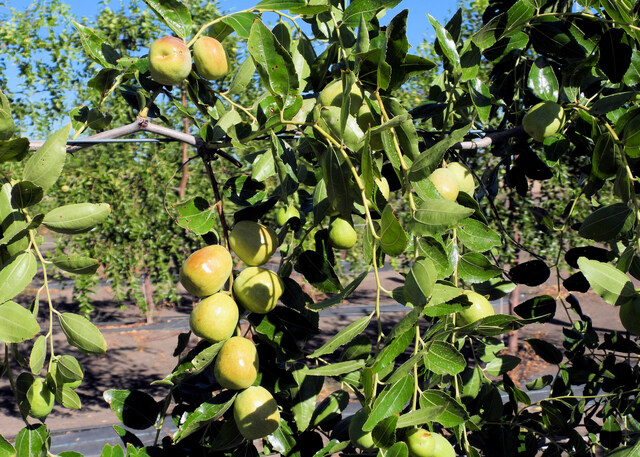
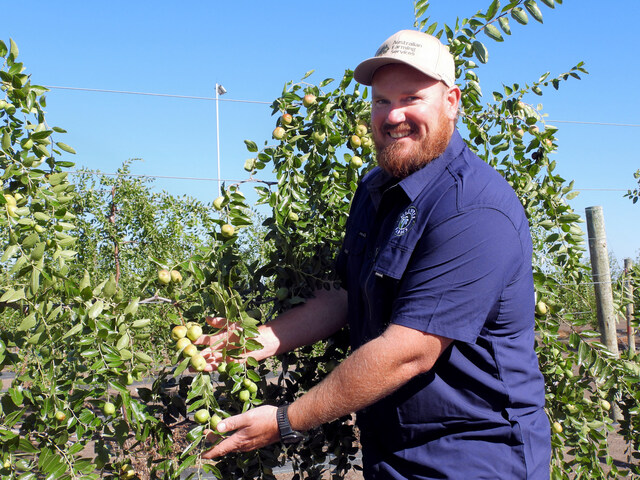
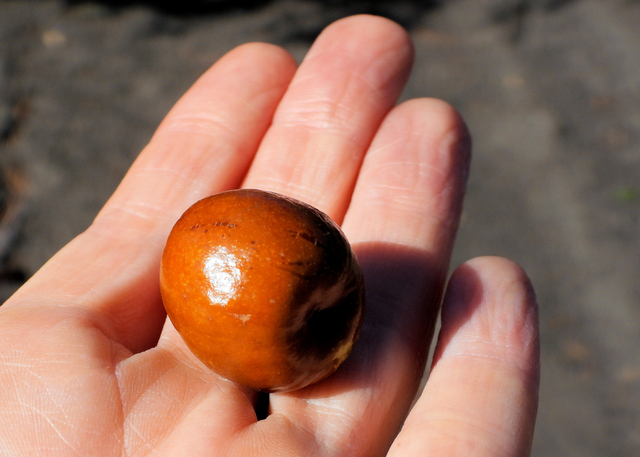
THEY look like tiny apples, taste like a crisp pear and carry more vitamin C than an orange.
And in the red dirt of Koraleigh, they are quietly reshaping one family’s farming future.
Under the banner of Maxwell Farms, Robert and Brenda Maxwell, alongside their sons Riley and Cooper, are carving out a niche in one of Australia’s least understood crops: jujubes.
The Maxwells planted 3300 jujube trees – two mains varieties of Chico and Li – in what he describes as a calculated gamble.
“It was one of those things where the price was good. There was sort of no one else doing them,” Mr Maxwell said.
“I’ve got a mate in Robinvale that’s put some in as well and he sort of told me, jump on these while the going’s good. No one’s growing them around here, so we’ll give them a guess.”
Originally, the plan was far bigger.
“We were going to plant 10,000. We pulled the pin on them because at a standstill at the moment there’s a bit of an oversupply.”
The jujubes were never meant to be the end game. They were intended to bankroll another long-term investment.
“The plan was to get those jujubes in the ground and help fund us setting up a pecan farm,” he said.
“So we’ve got pecans in as well. The jujubes, we sort of looked at them as a bit of a cash crop, because in the first year you get a crop back off them.”
That early return was appealing, but the hidden cost was labour.
“It’s just the labour intensive stuff that we didn’t really budget for and work out. But yeah, just trying to grow them and get some cash flow coming back in to help set up our pecans.”
Mr Maxwell had no prior experience with jujubes. He has worked in horticulture for years, growing other nut trees, but this was new territory.
“You’re planting a tree that no one knows anything about. There’s no exact fertiliser program. There’s no spraying program for them. That’s all new.
“You’re flying off the seat of your pants trying to work out, this has popped up, we need to spray this.
“What sort of fertiliser requirements they need. Same with water. We’re still learning.”
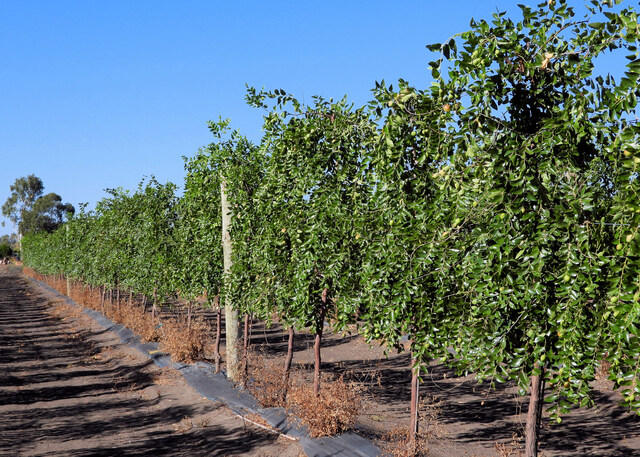
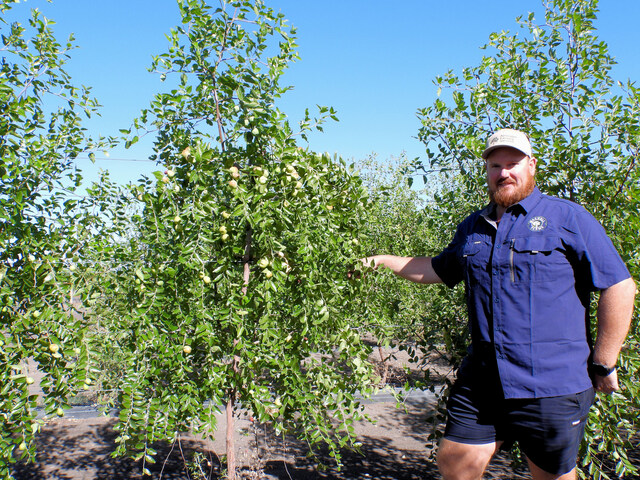
The trees are planted under a super high-density system, kept under two metres tall to reduce labour costs and make picking easier. All fruit is hand-picked.
“They’re similar to an apple. If you drop it or bump it, you’ll dent it. You can’t actually tell from the outside until they sit there and they’ll get little dents all over them.”
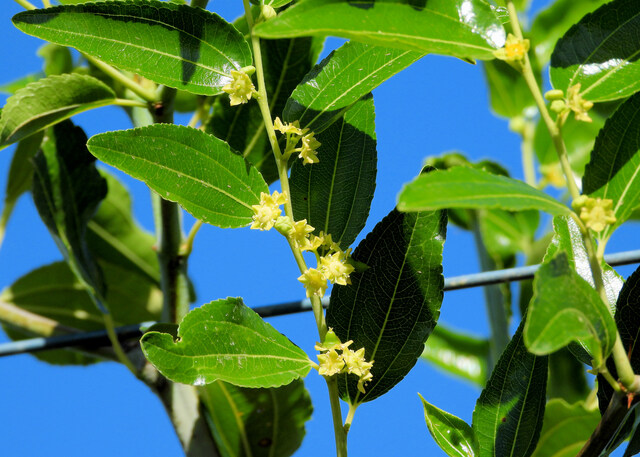
The trees come out of dormancy in late September or early October. Flowering begins in November and continues through to March.
“They just continuously flower and continuously put fruit on,” Mr Maxwell said.
Young trees, now two and three years old, have struggled to reach their potential.
Mr Maxwell hopes to eventually harvest 10 to 12 tonnes from the current planting, but extreme heat has taken its toll.
“I think the extreme heatwave that we had knocked a fair bit of fruit off,” he said.
Fruit fly has also been a serious challenge.
“Fruit fly absolutely love them, because there’s nothing else really ripening at that time around March, April. So we’re sort of the last thing to ripen,” Mr Maxwell said.
“2023 and 2024 were pretty bad. All the early stuff that ripened up, we basically picked it onto the ground.”
Irrigation is carefully managed using moisture probes to maintain what Mr Maxwell calls a “happy medium”.
“They’re a high root sucker tree. You could go through over five times a year knocking off root suckers.”
In the Mallee summer, the trees cope well, though Mr Maxwell said their youth means they are still finding their balance between early and late fruit set.
Beyond production, marketing has proven just as complex.
The fruit is largely Asian dominant. When eaten fresh it is called a jujube. When dried, it becomes a Chinese red date, widely used in soups and teas.
“A lot of the Asian countries have been eating it for quite a number of years and they know all about it and they love them,” Mr Maxwell said.
“I think once the Aussies work out their health benefits and how good they are, because the research I’ve done, they’re actually a superfood, once people get onto them, I think they’ll take off.”
Jujube fruit is low in calories but rich in fiber, vitamins, and minerals, with more vitamin C than an orange per weight.
Market timing is everything. Early in the season, prices can sit around $12 a kilogram, dropping to $6 by the end.
Queensland fruit enters the market earlier and can fetch $20 to $30 a kilogram due to strong demand.
“There’s huge demand for them at the start. Then all of a sudden they’re all flooding in and the price comes down,” Mr Maxwell said.
Mr Maxwell moves fruit through Melbourne market with the help of an agent contact, but also sells locally and directly from the farm.
“We advertise on Facebook, just letting everyone know in the area that we’ve got jujubes. We do a couple of local markets. We normally have a little thing printed out so people can see the health benefits and what they are, because no one knows what they are,” Mr Maxwell said.
As numbers increase and the crop ripens, most fruit heads to Melbourne due to limited local demand.
Grading remains another work in progress. Mr Maxwell sorts fruit into four sizes, from small to extra large, but says there is no established standard.
Despite a surge in plantings around Mildura, with some growers expanding from 3000 or 4000 trees to 10,000 as prices rose, there is little formal support.
In his own district, he knows of only one other grower with similar numbers.
For the Maxwells, one of the most rewarding parts has been the reaction from customers.
“When you can go to someone and say, I’m growing jujubes, and they’re just like, what’s that? And then you can go on a tangent and tell them what they are, what they do and how they grow,” Mr Maxwell said.
He prefers eating them fresh, though one small planting of the honey jar variety stands out.
“It’s the sweetest variety, but it’s also the smallest. When you dry them, they’re unbelievably sweet,” Mr Maxwell said.
Sweet and crunchy when fresh, the honey jar has a classic jujube flavour and crispness with a blue gum honey flavour.
This smaller, round jujube fruit is said to develop a unique caramel apple flavour as it dries. The variety is a heavy producer and harvest can be extended with multiple pickings.
With expansion space almost exhausted as pecans fill the remaining blocks, the next move may depend on future land purchases and market signals.
“If the opportunity arises once we buy our next farm, there’s potential there that it could go all jujubes or it could go all pecans,” Mr Maxwell said.
For now, Mr Maxwell juggles the family venture while managing a 1600 hectare almond farm, keeping the Maxwell Farms Facebook page ticking over when time allows.
“It doesn’t get updated as much as I’d like. But when you’re managing a 1600 hectare almond farm as well as trying to grow jujubes on the side, you get pretty busy,” he said.
In a district known for citrus, almonds and grapes, the small, glossy fruit hanging beneath two metre trees stands out as something different.
Whether jujubes remain a niche curiosity or become the Mallee’s next breakout crop, Maxwell Farms has already staked its claim on unfamiliar ground.