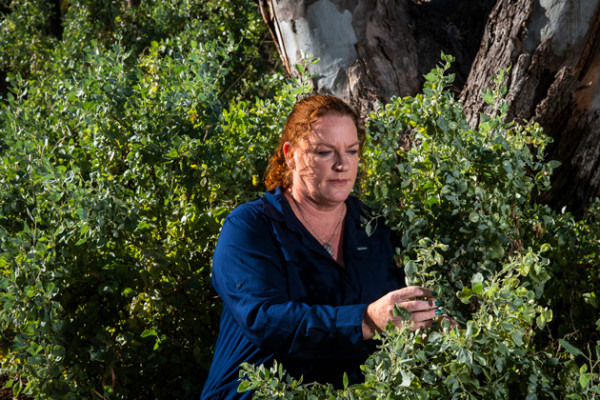
FILLING the late-summer and early-autumn feed gap is a constant challenge for woolgrowers in dryland farming regions such as the Mallee, north-west Victoria and south-west NSW’s wheat-sheep zones, particularly during dry years.
That is why many woolgrowers are turning to drought-tolerant native shrubs, such as saltbush, to provide an alternative source of nutrition for their livestock during the feed gap.
Anameka saltbush is a variety of old man saltbush, developed by CSIRO and offering higher nutritional value and palatability, compared to other saltbushes.
It allows growers to utilise infertile land and areas impacted by dryland salinity. CSIRO is also trialling elite lines of rhagodia, a closely related shrub.
Previous research has shown that sheep offered Anameka saltbush or rhagodia, while grazing cereal residues, maintained weight and had 20 per cent greater wool growth than sheep offered cereals alone.
In respiration chambers, inclusion of rhagodia led to 26 per cent less methane produced by the sheep.
AWI project manager Emmah Goldsmith said the ultimate aim was to improve whole-farm stocking rates and help manage seasonal risk, especially as climate variability increases.
“A key result of the research is that a new generation of perennial shrubs has been identified that have the capacity to double existing biomass growth rates and could have the potential for direct seeding,” Ms Goldsmith said.
“Information has been created and already rolled out to producers regarding shrub grazing management, and the use of fertilisers and adapted annual legumes to optimise shrub system productivity.
“Adoption of these superior shrub systems will lead to additional benefits such as reduced dryland salinity, enhanced ecosystem function, higher animal welfare and improved eco credentials for wool-growing.”
During the project run by CSIRO, a series of four on-farm paddock-scale field experiments were used to obtain grazing data and compare shrub genotypes.
CSIRO agricultural scientist Hayley Norman said they identified elite old man saltbush seed lines with similar nutritional value to Anameka that reliably produce at least 50 per cent more biomass but are less palatable. These are almost ready for commercialisation.
“Through CSIRO’s Drought Mission, we are finalising comparisons of seed ecological traits with a view to developing direct seeding for some situations,” Dr Norman said.
“We have also identified adapted rhagodia lines which are incredibly productive on deep, infertile sandy soils and have high digestibility and crude protein, although there are still some issues with palatability requiring further consideration.
“These drought-tolerant native shrubs, grown on soils that are marginal for crop production, provide nutrients to complement crop and pasture residues during summer/autumn and reduce supplementary feed inputs.”
Another project aim was to investigate opportunities to halve establishment costs through seed lines which can be planted in nurseries or possibly direct seeded in paddocks.