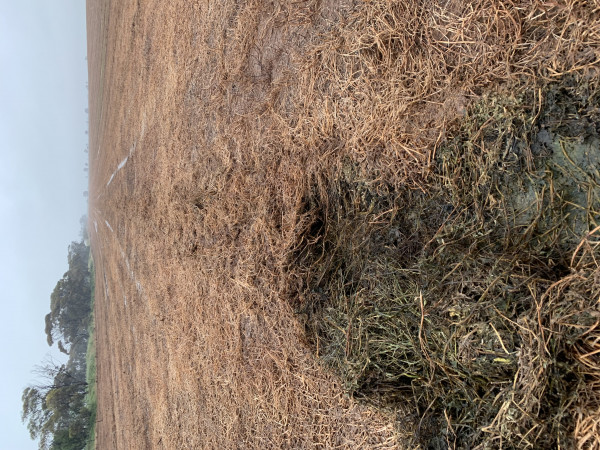
THE region’s high hopes of a record hay season have diminished, with farmers unable to catch a break in the weather to bale crops.
The forecast of a wet spring has become a reality throughout the Mallee with the Swan Hill aerodrome recording more than 90mm last month, making it the wettest start to spring since 2016, when 89mm was recorded.
Farmers and contractors are on edge as the continuous wet weather starts to impact crops.
Lake Boga hay contractor Adam Taylor said this spring was one of the wettest and coolest he could recall.
“The current state of play is it’s obviously very wet at present,” Mr Taylor said.
“We can’t really do anything until we can get a dry period.”
While the contractor has baled a small amount of silage in “trying conditions”, Mr Taylor said a lot of farmers had cut their crops and silage but had been unable to progress any further due to the wet weather.
“We have another lot of silage cut that’s probably had three lots of rain on it now,” Mr Taylor said, noting any reprieve from the rain had been short lived.
“There’s been a lot of very good crops of dry land vetch cut and a bit of oats as well,” Mr Taylor said.
“These crops could handle a bit of rain on them, especially straight after being cut, but l think this last rain event over three or four days could do a lot of damage, due to being wet for a long period of time.”
With little reprieve in sight, Mr Taylor said farmers and contractors were waiting for a dry period to salvage what they could.
“The clover and rye-infused crops left standing are at the stage where they really need cutting as it’s starting to go yellow and rotten underneath with such heavy canopies where the substrate is sopping wet,” Mr Taylor said.
“With the outlook pointing towards rain fronts coming through nearly every week, it just feels like it’s going to keep coming.”
The ongoing wet weather is expected to severely impact what was shaping up to be a perfect hay season and has some farmers on edge as harvest fast approaches.
“Crops that are adjacent to creeks and rivers are starting to be in a nervous predicament with all catchments full and starting to run over,” Mr Taylor said.
“The grain harvest is still looking potentially unbelievable and the Mallee can handle more rain than most, but l think most farmers would be happy if it stopped now.
“Farmers are just playing the waiting game now, making decisions as it dries out. If things dry out, it will be fine. If it continues raining, things will become very difficult.”