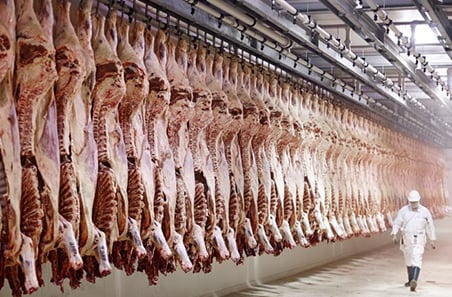
Cattle slaughter rates continue to rise

In late March, MLA’s market information team forecast cattle slaughter rates in April would decline sharply (with April 2023 the shortest working month since 2017).

The team also predicted slaughter rates would rebound strongly in May.

The May performance data month-on-month and year-on-year indicates these expectations for a strong improvement in kill numbers were realised.

May versus April 2023: Weekly average kill numbers for May rose by 20 per cent or 17,500 head compared to April. Kill numbers for May were higher by 20 per cent or 70,000 head month-on-month compared to April.

May 2023 vs May 2022: Weekly average kill numbers for May 2023 were higher by 30 per cent or 24,000 head year-on-year. Total kill numbers for May 2023 were higher by 30 per cent or 97,000 head year-on-year.

Evidently, significant increases in throughput occurred during May as processors shook off shortened working weeks and lifted numbers.

Larger numbers of finished stock provided processors with ample choice, although the improvements in May kill numbers were also directly tied to the lack of rain across many parts of the eastern seaboard at the time.

In year-to-date terms, 2023 volumes are the highest they’ve been since 2020, with this year’s figures 26 per cent or 467,000 head higher than 2022 totals.

Compared to 2021 when Australia processed 6 million head of cattle, year-to-date slaughter rates are higher by 11 per cent or 231,000 head.

Importantly, as the calf drops from 2021 and early 2022 reach finished weights, the increasing supply of slaughter-weight stock has been met with continually improving processor capacity.

Evidence of this has been seen in recent weeks, with weekly slaughter numbers reaching their highest levels in more than three years.

Based on 2023 performance so far, MLA recently released its cattle industry projections, which forecast an 18 per cent or 1.1 million head increase in slaughter numbers year-on-year.

Current weekly performance suggests these volumes are attainable.

Despite the outlook for higher slaughter, 2023 figures (if realised) would remain 9 per cent or 689,000 head below the 10-year average.

If processors continue to operate at or around current kill rates and labour issues ease with improved access to international migrants, MLA’s market information team forecasts high volumes of slaughter-weight animals will come to market as the year progresses.
Digital Editions


More News

  • Wine producers call for intervention

    Wine producers call for intervention

    AUSTRALIA’S winegrape producers’ association has warned that the sector is entering a structural crisis as global demand continues to spiral. In their pre-budget submission for 2026-27, Australian Grape and Wine…

  • Vineyard vintage outlook wine-derful

    Vineyard vintage outlook wine-derful

    THIS year’s vintage is shaping up well across the Murray Darling. Duxton Vineyards, operating more than 2400 hectares as well as a large-scale winery, are reportedly on track for a…

  • Honey on tap un-bee-lievably good

    Honey on tap un-bee-lievably good

    Purchase this photo from Pic Store: 532909 WHAT’S better than beer on tap? Honey, especially if it’s made and produced by Megan and Lachie Mannes, from the Mannes Desert Honey…

  • China driving Aussie almond demand

    China driving Aussie almond demand

    DEMAND for Australian almonds remains strong despite easing from last season’s record highs, according to the Almond Board of Australia. The industry’s October sales position report, released in December, shows…

  • Tractor tragedy sparks concern

    Tractor tragedy sparks concern

    A FARMER has become the first workplace fatality for 2026 after being entangled in a tractor wheel, prompting renewed calls for farmers to stay vigilant around machinery. The death comes…

  • Collection under the hammer

    Collection under the hammer

    AN eclectic curation of vintage and antique Australian pastoral machinery and memorabilia will go to auction on 1 February. Yvon Smythe and her late partner, Neil O’Callaghan, began the Manangatang…

  • Mallee groundcover levels hit new low

    Mallee groundcover levels hit new low

    GROWERS in the Northern Mallee are facing some of the worst seasonal conditions on record, experts have warned, with many paddocks left “bare and vulnerable” due to “extremely poor” growing…

  • Old iron, new spark to fire up

    Old iron, new spark to fire up

    HISTORY will be rolling, rattling and roaring into action on the Australia Day long weekend when Quambatook’s paddocks turn back the clock and put vintage muscle back to work. The…

  • Crisis under the microscope

    Crisis under the microscope

    A MAJOR new research push has been launched to investigate labour and skills shortages gripping key farming regions, with the Murray–Darling and Swan Hill firmly in the spotlight. AgriFutures Australia,…

  • Calls flow for royal commission

    Calls flow for royal commission

    Purchase this photo from Pic Store: 524159 AUSTRALIA needs a royal commission into water management in 2026, according to Murray MP Helen Dalton, who says politicians are “destroying” the nation’s…