Andrew Mole
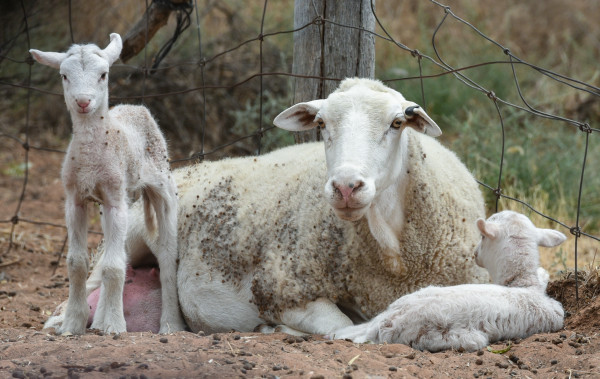
There are currently no evidence-based guidelines available for supplementary feeding ewes during lambing, with only anecdotal evidence suggesting self-feeders or trail feeding is better for lamb survival.
Which in northwest Victoria is where the Northern Mallee Producer Demonstration Site and Agriculture Victoria livestock extension officer Erica Schelfhorst come in. Helping northwest producers achieve better lambing percentages to achieve better bottom lines.
Ms Schelfhorst said the group came together earlier this year at a workshop on ewe requirements, and assessing feed on offer for pregnancy management at Nowingi, about 50km south of Mildura.
But added her local group’s project is still in the first of its three years, with the participating farms having agreed their goal is to boost their numbers of lambs weaned by 5-10 per cent.
Now that work, limited to regional producer demonstration sites with varying projects, will be underwritten by a new national partnership between MLA, Australian Wool Innovation, Murdoch University and Charles Sturt University. It aims to address these challenges through the optimal supplementary feeding strategies for lamb survival project.
The project will develop recommendations for producers so they can make more informed decisions about supplementary feeding ewes during lambing.
Murdoch University project lead, Dr Amy Lockwood, said producers have several questions about the best methods of supplementary feeding ewes during lambing for lamb survival, including: What time of day they should feed ewes; The proximity of feeding to watering points and shelter; If they should use trail feeding or self-feeders; If they should use alternative methods such as broadcasting lupins.
Dr Lockwood said the project will provide producers with information at the farm level to help improve productivity and increase lamb survival.
What the project involves
The first stage of the project is assessing whether self-feeders or trail feeding leads to better lamb survival at 24 hours on-farm research sites across southern Australia.
Sensor technology is also being used at a subset of these research sites to investigate the impact of the supplementary feeding method on the behaviour of ewes during lambing.
Intensive experimental work in the second stage of the project will be informed by the outcomes of the first stage of the project, but could include evaluating the impacts of the proximity of feeders to watering points or shelter and the time of feeding on lamb survival and ewe behaviour.
AWI reproduction and nutrition project manager, Emmah Goldsmith, said the outcome of the project are important to all sheep producers, whether they have a wool or meat focus.
“The effect of supplementary feeding method on lamb survival has been a long-standing knowledge gap, and growers have been calling for evidence-based answers,” Ms Goldsmith said.
“The guidelines produced from this project will be a valuable addition to producers’ toolkits, especially as climate variability increases.”
Get involved
Ms Goldsmith said the project is looking for more research sites. She encourages producers who want to be involved and have supplementary feeding as part of their planned management for lambing to contact the research team.
The project is targeting producers who lamb in autumn, however, producers who lamb in winter or spring will also be engaged as research sites when ewes require supplementary feeding during lambing due to limited pasture availability, such as in dry seasons.
A minimum of 300 single-bearing and 160 twin-bearing ewes are required per farm (no maidens) to participate.
Ewes will be allocated to be fed via self-feeders or trail feeding during lambing and the impact on lamb survival will be assessed to marking.
If you are interested in participating in this research, please contact the project leader for your state:
Victoria
Steve Cotton, s.cotton@dynamicag.com.au 0447 352 321
New South Wales
Susan Robertson, surobertson@csu.edu.au 02 6933 4199