JEFF Long’s $2.5 million investment in a processing facility is about to start paying dividends at his Tragowel emu property.
The delayed completion of the facility has had a knock-on effect on this year’s production schedule, which is expected to run into next week.
Mr Long is processing 4000 birds – 3000-plus are his and the rest are being contract butchered.
He says throughput is about 100 birds a day, with each carcase producing meat, fat, feathers and eggs. Eggs are not produced in the abattoir – that is part of the farm production.
“We are a bit late, but we were able to get the licensed processing facility, enabling us to become a vertically integrated business, from paddock to plate, up and running late last year in just three months,” Mr Long says.
“Through a carefully managed breeding program and our use of sustainable farming practices, the addition of the abattoir also complements the overall size of our business.
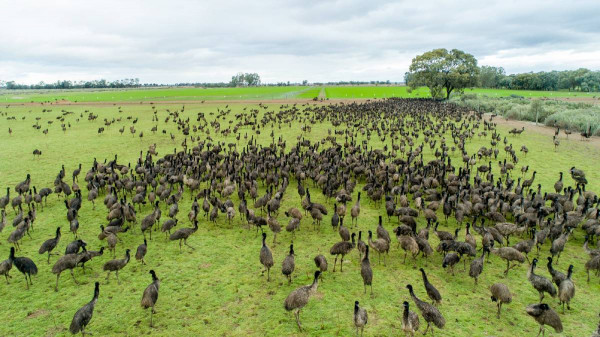
“With 8000 birds on Longview Emu Farm, we are home to about two-thirds of the total number of emu farm birds in Australia at this point in time.
“When the processing facility is going flat out, we have about 30 staff on hand, but at the moment there are 17 workers, who have come from Vanuatu for the jobs, plus a few locals.
“We couldn’t get enough Australians to come here for a seasonal program. But the guys from Vanuatu – and none of them had any butchering skills so we had to teach them the lot – they are all genuinely interested in being here for the next and future seasons, which is great for them and us.”
Mr Long says the commitment to sustainable manufacturing at Longview and the processing plant – trading as The Emu Farmers Company – includes solar installations, which cover the operation’s energy consumption.
He says they also use compostable plastic alternatives wherever possible “and aim to honour the whole emu by ensuring nothing is wasted”.
But the most surprising outcome of the facility is its primary end-products of meat and fat.
“Birds are processed at two-and-a-half years of age and from one of those we would expect to get 11kg of meat and 13kg of fat,” Mr Long says.
“The meat goes to distributors – we have them in Sydney, Brisbane, WA and Adelaide. We also have a cool store in Melbourne, where we don’t have a distributor yet, but demand there is strong and we do a brisk parade.”
And brisk is putting it mildly – among his customers there are Attica, the dual Michelin sensation mostly ranked Victoria’s No.1 restaurant, and Mabu Mabu, the likeliest contender for top spot.
However, it’s the bulk oil Mr Long is after. That is where the demand, and the more lucrative returns are found – which might account for it being a bigger end product.
“Emu oil contains a vast amount of Omega-3,6,7 and 9, vitamins A, D, E, F and K2, promoting and supporting a healthy lifestyle, anti-inflammatory effects, and alleviating joint and muscle pain and skin concerns,” Mr Long says.
“Our pure emu oil is food and cosmetic grade, with all batches tested for safety and are PrimeSafe licensed, NATA-approved testing.
“They are used for therapeutics, cosmetics, moisturisers, shampoos, conditioners, and hair and skin treatment, with a three-year shelf life from the date of production.”
Mr Long says the farm has been selectively breeding calm birds for more than 30 years to produce the highest-quality product.
As a result, he says the emu meat is consistently tender and offers wholesalers and consumers a healthier red meat alternative that is high in protein and low in fat and cholesterol.
“Other by-products include emu eggs, which are all blown by hand with one hole in the bottom end and they are perfect for carving, decorating, or painting.
“Our Australian emu feathers are 100 per cent natural and untreated and they come in mixed lengths and a variety of colours, making them perfect for artisanal products, clothing, nesting material for aviaries, and more.”
 dXQBCyFTKjzKCtIscbXv