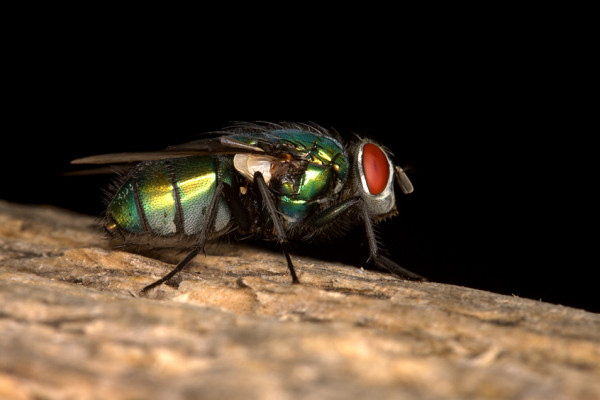
Managing flystrike in sheep

RECENT rainfall and warm temperatures have brought with them an increased risk of flystrike from the dreaded blowfly Lucilia cuprina.

Flystrike is the most important of all sheep ectoparasite diseases and is one of the most significant animal health considerations affecting the Australian sheep and wool industries.

Affected animals can experience an elevated temperature, rapid breathing and weight loss due to reduced appetite, and may eventually succumb to blood poisoning and die if left untreated.

Managing flystrike requires an integrated approach using a range of methods to greatly reduce the risk.

What are the ideal environmental conditions for flystrike?

• The presence of primary species (most commonly the Australian sheep blowfly)

• Ideal air temperatures between 17 and 38 degrees

• Recent rain – enough to keep suitable sites on the sheep moist for about three days

• There must be susceptible sheep with suitable sites (wrinkles, urine, faeces), which attract flies and sustain larvae

• Wind speeds below 9 km/h, giving flies the best opportunity to disperse


Treatment and management

OPTIMUM fly control greatly depends on farm management practices.

While producers can’t do much to control the weather conditions that flies thrive in, there are both treatment and management options available, and these are best used in an integrated approach.

The sheep industry is fortunate to have access to a range of insecticides for prevention and treatment of flystrike, with several methods of application, offering varying levels of protection.

When deciding on which treatment to use, consider how long you want coverage to last, the timing and method of the application, and of course any withholding period (WHP) or export slaughter interval (ESI) on products.

This is particularly important for terminal lambs or cull ewes.

It is important to rotate chemical groups within a flystrike season if more than one chemical application is required.

Integrating both early and late season treatments, alongside shearing and crutching in spring, early summer and autumn will further reduce susceptibility to flystrike and contribute to reducing fly numbers by limiting ideal sites for the adult blowfly to lay her eggs.

This in turn reduces the number of flies that can contribute to the fly population, which is in turn, a great preventative measure for the following season.

Monitoring for fly activity later in the season is still essential. Flocks may require additional treatment or management as flies can emerge from the soil with a sudden change to preferable weather conditions.

There are also long-term management strategies available which include shearing, crutching, strategic lambing dates, breach modification, breeding selection, as well as dag management to reduce risk.
Digital Editions


  • Collection under the hammer

    Collection under the hammer

    AN eclectic curation of vintage and antique Australian pastoral machinery and memorabilia will go to auction on 1 February. Yvon Smythe and her late partner,…

More News

  • Calls flow for royal commission

    Calls flow for royal commission

    Purchase this photo from Pic Store: 524159 AUSTRALIA needs a royal commission into water management in 2026, according to Murray MP Helen Dalton, who says politicians are “destroying” the nation’s…

  • Big skies and farmscapes

    Big skies and farmscapes

    Purchase this photo from Pic Store: 524028 THE Gallery Balranald is currently showcasing the work of professional artist Graham Hearn. His latest exhibition, Big Skies and Farmscapes, reflects the vast scale and…

  • Difficult outlook for grape growers

    Difficult outlook for grape growers

    Murray Valley Winegrowers has acknowledged the findings of Wine Australia’s Australian Wine Production, Sales and Inventory Report 2025, which confirms the challenging market conditions facing growers. The newly released report…

  • Benham appointed to new ag role

    Benham appointed to new ag role

    The Nationals member for Mildura, Jade Benham, has been appointed Shadow Assistant Minister for Agriculture and Regional Development, as part of Jess Wilson’s new Shadow Cabinet announcement. Ms Benham said…

  • Connecting urban and rural Australia

    Connecting urban and rural Australia

    HAMISH McIntyre grew up on the land in Queensland, learning the rhythms of farming from his family. Today, he runs a sprawling family business across the St George, Dirranbandi, Quilpie,…

  • Farmers warned to stay alert

    Farmers warned to stay alert

    A RUN of booming haystack and shed fires across regional Victoria has sparked fresh warnings for farmers as hay season rolls into full swing. Fire crews in the west and…

  • Bumper harvest fuels Cobram Estate’s growth

    Bumper harvest fuels Cobram Estate’s growth

    COBRAM Estate Olives has reported one of its strongest years on record, with an exceptional “on-year’’ harvest in Australia driving improved earnings, higher production volumes and a confident outlook from…

  • Select Harvests’ cracking pace

    Select Harvests’ cracking pace

    SELECT Harvests Limited has released its 2025 business update, reporting a final almond crop estimate of 24,700 tonnes, slightly below the midpoint of its earlier forecast. The company says the…

  • Further water buybacks anger farming industry

    Further water buybacks anger farming industry

    FARMERS, politicians and advocacy bodies are warning further water buybacks announced last week will gut regional towns, drive up food prices and cripple Australia’s dairy heartland. Federal Water Minister Murray…

  • Farmer takes action in feral pig fight

    Farmer takes action in feral pig fight

    IN THE heart of south-western New South Wales, sheep and cattle farmer Colin McCrabb is waging a quiet war against a destructive and elusive enemy -feral pigs. Operating a 6800-hectare…