Boosting lamb survival

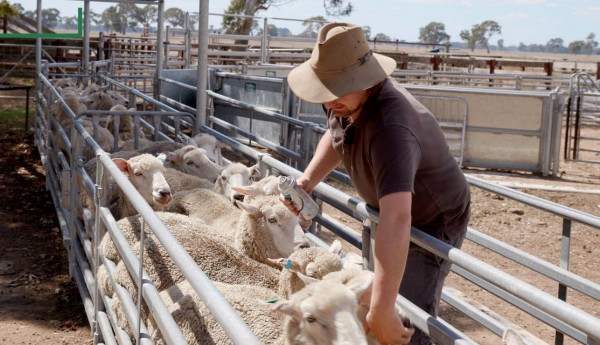
Victorian prime lamb producer Andrew Edgar’s quest to boost lamb survival led him to participate in the MLA-funded Fit to Join project, which mapped out ways to improve reproductive performance.

Andrew runs 10,000 composite ewes, with lambing in late June for four weeks. He uses pasture supplemented with straw, silage and grain, and confinement feeding during autumn.

“I start weaning all lambs at 10 weeks of age, regardless of the season, to give the ewes plenty of time to put on condition for next joining,” Andrew says.

“If ewes are not in good condition by joining (excluding ewe lambs, that lamb later) I know there’s something wrong with them and they get culled on body condition.

“Our lamb and ewe survival rates were already pretty good, but we can always do better which is why I was keen to be involved in the ‘Fit to Join’ project.”

Poor udders showed poor results

“What really stood out for me were ewes with poor udders or lumps that were lambed in one mob,” Andrew says. “It was amazing to see the difference in lamb survival rates as a result.

“We marked between 20–30 per cent less lambs out of those ewes with poor udders. These ewes otherwise visually had nothing wrong with them.

“Getting those bad udders out of your flock is important. If they’re just mixed through everything else, you don’t really see the impact, but because they were all in one mob, it was very evident.”

Before this project, Andrew culled based on ‘wet or dry’ at lamb marking and scanning, focusing on retaining a younger flock.

Now, his culling decisions are more strategic after participating in the ‘Fit to Join’ project, and he’s open to retaining older ewes if their condition, teeth, feet and udders are sound.

“In the past I’d wet and dry at marking time,” he says.

“I was taking out the ewes that lambed and lost, but ewes losing one lamb (out of twins) or udder issues developing after marking weren’t being identified.

“But now assessing udders one month post-weaning is my number one culling tool.”

Timing is key

Andrew says it was important to get the timing right when assessing the udders, and wait about four weeks after weaning so the ewe’s udder has time to retract back down.

“When the udder retracts back down you can feel those little lumps and any abnormalities,” he says.

“I think that’s how a lot of them get missed because producers do the assessment at weaning.

“From a producer perspective it’s quite an easy process so just get in there and do it – as the project highlighted, it’s a profitable process to do.

*To learn more go to: mla.com.au/fittojoin 
Digital Editions


  • Collection under the hammer

    Collection under the hammer

    AN eclectic curation of vintage and antique Australian pastoral machinery and memorabilia will go to auction on 1 February. Yvon Smythe and her late partner,…

More News

  • Calls flow for royal commission

    Calls flow for royal commission

    Purchase this photo from Pic Store: 524159 AUSTRALIA needs a royal commission into water management in 2026, according to Murray MP Helen Dalton, who says politicians are “destroying” the nation’s…

  • Big skies and farmscapes

    Big skies and farmscapes

    Purchase this photo from Pic Store: 524028 THE Gallery Balranald is currently showcasing the work of professional artist Graham Hearn. His latest exhibition, Big Skies and Farmscapes, reflects the vast scale and…

  • Difficult outlook for grape growers

    Difficult outlook for grape growers

    Murray Valley Winegrowers has acknowledged the findings of Wine Australia’s Australian Wine Production, Sales and Inventory Report 2025, which confirms the challenging market conditions facing growers. The newly released report…

  • Benham appointed to new ag role

    Benham appointed to new ag role

    The Nationals member for Mildura, Jade Benham, has been appointed Shadow Assistant Minister for Agriculture and Regional Development, as part of Jess Wilson’s new Shadow Cabinet announcement. Ms Benham said…

  • Connecting urban and rural Australia

    Connecting urban and rural Australia

    HAMISH McIntyre grew up on the land in Queensland, learning the rhythms of farming from his family. Today, he runs a sprawling family business across the St George, Dirranbandi, Quilpie,…

  • Farmers warned to stay alert

    Farmers warned to stay alert

    A RUN of booming haystack and shed fires across regional Victoria has sparked fresh warnings for farmers as hay season rolls into full swing. Fire crews in the west and…

  • Bumper harvest fuels Cobram Estate’s growth

    Bumper harvest fuels Cobram Estate’s growth

    COBRAM Estate Olives has reported one of its strongest years on record, with an exceptional “on-year’’ harvest in Australia driving improved earnings, higher production volumes and a confident outlook from…

  • Select Harvests’ cracking pace

    Select Harvests’ cracking pace

    SELECT Harvests Limited has released its 2025 business update, reporting a final almond crop estimate of 24,700 tonnes, slightly below the midpoint of its earlier forecast. The company says the…

  • Further water buybacks anger farming industry

    Further water buybacks anger farming industry

    FARMERS, politicians and advocacy bodies are warning further water buybacks announced last week will gut regional towns, drive up food prices and cripple Australia’s dairy heartland. Federal Water Minister Murray…

  • Farmer takes action in feral pig fight

    Farmer takes action in feral pig fight

    IN THE heart of south-western New South Wales, sheep and cattle farmer Colin McCrabb is waging a quiet war against a destructive and elusive enemy -feral pigs. Operating a 6800-hectare…