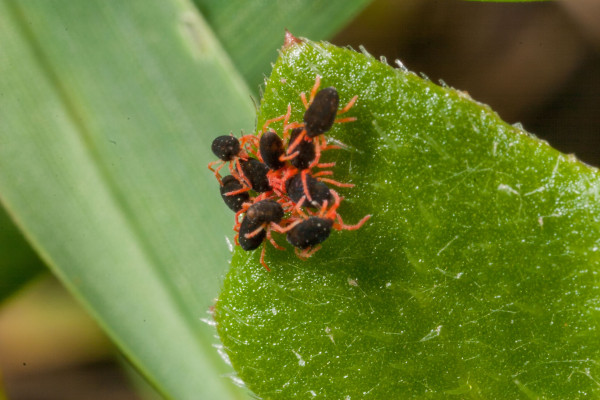
Repeated use of limited registered chemicals for the control of this pest has resulted in the emergence and spread of insecticide resistance to synthetic pyrethroids and organophosphates across most of the zone.
Ongoing resistance surveillance showed insecticide resistance in the RLEM, to both SPs and OPs, was now present in several regions in Victoria and South Australia and had become widespread across Western Australia.
Meat & Livestock Australia was co-investing into a larger Grains Research and Development Corporation project led by Cesar Australia to extend the scope of the outputs from grains industry research and to validate these in pasture systems for the benefit of red meat producers.
Free screening service for producers
THIS project aimed to reduce the significant impacts of RLEM on grain and pasture productivity through improved pest management.
The work will lead to improved biological, cultural and chemical control strategies for RLEM, and will help growers and advisors make better decisions around pesticide use.
As part of this research, Cesar Australia is running a free screening service to test for resistance in populations.
Producers are asked to contribute to this research by getting in touch if they either noticed a chemical control failure, suspect insecticide resistance or have paddocks that continually require control of RLEM with pesticides.
This no-cost screening service is made possible through the co-investment and in collaboration with the University of Melbourne, the Western Australian Department of Primary Industries and Regional Development and CSIRO.
The service will not only help detect any resistance before it becomes widespread, but also assist in identifying the best control options for producers.
Cesar Australia will be undertaking field trips in the coming months, so producers can get in touch to collect RLEM from their area.
A collection kit can also be provided containing the necessary equipment to send mites in for screening if required.
RLEM management and helpful tools
MONITORING of populations and carefully timed sprays (if required) are important for RLEM management.
For producers who are experiencing problems, there are several decision aid tools to guide if and when pesticide usage is warranted.
The complex lifecycle of RLEMs gives rise to critical monitoring periods.
In autumn, producers can use the RLEM hatch timing tool (cesaraustralia.com/resources/redlegged-earth-mite-hatch-timing-tool/), which can give an indication of when crop monitoring should increase, by predicting when mite eggs are likely to hatch.
The RLEM seasonal risk calculator (cesaraustralia.com/resources/redlegged-earth-mite-interactive-risk-calculator/) is a tool that considers the different factors that contribute to RLEM abundances – such as paddock history, broadleaf weed coverage and insecticide usage.
It helps identify paddocks at risk of high mite infestations which may require chemical applications.
The timerite tool (www.wool.com/land/timerite/) can then be used to ensure sprays are applied at the correct time in spring to reduce RLEM numbers surviving through to the next season.
Producers can also refer to the RLEM resistance management strategy (www.grdc.com.au/resources-and-publications/all-publications/factsheets) to reduce chemical control failures and implement best management practices on-farm when it comes to managing RLEMs.