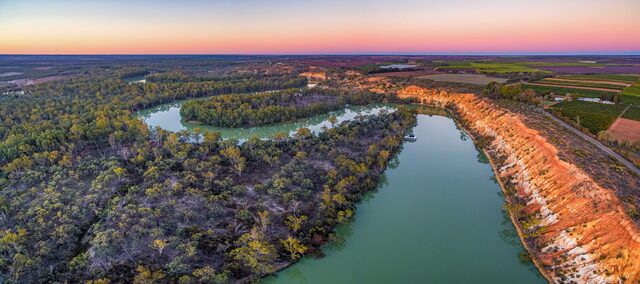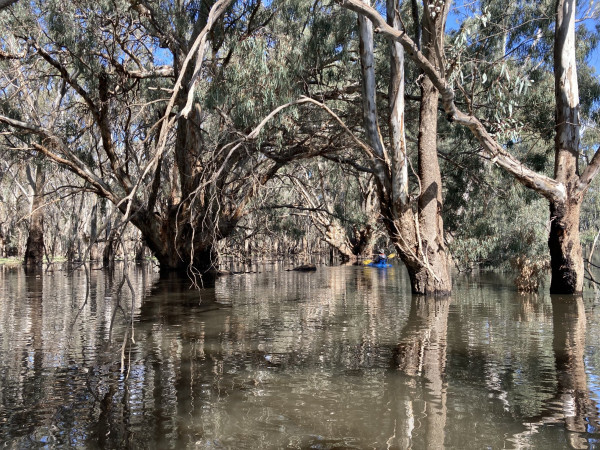
CENTURIES-old river red gums in Nyah Vinifera Park are benefiting from recent overbank flooding, but environmentalists and scientists fear such flows may be too little, too late for the fragile ecosystem.
Jacquie Kelly, the Chair of Friends of Nyah Vinifera Park, said while recent flows were a cue for wetland species to come back to life, the area showed signs of lost vitality.
“What we’re noticing is that years ago, you used to see swans’ nests, and you would see a lot more wildlife out there,” Dr Kelly said of the park, about 100km east of Robinvale.
“Now we’re noticing with these overbank events … there’s not the amount of wildlife there anymore.”
She said while the park received flows in 2011 and 2016, reduced overbank events were leading to a system decline.
“There’s a threshold you can reach with a living system, like with the human body, where it’s too far gone. If you go into Nyah Vinifera Park, there’s parts of it that just look like a cemetery, an Armageddon.”
Dr. Kelly said while discussion about returning 450GL to South Australia had resulted in division among environmentalists, irrigators and politicians, she believed “consensus” existed on delivering more environmental water by easing constraints.
“We’ve gathered all this water, but we’re still not getting it into the floodplain.”
The Murray-Darling Basin Ministerial Council is due to meet for the first time in two years on October 12 and the issue of deadlines for returning water to the environment is likely to be a hot topic.
Victorian and NSW water ministers have signalled their governments would not meet the June 2024 deadline to complete infrastructure projects to deliver more than 600GL in water savings for the environment.
ANU Professor of Environment and Society Jamie Pittock believes ministers can do more to meet environmental objectives by implementing the constraints relaxation program which he says would be a “win-win” for farmers and environment.
Both state governments have begun consultations to develop frameworks to negotiate with landholders, but 10 years after the Basin Plan, constraints agreement hs not been achieved.
Constraints relaxation involves mimicking natural water flows by sending stronger pulses of water down rivers and requires Victorian and NSW governments to negotiate with landholders to allow spills to inundate low-lying floodplains on their land.
Mr Pittock told the River Peoples’ Forum in Swan Hill last month he had found in a four-year study that environmental water only reached about 2 per cent of wetlands on floodplains and said governments needed to get a move on to reach agreements.
“It’s about 95,000 hectares of private land in bulk,” Mr Pittock told the forum. “If agreement was reached on that, then nearly 400,000 hectares of floodplain water floodplain wetlands could be watered with these pulsed flows.”
Mr Pittock told Sunraysia Daily business cases to reach agreements with about 3300 landholders on both sides of the Riverina totalling $900 million had been prepared and was endorsed by the federal government, which had set aside funding for the initiative.
He said while early negotiations highlighted that some farmers had feared too much of their land would be inundated, the real hold-up was that state governments had not focused on the benefits of the strategy.
“It is flood-proofing those floodplains for unmanaged floods up to the Bureau of Meteorology’s mild level of flooding,” he said. Much of the money would actually go as payments to landholders to purchase flood easements.”
“And getting those floodwaters up onto the floodplain will do things like recharge groundwater aquifers, support native fish breeding like the Murray cod, and enhance tourism and recreation.”
Mr Pittock said time was running out and if constraints were not implemented, it could lead to 70 to 80,000 billion litres of water being purchased from irrigators.
Both state governments have begun consultations to develop frameworks to negotiate with landholders, but 10 years after the Basin Plan, constraints agreement remain on the horizon.
A Victorian government spokesperson said the state was making progress in its constraints measures program and a feasability study would be completed by the end of the year.
“The Committee is made up of Registered Aboriginal Parties, local landowners, irrigators, community members, and others to effectively capture local knowledge and experiences across water-based issues in these areas.”
Meanwhile, a spokesperson for the NSW Department of Planning and Environment said the state had 100 case studies and was developing a negotiation framework for landholders.
“We are also developing a Landholder Negotiation Framework to protect the interests of farmers and landowners and guide discussions on mitigation measures for those affected by increased environmental flows,” the spokesperson said.
A NSW government discussion paper, which received 30 submissions earlier this year, found key concerns among responses were understanding potential impacts of constraints easing and if agreement structures were mandatory.