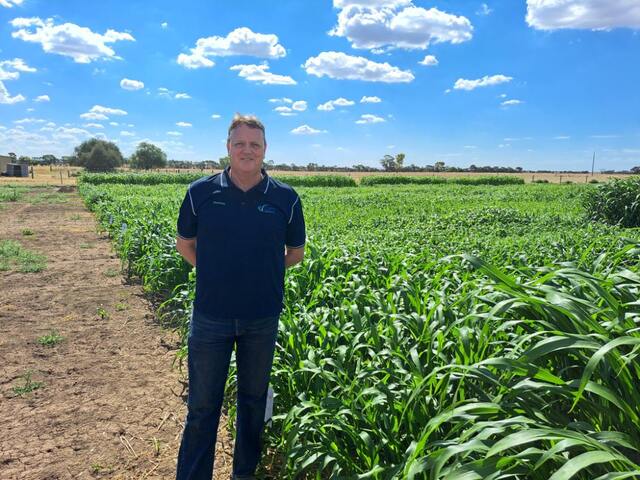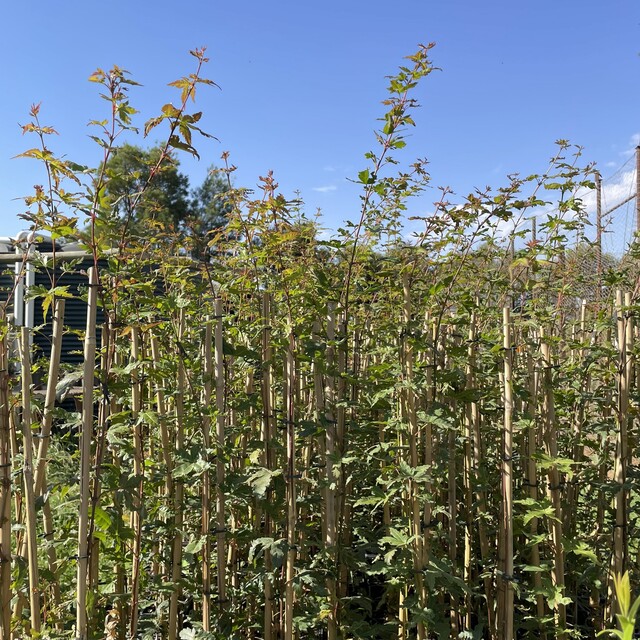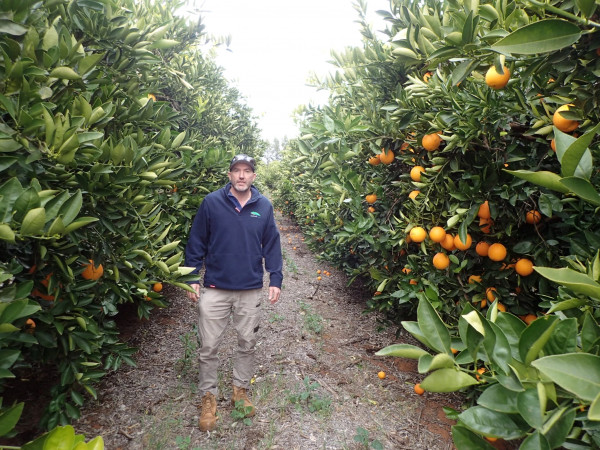
SUNRAYSIA citrus grower Matthew Cottrell has become a casebook study for a NSW Department of Primary Industry research project on high-density plantings across the industry.
As well as citrus, Mr Cottrell and his family also produce wine and table grapes on their 230ha at Nangiloc, where their citrus orchards include a range of early, mid, and late navels, as well as seeded daisy and tangold mandarins.
Inspired about high-density options during a visit to California in the early 2000s, Mr Cottrell returned to Cottrell Farms to explore the concept of his own high-density plantings, based on their potential for early yield gains and robust cash flow.
The team at Cottrell Farms embarked on a significant new citrus development on a green fields site, planting many blocks in a high-density pattern.
Which, following the plant spacing Mr Cottrell had seen in California, a pattern of 5m by 2.5m, equating to approximately 800 trees per hectare.
“The high early yields and subsequent financial returns made high-density orchards an attractive prospect,” Mr Cottrell said.
Canopy management
Initially, the results were promising, with yields exceeding his expectations during the first nine years.
“We knew tree congestion would be a challenge, but we believed careful pruning could effectively manage this issue as the trees matured,” he said.
Several challenges arose around pruning during the initial seasons. Hand pruning offered a potential solution but was expensive and time-consuming.
“Contractors charged a per-tree rate, regardless of the number of trees per hectare, leading to higher pruning costs per hectare,” he said.
To mitigate these challenges, Mr Cottrell used mechanical hedging supplemented with hand pruning only.
However, mechanical hedging threw-up a new management issue, being less selective and removing all types of shoots, including the next season’s bearing wood.
Additionally, the trees had to be mechanically topped to maintain a safe height for picking, sometimes requiring topping in both spring and autumn to keep the trees under control.
“Further to all this, tighter rows increased the risk of mechanical damage and achieving optimal fruit colour became more challenging due to the increased shading caused by the denser canopy. Although there was a reduction in blemishes, which I believe can be attributed to the windbreak effect created by closer row and tree spacing,” Mr Cottrell said.
Cottrell Farms also has a high-density planting of afourer mandarins, protected by a permanent netting structure.
“While the nets help to reduce wind blemishes on the fruit, they also lead to increased vegetative growth, requiring additional pruning to manage excessive water shoots,” Mr Cottrell said.
The trees under the nets are also more susceptible to certain pests, particularly light brown apple moth and red scale.
“Weekly monitoring during spring is necessary to detect and mitigate pest issues before they escalate and cause significant blemishes on the fruit,” Mr Cottrell .
Rootstock selection
In Mr Cottrell’s experience, different citrus varieties and rootstocks responded differently to high-density canopy management. For example, a 14-year-old block of seeded daisy trees – spaced at 6m by 2.5m on Citrange rootstock – consistently produces high yields.
Those trees responded well to hard hedging, resulting in excellent yields.
However, pruning posed a challenge for some of Mr Cottrell’s late-maturing navel orchards, where the later harvest pushed pruning too close to flowering.
He chose to avoid pruning around flowering time, postponing until early summer and after fruit set.
Certain rootstocks, such as Citrange, produce vigorous trees that are not well-suited for high-density plantings.
Mr Cottrell said trees on Trifoliata rootstock, which were less vigorous and smaller, proved to be more compatible with high-density orchards.
While Trifoliata trees mature later, Mr Cottrell said they retained their fruit for longer, offering flexibility for harvest timing.
“Achieving a balance is essential, as relying solely on Trifoliata or Citrange trees could lead to concentrated harvest timing and associated risks,” he said.
Today, Mr Cottrell’s new plantings are on either 6m or 6.5m spacing.
“The orchards with a 6.5m row spacing yield just as well as the high-density orchards once fully mature but require a less intensive pruning regime,” he said, adding that for smaller Trifoliata trees, a 6m spacing would be considered to accommodate their compact size.
Keep tree vigour in check
Mahmud Kare, a research horticulturalist with NSW DPI is leading components of work within the levy-funded National Tree Crop Intensification in Horticulture Program.
He said managing tree vigour is a key to success in high-density orchards.
“The objective is to promote fast early growth and then slow this down as the trees mature,” Mr Kare said.
One approach being researched by the program is using dwarfing viroids.
However, Mr Kare warned there were challenges associated with segregating blocks during pruning, and there were only a few dwarfing viroid orchards in the Sunraysia region for observation and analysis.
“Nevertheless, high-density orchards have potential, provided the right tree vigour is achieved by carefully selecting appropriate varieties and rootstocks, and employing technologies such as viroid dwarfing,” he said.
NSW DPI citrus development officer Steven Falivene said it was crucial to conduct comprehensive economic analysis to make informed decisions about the viability of high-density orchards.
“This analysis should encompass not only the first 10 years, but also extend to a 20-year timeframe,” he said.
Mr Cottrell is eagerly awaiting the economic analysis and other insights generated from the ongoing AS18000 program for citrus.
“We continually seek ways to optimise productivity and financial returns,” he said.
“By exploring high-density orchards and their associated challenges, I have gained valuable insight into effective pruning strategies, selecting appropriate rootstocks, and the effects of tree spacing.
“High-density can be productive and profitable.”