The Australian almond industry says it is working for Australia with the many things it does – and doesn’t do. North West Farmer spoke to Almonds Australia chief executive Tim Jackson about an industry he says is on its way to contributing $2 billion to the economy, is creating more than 10,000 jobs and is not pillaging agricultural Australia’s water supplies.
In 2000 there were just 3500ha of almonds in southern Australia – 22 years later that had hit 62,500ha.
And across Victoria, NSW, SA and WA there’s more in the pipeline, says Australian Almonds chief executive Tim Jackson, explaining, in the understatement of the year, that the Australian almond industry continues to be the crop of choice for horticultural investors in the southern Murray Darling Basin.
Investor interest, Mr Jackson says, is based on the almond’s long-term return projections, the non-perishable nature of the product and the relatively low labour requirements.
Add in the health benefits of almonds, the ongoing adoption of plant-based ingredients in diets and the varied applications for almonds, he says, and you have “a compelling case to join the industry”.
“An Almond Board of Australia (ABA)-commissioned independent economic study three years ago showed the almond industry already contributed $1.6 billion to the region economics in which it was grown, such as northwest Victoria, and generated an ever-increasing number of jobs,” Mr Jackson explains.
“As the industry continues to grow so does its importance to those regional communities,” he says.
“The challenge facing the almond industry today is the same one encountered by other large irrigated commodities – water use.
“Our growth means we do use more water than previously, but to then take that further and say we are using too much water is a myth.”
Mr Jackson says the popularity of almonds has resulted in a large portion of irrigation water being used to grow almonds – but that isn’t a bad thing.
He describes the industry’s record on water use as “pretty impressive”, adding no-one in almond growing wastes a drop, with nearly every orchard using drip irrigation right in the rootzone.
“All water consumed by farming communities which is used for irrigation represents just one third of all water in the Murray Darling Basin at any given time. In more recent years it has been a lot less than that,” Mr Jackson says.
“We are not sucking the river dry as some like to claim.
“In the grand scheme of things, the volume of water being used for almonds is relatively small.
“If more water is being used on almonds, that just means water previously on other irrigated crops that are now not as profitable is being moved across to an industry which is.
“That is the unfortunate reality of food and fibre production.”
Mr Jackson says the perception almonds are a thirsty product has permeated the minds of many urban consumers who do not understand primary production.
He says setting the record straight on this perception remains a key focus for the industry.
“Debunking a convenient myth with a complicated truth remains the industry’s challenge,”Mr Jackson says.
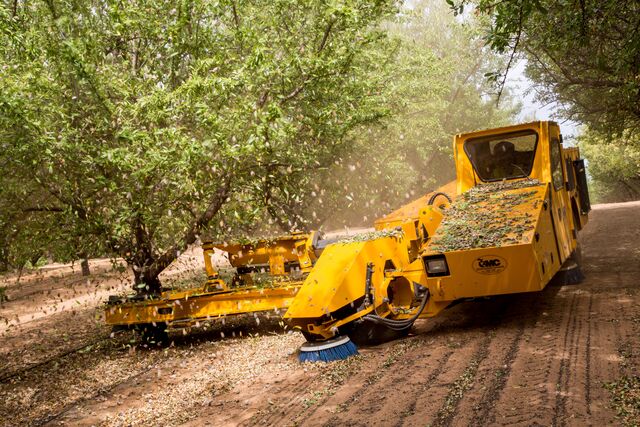
“Very few people realise when almonds are harvested there is zero waste involved.
“Every piece of fruit is used in some way.
“It is not a case of just picking the good-looking ones and dumping the rest,” he says.
Here is the almond life cycle:
· There are approximately 10,000 nuts of fruit on a mature tree.
· Each piece of fruit consists of three equally weighted components – a green hull, a shell and a kernel.
· After harvest the hulling and shelling process separates the kernels, which are then sorted, graded and used in a range of products. Almond milk production is a classic example of the destination for some of the lowest-grade kernels and the success of the industry’s value adding to boost grower returns.
· For the hull and shell there are also multiple uses. While stock feed has been a traditional destination for this product, in more recent times research has proved it can also be used for a variety of purposes, from the generation of electricity through to a natural fertiliser.
Mr Jackson says there are examples everywhere in the Australian industry and overseas where processors have created their own closed-circle economy where everything harvested is used to improve the bottom line and the environment.
“We have one major producer who powers their factory all year round from burning hull and shell and then produces fertiliser from the leftover biochar and any remaining hull and shell,” he explains.
“That is a spectacular sustainability success story and genuinely underlines just how the industry is maximising the impact of every drop of water used.
“When you take into consideration the 100 per cent use of the crop harvested, our water use is far lower than most consumers possibly realise.
“In the past the traditional measuring metric for water use has only taken into account the volume of kernel produced – but as I have just explained, the kernel is only one third of the weight of each piece of fruit.
“We are committing to re-educating consumers on almond production.
“It is an exciting opportunity to demonstrate our growers and processors are as committed to sustainable production as the consumers themselves.”
Mr Jackson added a “whole of orchard recycling” project is also demonstrating the values of mulching old, discarded orchard trees and then ploughing them back into the soil to improve its organic content.
He says while this innovation is already commonplace in California, the ABA has two growers currently trialling this in different soils to measure its impact locally.
“As an industry we are committed to doing things more efficiently, more sustainably and more profitably,” Mr Jackson says.
“That is why we have created our own experimental orchard and created trial sites right across the different growing regions, including that stretch of the Murray from the Victorian/SA border upstream towards Swan Hill.
“We are all about working together to improve the triple bottom line.”
Mr Jackson also points out establishing independently verifiable data which confirms the industry’s claims around sustainable production has been a key focus in the past 18 months.
The industry has appointed a sustainability officer and has also launched a best management practice benchmarking portal to assist growers in comparing the practices against their peers and the standards set.
“We understand times are tough for many of our growers so our portal is all about bringing people together and recognising how better we can harness different aspects of how almond growing can be done,” Mr Jackson says.
“The content has been generated by industry for industry.
“Down the track we know these growers are going to be asked to demonstrate they are growing sustainably, so our program is all about preparing them for that inevitability.
“A key component is that it is an anonymous portal in which growers can feed in their information and get an instantaneous report ranking them against the industry standard and the rest of those growers participating.
“It is not about naming and shaming but setting standards and bringing everyone along for the ride.
“It will help growers to identify potential gaps, larger operations with multiple farms to rank their operations and the ABA to focus research and extension resources in the areas of most need.”