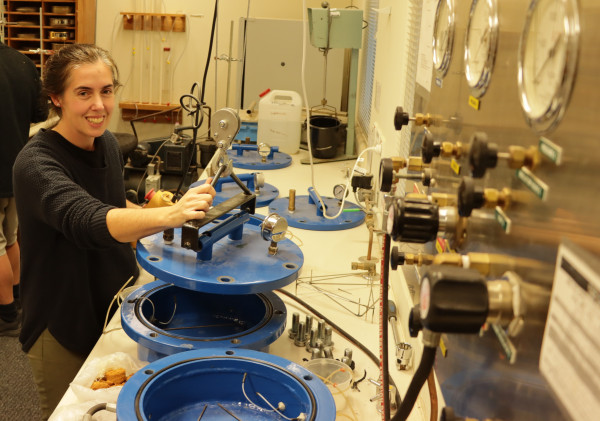
Katherine Dunsford is a research scientist with Agriculture Victoria based at Horsham. She completed her PhD in understanding the causes of poor grain yield responses to N and P Fertilisers in 2019. Her areas of research include crop nutrition, particularly N and P, as well as soil water interactions in cropping systems using APSIM and more recently amelioration of subsoil constraints using organic amendments.
Agriculture Victoria is undertaking valuable research to help improve the ability of Victoria’s farmers to better manage drought.
Dr Katherine Dunsford, a research scientist with Agriculture Victoria, leads a team of 10 scientists and technicians on the ‘improving soil structure for resilient ecosystems’ project.
“In Australia soil is the basis for most agriculture, both food and fibre, and directly tied to our food security and economy,” Dr Dunsford explained.
“And poor soil structure limits rainfall capture and root access to water, shrinking the soil’s water bucket,” she said.
“It can also lead to increased greenhouse gas emissions and reduced fertility, resulting in lower plant production and poor environmental outcomes.
“But to measure that accurately, we need to be able to measure vital data such as the infiltration of water into soils, and when you look at the southwest and its clay soils, the drought there has caused widespread cracking, big cracks, and it’s hard to measure infiltration when rain vanishes into those cracks in seconds.”
The work being completed by Dr Dunsford and her colleagues will wrap up in September next year.
She said although the current dry conditions have affected some components of the work, the researchers have already collected have a lot of field samples and started to analyse them in a state of art soil physics laboratory.
“Soils can have naturally poor structure, or as a result of management decisions, such as excessive tillage or trampling by cattle in wet conditions,” Dr Dunsford added.
“‘Our research focuses on understanding how different soil amelioration strategies such as organic materials and gypsum can improve soil structure and soil function,” she said.
“We are utilising established amelioration trials, including grains based trials across the Wimmera, work which has previously been funded by other organisations, such as GRDC and Dairy Australia.
Previous research has shown that structural changes to the soil can take time to develop and therefore leveraging off previous work can give us a good head start.”
Dr Dunsford said they are looking to expand understanding across a wider range of soil types and industries, particularly in the grains and dairy industries.
“We hope to achieve this by identifying, collecting and testing strategies for improving soil structure on soil types where we have not had the benefit of field trials.
The goal is to guide farmers to effective strategies to improve soil structure which in turn will hopefully maintain or boost productivity, enhance drought resilience, and increase environmental services in a changing climate.
NSAP is a five-year plan under the 20-year national soil strategy and the latest round of funding aligns to priority actions which aim to improve Australia’s soil health and long-term security.
“By recommissioning the soil physics lab at the Tatura SmartFarm we are able to gain a greater insight into the impacts of amelioration strategies on (changes to) soil structure . We will be working hard for the next year or so making the most we can from all these opportunities,” she said.
“The sooner we can get the results from the soil physics analysi, the sooner we can feed the results into other components of the project and ultimately deliver clear messages for growers.
“Results from the field and to some degree the glasshouse studies will feed into simulation modelling which will enable us to have a greater understanding of the implications of changes in soil structure at a paddock or landscape scale” she said.
“We want to be able to educate growers, and we are in the process of planning the workshops from this research and how far they will be able to go.”
Dr Dunsford said the research is also as much about what might not work as what will help take agriculture forward.
For example, she said what might effectively ameliorate a sodic soil in one location, might not have the desired effect in others.
“With the workshops, when you are unveiling the latest research, you often find the people who attend are already heading down similar paths. Often they come equipped with some level of expectation and knowledge,” she added.
“The whole point is to rejuvenate interest and strengthen knowledge in soil physics not just within Victoria, but Australia more broadly, because of its critical importance to agricultural productivity and the environment in changing climates.
This project which has been supported with a $1.49 million injection from Canberra’s National Soil Action Plan (NSAP) and funding will be spread through the Horsham and Tatura SmartFarms and driving the network of specialists working across the state, from Swan Hill to West Gippsland, and Tatura to Horsham.
To learn more about NSAP go to agriculture.gov.au/agriculture-land/farm-food-drought/natural-resources/soils/national-soil-action-plan.