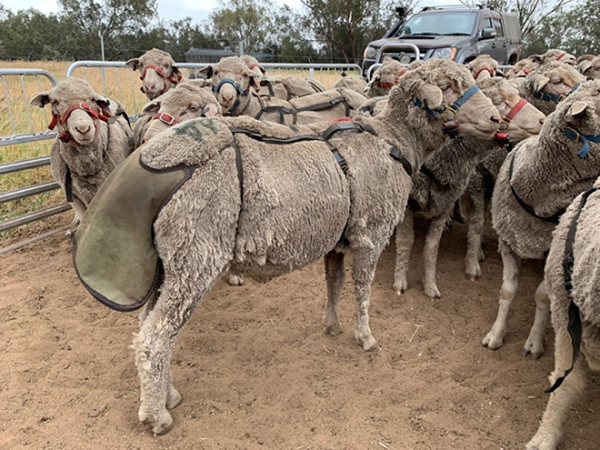
A three-year project, aptly titled ‘Grazing Bytes’, has demonstrated AWI smart tags can be used to predict feed intake, and especially liveweight change, which could enable woolgrowers to optimise grazing decisions.
This would improve both pasture and animal performance.
AWI’s investment in smart tags aims to enable woolgrowers to track, monitor and assess the status of their flock in real time – and make more informed decisions to increase their enterprise’s profitability.
The recent Grazing Bytes project utilised AWI smart tags to assess grazing behaviour, feed intake and ultimately accurately predict liveweight change.
At the beginning of the project in 2019, farmer workshops were held across a range of Australia’s sheep producing regions (WA, SA, Victoria, NSW) to gain insights from a broad range of producers on the kinds of use cases they would envisage, and the format they would like the information to be in.
However, all research work was undertaken in WA due to COVID restrictions.
The smart tag data generated during the project was matched with known feed intake information and liveweight change information generated in a range of scenarios.
The data sets were then used to train and test machine learning algorithms to predict a range of grazing and liveweight change attributes. The results were very promising.
“The Grazing Bytes project clearly and successfully demonstrated that AWI smart tags could be used to predict both feed intake and especially liveweight change,” AWI Agri-Technology program manager Carolina Diaz says.
The most promising result was the ability to accurately predict liveweight change over seven days from smart tag behaviours (grazing, walking and ruminating) over the same period.
While the datasets were small, almost 70 per cent of the actual changes in liveweight over seven days were explained by the predicted changes in liveweight.
Furthermore, the predictions of liveweight change appeared to be independent of the plot and feed on offer (FOO) and therefore, if validated using larger data sets, the approach may be transferable across different grazing environments and scenarios.
Carolina says the implementation of this technology in due course would likely have a positive impact on labour efficiency, farm productivity and business profitability.
“The prediction of grazing behaviour, feed intake and liveweight change from the AWI smart tags could ultimately be used to develop paddock movements that optimise the utilisation of feed available across the farm at different times of the year,” she says.
“It could also enable more efficient and timely use of supplementary feed.
“The data, even on a weekly basis, would make it much easier to allocate the appropriate amount of feed to priority mobs and increase the accuracy of achieving condition score targets to improve reproduction and lamb marking rates.
“Together with information on location, the data could also provide spatial information on forage productivity that could be used to improve paddock management and design.”