Trapped for an immediate solution to keep Australia’s almond industry going without the hives it will need next month for pollination across Sunraysia, the industry is turning to new self-pollinating varieties.
And the solution is there, in an Adelaide University project running since 1997 and producing trees that don’t need bees.
Program lead Michelle Wirthsensohn says the research team now has several varieties which can deliver the two major requirements – they can self-pollinate, and they are an almond which consumers will accept.
Dr Wirthsensohn says the varroa mite incursion in NSW, which has thrown the almond and apiary business into chaos, was always a matter of when, not if and one of the key reasons the search for these self-sustaining varieties began 25 years ago.
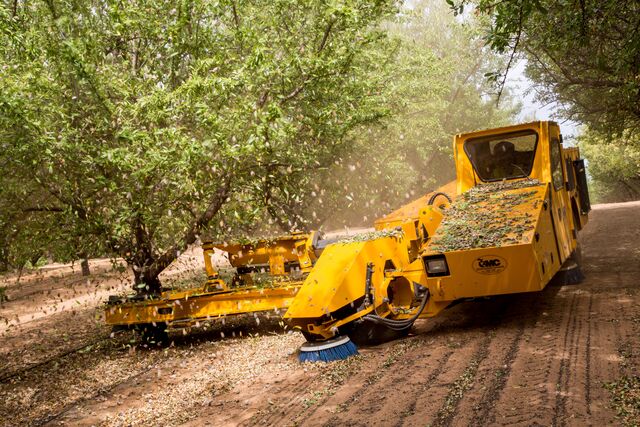
She says this year’s Australian almond harvest provided the best commercial indication of the success of new varieties developed by the University of Adelaide team in conjunction with the Almond Board of Australia and Hort Innovation.
As well as not needing bees, she adds results from their trial blocks show the yield for the six varieties developed in the program all produced much greater results than the industry ‘standard’, nonpareil.
Those results were:
· Mira 163 per cent up on Nonpareil
· Maxima 155 per cent
· Rhea 152 per cent
· Carina 146 per cent
· Capella 120 per cent
In a separate block trial, the latest new variety, Vela, produced a yield of 180 per cent above that of Nonpareil.
“The six new varieties were commercially released in Australia in 2016 and 2017 with four of them self-fertilising. Since then, 204,000 budwood cuttings have been sold to nurseries by the Almond Board of Australia with the varieties Carina and Maxima proving the most popular so far,” Dr Wirthensohn.
Three of the varieties – Carina, Mira, and Maxima – have semi-hard shells while Vela is a soft shell, Rhea a paper shell and Capella has a hard shell. Maxima and Rhea are not self-fertilising, but Maxima is proving popular among some Australian growers because of its large kernel.
“Capella has all but been ruled out here because of that hard shell but there still could be a market for it overseas,” Dr Wirthensohn added.
“Our breeding program is ongoing, and we are just in the process of getting funding for another five years to continue the work – the latest figure we have on tree sales, for example, would show about 12 per cent of the industry now has our new varieties in their systems,” she says.
“Feedback from commercial growers with the new varieties would also be important this year for the future expansion of the new varieties as their trees should now be delivering reasonable crops.
“The first big commercial crop will be this year of Carina and Maxima. Some of the growers got reasonable crops last year but the next thing will be the marketers will have to find markets for them or decide which categories they fall into.”
Dr Wirthsensohn says nearly all those trees will be Carina.
She says the researchers plan to put another 3500 trees in the ground in Loxton, in the heart of the Riverland in South Australia. The successful Carina variety was created with a cross from the market standard nonpareil and lauranne.
“The new varieties are now about to be trialled in the US, with the first of them about to be planted by Sierra Gold in California and another at the University of California, Davis. We are also hoping to get them into Spain for trialling soon.
“They are only starting in the US now as we had a five-year embargo on the new varieties to give Australian growers the chance to be at the cutting edge,” she says.
The new Australian almonds are all registered for PVRs (plant varietal rights) and patented in the US as well. The US is also the dominant almond producing nation, growing about 80 per cent of the world’s almonds, followed by Australia, Spain, Iran, and Italy.
Growers now have several varieties to consider, not only with the new Australian varieties but ones from overseas like Shasta from the US.
“Apart from yield, shell type and disease resistance they are looking for aesthetics too – nonpareil still produces one of the best-looking almonds but the softer your shell gets the more vulnerable your almond is to dirt, pests and fungal attacks,” said Dr Wirthensohn.
She says concerns about declining bee colonies, particularly in the US, have nurseries looking to the new varieties that do not require bees for pollination. The decline in bee numbers in recent years has been blamed on a variety of factors including pesticides, climate change and parasites, and here in Australia, bushfires.
“Our most recent Australian bushfires destroyed thousands of hives and important bee habitats. The bee decline has coincided with a rise in global almond consumption and increased plantings that led to record production of 1.3 million tonnes in 2017/18.
“The Sunraysia is facing some tough times with hives due to start going in from August and more than half those required are now trapped in NSW. Some of the huge growers along the Murray at the South Australian border end, such as Select Harvest and Olam, have some hard decisions ahead.”
Almond Board of Australia chief executive Tim Jackson agrees, saying the almond and bee industries have been “pretty well living varroa mite 24/7 since the Newcastle outbreak was reported.
But says the worst thing about that is “we can’t actually do much”.
“We have had our industry development officer working with NSW Agriculture but right now, with the border closed, there are about 145,000 Victorian hives based in NSW, especially in the north the state, having gone there for the warmer weather, and they can’t come home,” Mr Jackson says.
“This could not have come at a worse time – from next month the almond industry basically needs every hive from here to Queensland to support the Sunraysia/Riverland,” he says.
“If it all fails, we are trying to put together a fairly comprehensive program for alternative pollination, which yes, will be pretty labour intensive and the two industries will have to bear the cost.”