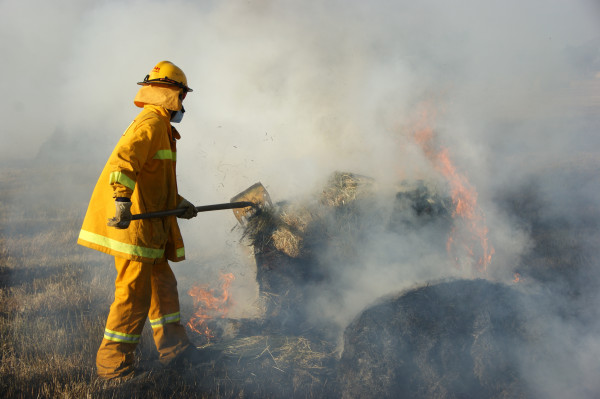
FIre risk alert over wet hay

FARMERS in the western and northern parts of the state are reminded of the dangers of high moisture content in hay as they begin cutting, baling and storing it to beat the persistent rain.

Large areas of Victoria have experienced heavy rainfall in recent weeks, and some communities have seen major flooding, which will have an impact on the moisture levels of crops and fodder.

These wet conditions present a risk for farmers trying to prepare their hay while the sun shines to beat the next bout of predicted rainfall.

If hay producers do not allow adequate time for grass and crops to dry out before baling, it can present a high risk for spontaneous combustion.

If hay has not properly dried out or has been exposed to rain or damp conditions, the moisture content in the bales may be higher than the recommended levels, leading to elevated risk of haystack fires.

It is also important to consider the storage of hay, as significant rain to exposed haystacks are at risk from spontaneous ignition.

This can be better managed by storing undercover or using hay caps or tarps to restrict rain getting into bales.

CFA chief officer Jason Heffernan said if hay is baled with high moisture content, it can heat up like compost, which can lead to spontaneous combustion weeks or months later.

“Farmers who have decided to carry on with hay production need to be extra vigilant this year to make sure condition are right for making hay and for the future storage and transport of the product as well,” he said.

“Hay fires are a real threat to properties and stock in farmland areas.

“Whether you’re a seasoned hay grower or switching to hay this year, it’s really important to take care of your hay and crops this fire season.”

CFA responded to almost 50 haystack related fires between July 1, 2021 and June 30, 2022.

Haystack fires can also start easily from lightning strikes or sparks from equipment.

“You should regularly monitor your haystacks by using a temperature probe or a crowbar to detect heating hay,” Mr Heffernan said.

Signs of heating hay can include steam rising from the stack or unusual odours like burning, must, pipe tobacco smell or a caramel smell.*breaout*

Haystack Tips

• Ensure hay is well cured before baling

Know the history of the hay you purchase

• Keep haystacks to a limited size and separate your haystacks

• Monitor moisture and temperature of your hay regularly

• Watch for unusual odours such as pipe tobacco, caramel, burning or musty smells.

• Store hay in separate stacks or sheds away from farm equipment and other buildings.

• Keep your hay dry. Protect it from rain, leaking rooves or spouts, and runoff. Cover stacks with tarps or hay caps.

• Don’t stack hay right to the top of a hay shed. Allow some air to circulate at the top – this helps to carry away moisture

Digital Editions


  • Collection under the hammer

    Collection under the hammer

    AN eclectic curation of vintage and antique Australian pastoral machinery and memorabilia will go to auction on 1 February. Yvon Smythe and her late partner,…

More News

  • Calls flow for royal commission

    Calls flow for royal commission

    Purchase this photo from Pic Store: 524159 AUSTRALIA needs a royal commission into water management in 2026, according to Murray MP Helen Dalton, who says politicians are “destroying” the nation’s…

  • Big skies and farmscapes

    Big skies and farmscapes

    Purchase this photo from Pic Store: 524028 THE Gallery Balranald is currently showcasing the work of professional artist Graham Hearn. His latest exhibition, Big Skies and Farmscapes, reflects the vast scale and…

  • Difficult outlook for grape growers

    Difficult outlook for grape growers

    Murray Valley Winegrowers has acknowledged the findings of Wine Australia’s Australian Wine Production, Sales and Inventory Report 2025, which confirms the challenging market conditions facing growers. The newly released report…

  • Benham appointed to new ag role

    Benham appointed to new ag role

    The Nationals member for Mildura, Jade Benham, has been appointed Shadow Assistant Minister for Agriculture and Regional Development, as part of Jess Wilson’s new Shadow Cabinet announcement. Ms Benham said…

  • Connecting urban and rural Australia

    Connecting urban and rural Australia

    HAMISH McIntyre grew up on the land in Queensland, learning the rhythms of farming from his family. Today, he runs a sprawling family business across the St George, Dirranbandi, Quilpie,…

  • Farmers warned to stay alert

    Farmers warned to stay alert

    A RUN of booming haystack and shed fires across regional Victoria has sparked fresh warnings for farmers as hay season rolls into full swing. Fire crews in the west and…

  • Bumper harvest fuels Cobram Estate’s growth

    Bumper harvest fuels Cobram Estate’s growth

    COBRAM Estate Olives has reported one of its strongest years on record, with an exceptional “on-year’’ harvest in Australia driving improved earnings, higher production volumes and a confident outlook from…

  • Select Harvests’ cracking pace

    Select Harvests’ cracking pace

    SELECT Harvests Limited has released its 2025 business update, reporting a final almond crop estimate of 24,700 tonnes, slightly below the midpoint of its earlier forecast. The company says the…

  • Further water buybacks anger farming industry

    Further water buybacks anger farming industry

    FARMERS, politicians and advocacy bodies are warning further water buybacks announced last week will gut regional towns, drive up food prices and cripple Australia’s dairy heartland. Federal Water Minister Murray…

  • Farmer takes action in feral pig fight

    Farmer takes action in feral pig fight

    IN THE heart of south-western New South Wales, sheep and cattle farmer Colin McCrabb is waging a quiet war against a destructive and elusive enemy -feral pigs. Operating a 6800-hectare…