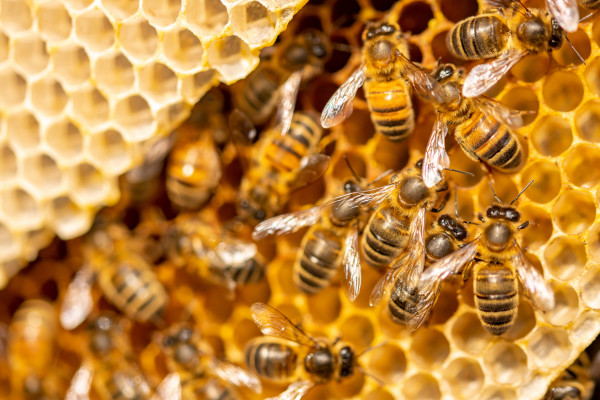
European honey bees are the next target following the euthanasia and destruction of recreational and commercially managed hives within the red Varroa mite eradication emergency zone.
This phase includes the complete removal of wild European honeybees from the zone.
Information on the emergency zones can be found at www.dpi.nsw.gov.au/varroa.
Euthanasia of wild European honey bees will be completed using a commonly available insecticide called fipronil.
Fipronil bait stations will be located and operated by NSW DPI within the 10km zone around each of the premises where Varroa mite was detected (the Varroa mite red eradication emergency zone).
To ensure the safety of people, animals, livestock and the environment, this work is strictly controlled by the NSW Department of Primary Industry, in accordance with an Australian Pesticide and Veterinary Medicines Authority permit [PER84929v2].
The fipronil bait stations are designed to exclude other animals and insects, and to prevent contamination of soil and water. While the fipronil bait stations are in active use, the baited area will be supervised by trained staff.
The first round of bait stations were deployed in the Jerry’s Plains area and have been operational since early October. The Nana Glen bait stations went operational from late October.
As the plan rolls out further across the eradication zones in the next few months, DPI will notify registered beekeepers within proximity to where bait stations will be deployed and directly contact landholders where bait stations are to be installed.
As per the Biosecurity Act 2015, you are required to authorise biosecurity officers to access your property to place baits in the red eradication emergency zone if requested to do so.
There will be at minimum a 2km buffer area between bait stations and the purple surveillance emergency zone, to reduce the risk of European honey bees from outside the eradication zone interacting with the bait stations.
If you see signage or bait stations in your area, do not tamper with the equipment.
You can help protect Australia’s food security by contacting us if you see European honey bee hives in the Varroa mite red eradication emergency zone. Call the Exotic Plant Pest Hotline on 1800 084 881 or the online form, found at www.dpi.nsw.gov.au/varroa.
The Biosecurity (Varroa mite) Emergency Order outlining the use of fipronil for the eradication of Varroa mites is available at www.dpi.nsw.gov.au/varroa.
Without any managed European honey bee hives within the eradication zone there won’t be any honey production in the area, however it should be noted that under the permit, all hive products, including honey and wax, must be destroyed and not consumed by humans or animals. Hive products must not be made available for sale or export as a raw or processed product.
Native Australian bees are not affected by Varroa mite. There is however, a very low risk that some native bees may be affected by the insecticide used to euthanise wild European honeybees.A number of mitigation factors are in place to reduce this risk, including:* Use of fipronil in bait stations only when bees are active and when the baited area is under supervision by trained staff
* Preliminary work conducted to attract wild European honeybees to the bait stations
* Use of bait stations designed and operated to exclude non-target animals
* Use of fipronil in bait stations only when bees are active and when the baited area is under supervision by trained staff
* Removal of fipronil from bait stations overnight
For more advice on managing native bees near fipronil bait stations, contact the Australian Native Bee Association.